Authority Engineer: Roles, Responsibilities, And Selection
Every major infrastructure contract executed under government frameworks, whether it's a highway project under NHAI or a bridge built through an EPC model, involves an authority engineer who acts as the independent technical check between the client authority and the contractor. This role carries significant weight: the AE reviews designs, monitors construction quality, certifies payment milestones, and resolves disputes before they escalate. For contractors and BD teams bidding on public infrastructure tenders in India, understanding what an authority engineer does (and how they're selected) isn't optional, it directly affects how you plan, price, and execute a project.
Authority engineer clauses appear frequently in contract conditions for high-value EPC and HAM projects. Knowing how these clauses shape your obligations can be the difference between a well-prepared bid and a costly oversight.
This article breaks down the authority engineer's roles, responsibilities, qualifications, and selection process, so you can walk into your next bid with a clear picture of who'll be overseeing the work and what that means for your firm.
Why the authority engineer role matters in projects
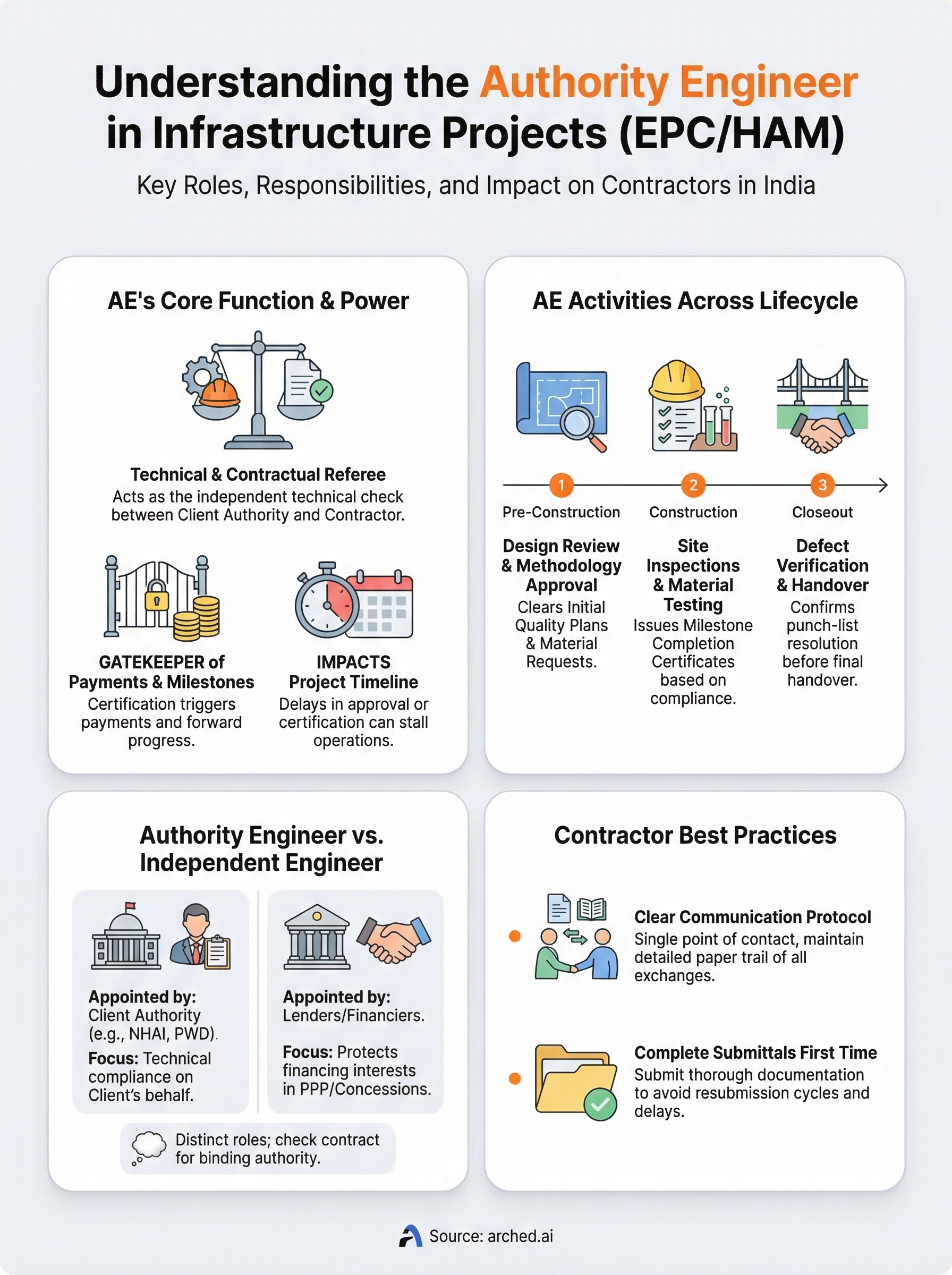
The authority engineer sits at the center of every major infrastructure contract as the technical and contractual referee between the client authority and the contractor. In India's EPC and HAM project frameworks, the AE's decisions on quality, timelines, and payments carry formal contractual weight. This is not a ceremonial position, and treating it like one is a mistake that shows up immediately during project execution.
The AE holds real power over your project timeline and payments
The authority engineer certifies completion of construction milestones, which directly triggers payment releases under most HAM and EPC contracts. If the AE flags non-conformance in a structure or rejects a BOQ line item, your payment gets held until you resolve the issue. For contractors managing cash-heavy infrastructure projects, a delayed certification can stall your entire operation within weeks.
The AE's certification is not a formality. It is a contractual gate that controls both payment and forward progress on site.
Beyond payments, the AE also reviews and approves design drawings, tests materials, and signs off on quality assurance records throughout construction. Every stage of your project moves forward only after the AE confirms it meets the contract's technical specifications.
Why misreading the AE's role leads to costly bid errors
Many contractors underestimate the AE's scope when preparing their bids. They price for construction but fail to account for the time and resources needed to document their work to the AE's standard. In practice, the AE expects detailed submittals, inspection requests, and test reports at every stage, and if your bid does not factor in that administrative overhead, your margins take the hit.
Your project team also needs to understand that the AE's instructions carry binding authority under the contract. Ignoring or delaying a response to an AE's notice or clarification request can trigger formal defaults, which compounds both your cost exposure and your reputation with the client authority.
What an authority engineer does across the project lifecycle
The authority engineer's involvement begins long before a single foundation is poured and extends through final handover. Mapping out what the AE expects at each stage helps your team prepare the right documentation in advance rather than scrambling to respond to inspection notices mid-construction.

Pre-construction phase
During pre-construction, the AE reviews your detailed project report, examines design drawings, and confirms that your methodology aligns with contract specifications. Your team submits initial quality management plans and material approval requests during this window, and the AE must formally clear them before physical work begins on site.
Delays at the pre-construction approval stage often compress your construction schedule, so submit complete packages the first time.
Construction and closeout
Once mobilization starts, the AE conducts routine site inspections, reviews material test certificates, and issues or withholds milestone completion certificates based on observed compliance. Near project close, they verify that all defect rectification and punch-list items are resolved against the contract's defects liability conditions before formal handover to the client authority is confirmed.
Authority engineer vs independent engineer and other roles
The terms authority engineer and independent engineer are used interchangeably in some project discussions, but they serve distinct contractual functions in Indian infrastructure projects. Confusing these roles when reading tender conditions leads to misread obligations and approval bottlenecks on site.

What separates the AE from an independent engineer
The authority engineer works under the client authority, such as NHAI or a state PWD, as their technical representative throughout construction. The independent engineer appears in PPP and concession arrangements, appointed by lenders to protect financing interests rather than the client's. Both review compliance, but they answer to different principals with different contractual powers.
- Authority Engineer: Appointed by the procuring authority; certifies payments and approves submittals on the client's behalf
- Independent Engineer: Appointed by lenders; monitors project performance to protect financing party interests
Never assume a directive from one applies to the other. Check your contract to confirm which role holds binding authority for each decision.
Where the project manager and site engineer fit
Your project manager and site engineer both sit on the contractor's side of the table. They coordinate internal execution and field supervision but hold no power to certify milestones or approve submittals.
Those approvals flow through the AE exclusively. Treating internal sign-offs as formal contractual clearances is a mistake that causes immediate delays when the AE hasn't approved the work.
How authorities select and appoint an authority engineer
Client authorities in India follow a structured procurement process to appoint the authority engineer for major infrastructure contracts. They typically issue a Request for Proposal (RFP) that outlines technical and financial qualification criteria, and shortlisted consultancy firms or individual experts submit their credentials against those requirements.
Qualification criteria authorities use
Procuring bodies like NHAI and state PWDs evaluate candidates on a combination of technical expertise, prior project experience, and team composition. The AE firm must demonstrate that its proposed personnel hold relevant engineering degrees, sufficient supervisory experience on comparable projects, and familiarity with applicable contract conditions such as MoRTH specifications.
Common criteria in AE selection RFPs include:
- Minimum years of experience supervising similar project types
- Demonstrated knowledge of applicable design and quality standards
- A qualified team lead with sector-specific credentials
Your bid team should review these criteria carefully, as the AE's background directly signals the documentation rigor you should expect on site.
The appointment timeline and your bid preparation
Authorities typically finalize the AE appointment before or shortly after awarding the main contract, so the AE is already in place when you mobilize. Requesting the AE's scope document early gives your project team time to align internal workflows before the first inspection notice arrives.
How contractors should work with the authority engineer
Your relationship with the authority engineer sets the tone for the entire project. Treat the AE as an adversary to manage and you create friction that slows approvals and strains your cash flow. Treat them as a technical partner whose sign-offs depend on your documentation quality, and the project moves significantly faster.
Build a clear communication protocol
Assign one dedicated point of contact on your team to handle all AE correspondence. This avoids conflicting messages reaching the AE from multiple people, which causes confusion and delays on approval decisions. Keep a log of every notice, inspection request, and response exchanged with the AE to protect your position if a dispute arises later.
A clean paper trail with the AE is your strongest defense if a milestone certification is challenged.
Submit complete documentation on the first attempt
The AE will return incomplete or poorly prepared submittals without approval, and every resubmission cycle costs your project time. Before you submit any inspection request or material approval, verify that your supporting test records and drawings are complete and cross-referenced correctly against contract specifications. One thorough submittal moves through the AE's review faster than three rushed ones stacked back to back.
Where to go from here
The authority engineer is a fixed feature of every major EPC and HAM contract in India's public infrastructure sector. Understanding their role before you bid, not after you mobilize, keeps your team from losing time and money to preventable approval delays. The key points from this article: the AE holds binding authority over milestone certifications and design approvals, sits on the client's side of the contract, and expects complete documentation every time your team submits a request.
Your next step is to start identifying high-value infrastructure tenders where the AE's scope is already defined in the contract conditions, so you can assess your firm's readiness before committing resources to a bid. If your estimators are already stretched, Arched can prepare the estimate and BOQ for you, reviewed by an engineer: send us the project.
Have a package your team can’t get to? Send it to us. Our engineers check and sign off everything we deliver.