What Is A Reverse Auction In Government Procurement? Guide
What is a reverse auction in government procurement? Learn how it works on GeM and IREPS, plus the pricing strategies you need to win more contracts.
If you've bid on government contracts in India through platforms like GeM or state e-procurement portals, you've likely encountered the term, but what is a reverse auction in government procurement, exactly? Unlike a traditional auction where buyers compete and prices go up, a reverse auction flips the process. Sellers compete against each other, driving prices down in real time until the lowest qualified bid wins.
For contractors and infrastructure firms operating in public procurement, reverse auctions are now a routine part of the bidding process. They show up across sectors, from road construction tenders to IT equipment supply on GeM. Yet many BD managers and bid teams still walk into these auctions without a clear strategy, losing margins on contracts they were technically qualified to win. The mechanics seem simple, but the tactical decisions around pricing, timing, and eligibility thresholds make all the difference.
This guide breaks down how reverse auctions work in Indian government procurement, the rules that govern them, and what you can do to consistently compete in them. We'll cover the step-by-step process, common formats, regulatory frameworks, and practical tips drawn from how procurement actually works on the ground. At Arched, we help firms track and analyze tender opportunities across 500+ government portals, and reverse auction tenders are among the most time-sensitive contracts our users monitor. Understanding how these auctions function is the first step toward bidding smarter.
Reverse auction meaning in government procurement
A reverse auction is a competitive bidding process where the roles of buyer and seller are inverted. Instead of multiple buyers competing to purchase a single item by pushing prices up, multiple sellers compete to win a contract by submitting progressively lower bids. The buyer, which in government procurement is typically a public authority or ministry, sits back and watches prices fall in real time. The contract goes to the lowest qualifying bid once the auction closes.
The core definition
When people ask what is a reverse auction in government procurement, the short answer is that it is a price discovery mechanism that government agencies use to create direct competition among pre-qualified vendors. The process starts after a standard qualification stage, so by the time live bidding begins, every participant has already cleared the technical criteria. What remains is purely price competition in real time, with each vendor able to see the current lowest bid and decide whether to go lower.

The key distinction is that reverse auctions separate technical qualification from price competition, which means you only compete on price against vendors who already meet the same standards you do.
This structure protects the buyer from awarding a contract to a vendor who cannot actually deliver. You must clear eligibility thresholds and technical qualification requirements before you ever enter the bidding stage, which makes the live auction phase a controlled environment rather than an open free-for-all.
How India's regulatory framework defines it
In India, the Ministry of Finance codified reverse auctions within the General Financial Rules (GFR) 2017, under Rule 161. The rule permits government buyers to use reverse auctions for the procurement of goods and services where price is the primary differentiator and specifications are clearly standardized. The Government e-Marketplace (GeM) has operationalized this rule at scale, turning reverse auctions into a default tool for commodity-type purchases across central ministries and state departments.
The Central Vigilance Commission has also issued advisories that apply to reverse auctions above certain value thresholds, requiring agencies to document the process, maintain bid logs, and justify the use of the format over other methods. For you as a vendor, this means the process carries formal compliance obligations on the buyer's side, which adds a layer of accountability you can reference if a dispute arises over bid timings or technical disqualifications.
What qualifies as a good fit for a reverse auction
Not every procurement goes to a reverse auction. Government buyers typically restrict this format to standardized, well-defined products or services where comparing bids purely on price is fair and practical. Common examples include uniform supplies, IT hardware on GeM, fuel procurement, and civil work items with fixed Bill of Quantities (BOQ) specifications where one vendor's output is nearly identical to another's.
The format breaks down when specifications are complex, when quality varies significantly between vendors, or when the total cost of ownership cannot be captured accurately in a single price figure. Infrastructure contracts that involve large design components or multi-year maintenance obligations rarely go through a simple reverse auction for this reason. Recognizing where the format applies versus where it doesn't helps you prioritize which tenders justify a full bid effort and which ones you can quickly assess and move on from.
Where reverse auctions show up in India
If you work in government contracting in India, reverse auctions are not a niche exception. Three main procurement ecosystems run them regularly, and knowing which portals use this format helps you allocate your bid resources more precisely across the right opportunities.
Government e-Marketplace (GeM)
GeM is the most visible platform for reverse auctions in India, and the one most BD managers encounter first. Central ministries, public sector units, and defense establishments use GeM's built-in reverse auction module for standardized goods, from IT hardware and office furniture to vehicles and uniforms. The platform lets buyers set a base price, minimum decrement, and auction window, then opens bidding to all pre-approved sellers in the relevant category. When you want to understand what is a reverse auction in government procurement in practice, watching a GeM auction in real time is the clearest demonstration available.

GeM's reverse auction module provides real-time rank visibility to every bidder during the live session, so you always know exactly where you stand relative to the current lowest bid.
State-level e-procurement portals
Several Indian states have embedded reverse auction functionality directly into their own e-procurement systems. Portals like Maharashtra's MAHATENDERS, Rajasthan's SPPP, and Telangana's e-procurement system have all run reverse auctions for civil contracts, supply agreements, and service tenders at the state level.
The key difference from GeM is that each state portal sets its own rules for minimum decrements, time extensions after a late bid, and how eligibility carries over from the technical stage. You need to read each auction notice individually rather than assume GeM's rules apply across the board.
Sector-specific platforms
Beyond general procurement portals, several sector agencies run reverse auctions for their own contract categories. IREPS (Indian Railways e-Procurement System) uses the format for materials procurement, and MSTC runs reverse auctions for surplus and scrap disposal across government departments.
These platforms often carry separate vendor registration requirements and pre-qualification criteria, which means GeM approval does not automatically let you bid on IREPS or MSTC auctions. Factor registration timelines into your pipeline planning so you are not disqualified from an auction you could otherwise win on price.
How a government reverse auction works step by step
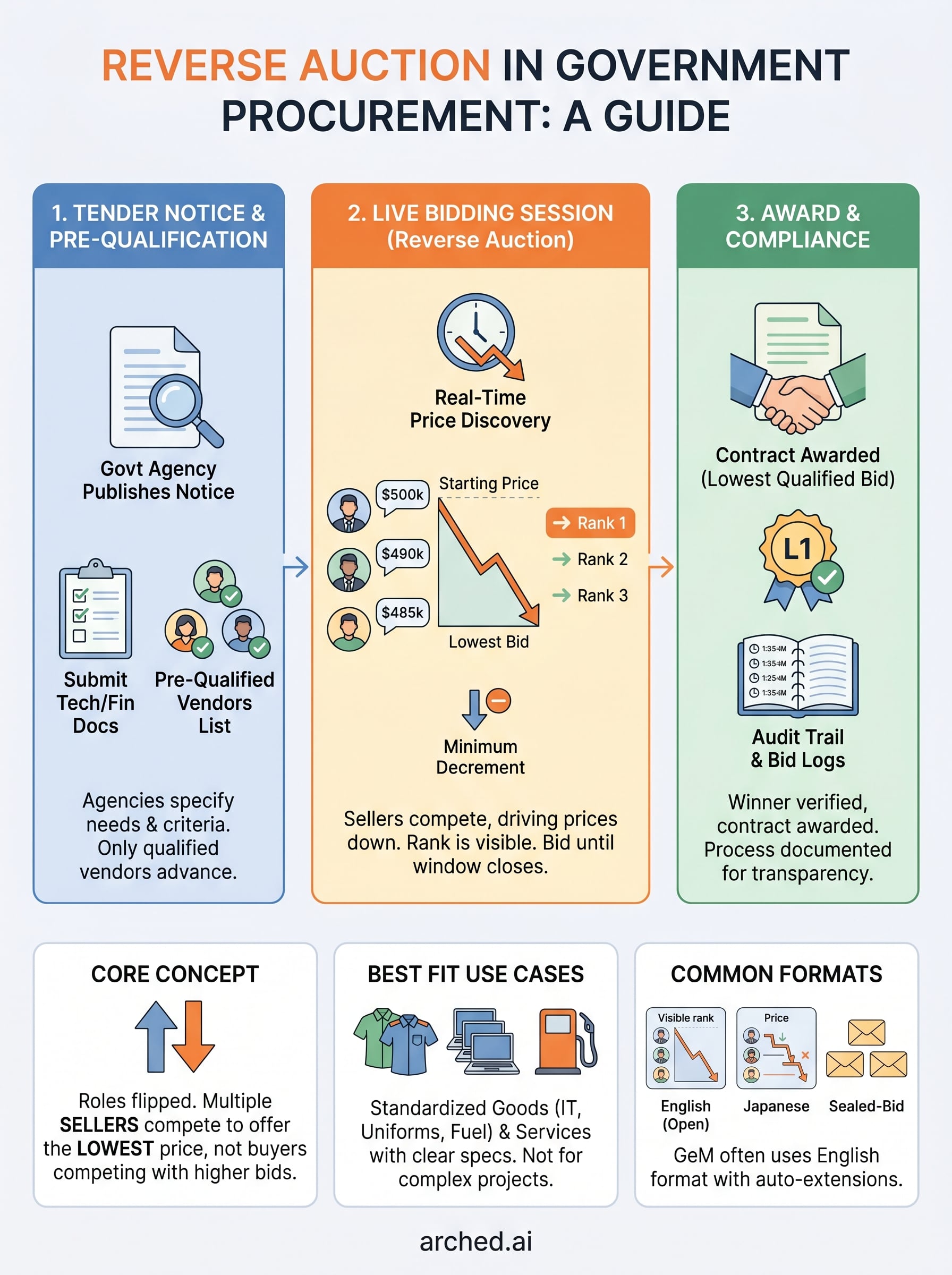
Understanding what is a reverse auction in government procurement means looking at the full lifecycle, not just the live bidding phase. The process runs in three distinct stages, and your preparation in the earlier stages directly determines how effectively you can compete when prices start moving.
Stage 1: Tender notice and pre-qualification
A government agency publishes a tender notice that specifies the goods or services required, the evaluation criteria, and the technical eligibility conditions. You submit your technical and financial documents during this stage, which typically includes registration on the relevant portal, proof of past project experience, turnover certificates, and any sector-specific certifications the agency requires.
Once the agency reviews all submissions, it publishes a list of technically qualified vendors who are cleared to participate in the live auction. Only vendors on this list can enter the bidding room. If you are disqualified at this stage, you have no recourse during the live session, so verifying your eligibility documents before submission is the highest-priority task in the entire process.
Stage 2: Live bidding session
When the auction window opens, every pre-qualified vendor receives login access to the bidding interface on the relevant portal. The agency sets a starting price, which is either a publicly declared reserve price or an undisclosed ceiling, and specifies the minimum decrement amount, meaning the smallest reduction you can submit below the current lowest bid.
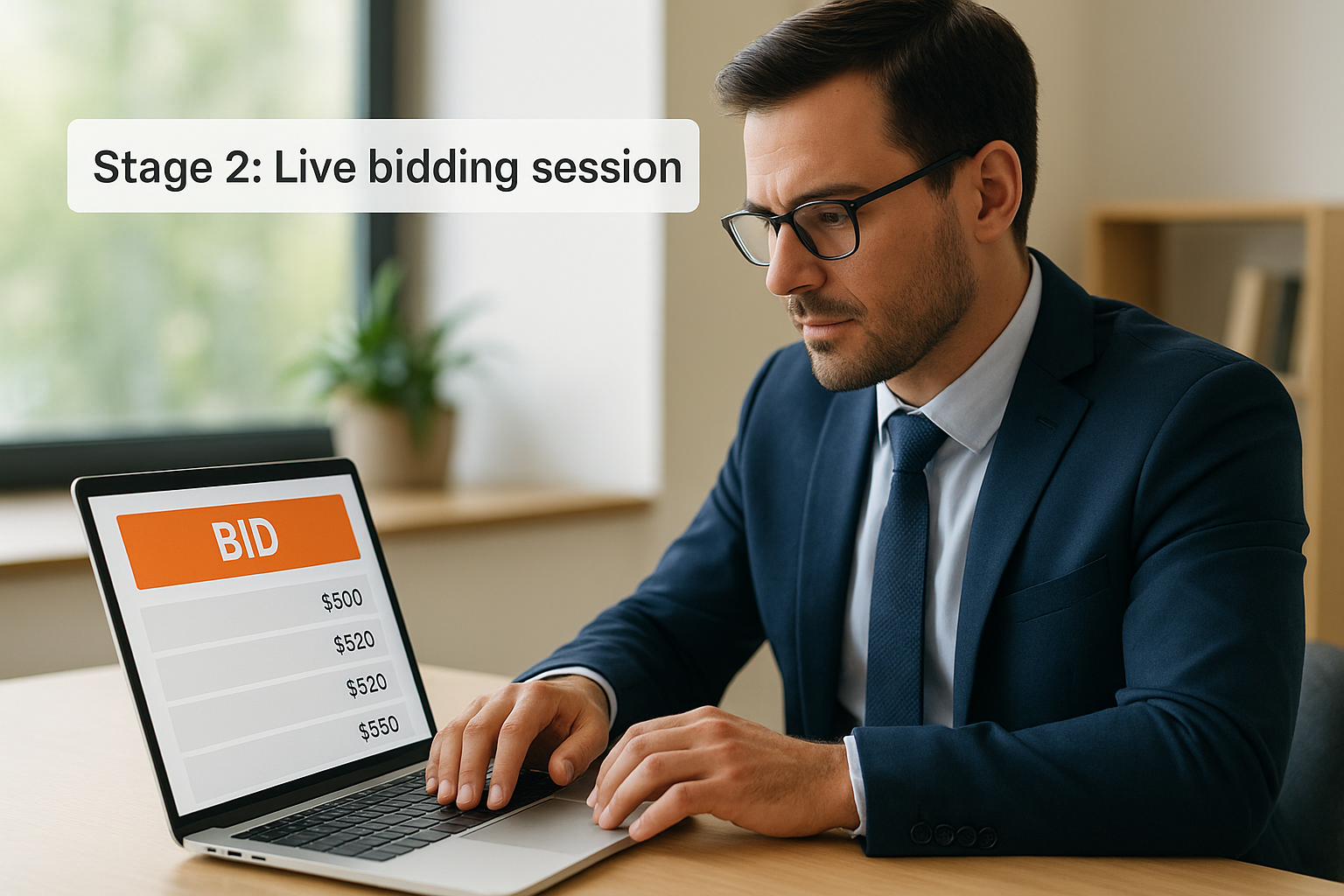
Your rank is visible in real time on most platforms, which means every vendor in the room knows immediately whether your bid holds the lowest position.
You can submit multiple bids during the session, and many portals extend the auction window by a fixed period if a bid arrives in the final minutes. Tracking these auto-extension rules before the session begins helps you time your lowest bid strategically rather than revealing your floor price too early.
Stage 3: Award and post-auction compliance
Once the session closes, the agency verifies that the lowest bid meets all technical qualifications and falls within the approved budget. The contract award notice follows, and the winning vendor typically receives a Letter of Intent within a defined period, which triggers the submission of security deposits and signing of formal agreements.
Agencies also maintain complete bid logs for audit purposes, so the entire process remains traceable from the first bid submitted to the final award decision.
Common reverse auction formats you will see
Not every reverse auction runs the same way. When you study what is a reverse auction in government procurement across Indian platforms, you will find that agencies use different auction formats depending on their procurement goals, the complexity of the goods being sourced, and how much visibility they want to give vendors during the live session. Knowing which format a tender uses before bidding begins changes how you structure your pricing strategy.
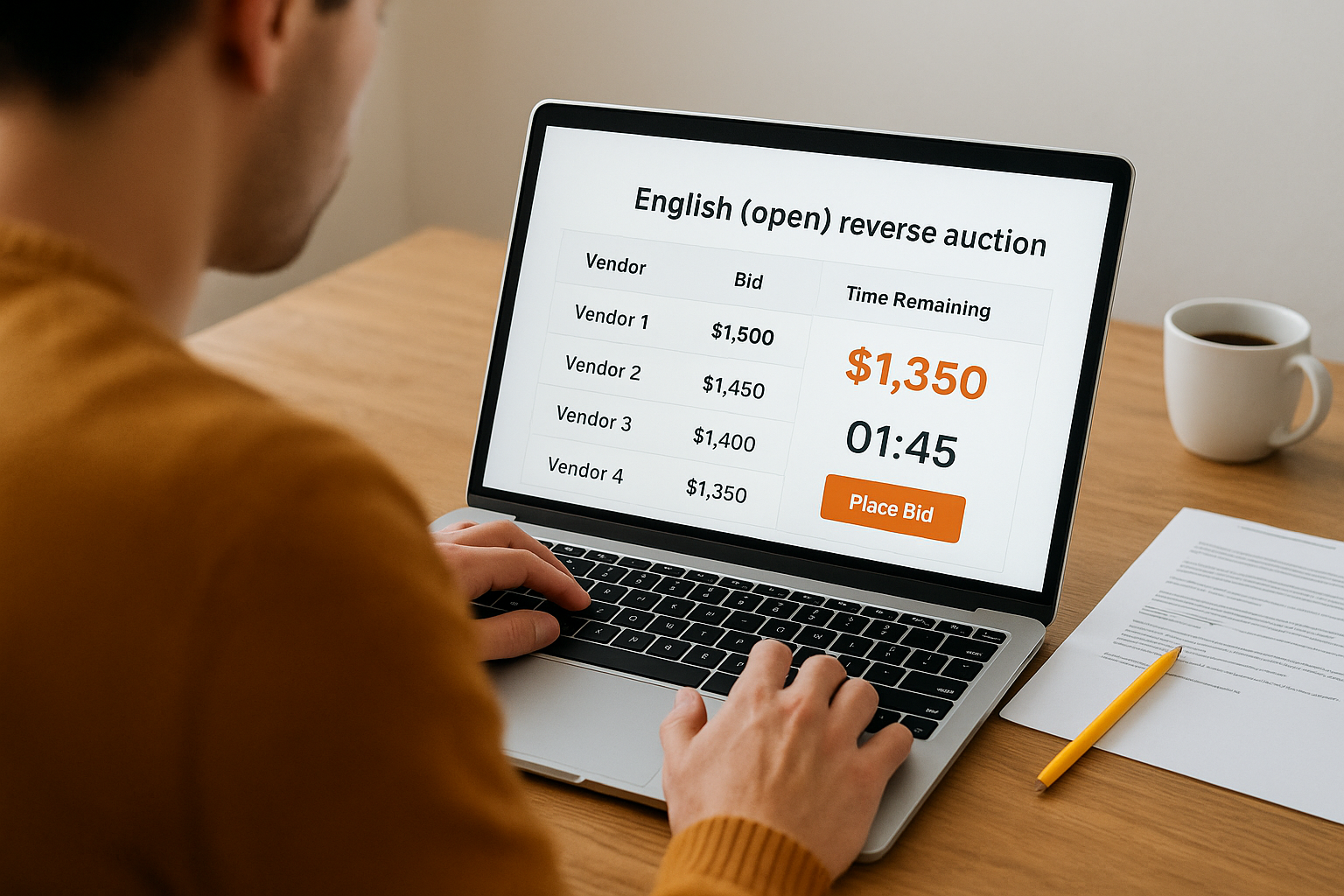
English (open) reverse auction
The English reverse auction is the format you will encounter most frequently on GeM and state e-procurement portals. In this format, all vendors can see the current lowest bid in real time, and you can submit lower bids at any point during the live session. The minimum decrement rule sets the smallest price reduction you must submit to beat the current lowest, which prevents vendors from edging ahead with a negligible price drop.
This format rewards patience and timing: bidding too early reveals your price floor to every competitor in the room.
Agencies often pair this format with auto-extension clauses that add five to fifteen minutes to the auction window whenever a new bid arrives in the final moments, ensuring last-second bids do not shut out genuine competition.
Japanese reverse auction
In a Japanese reverse auction, the buyer drives the price down incrementally rather than waiting for vendors to submit lower bids. The system presents a descending price at set intervals, and you must confirm at each level whether you will accept that price or drop out. Once you exit, you cannot re-enter the auction.
This format appears occasionally in bulk commodity purchases where the agency wants precise control over the pace of price reduction. Your decision point is not how low to bid but at which price level you walk away, which makes cost floor calculations critical before the session begins.
Sealed-bid reverse auction
A sealed-bid reverse auction combines the competitive pressure of a reverse auction with the confidentiality of a sealed tender. Every vendor submits a single price without seeing any other bids, and the agency opens all submissions simultaneously at the deadline.
You get no second chance to adjust your price, so your initial bid must reflect both your actual cost floor and a realistic assessment of what competitors are likely to submit based on past tender patterns in the same category. Reviewing historical bid data for similar tenders before you set your price is the most direct way to improve your accuracy in this format.
Reverse auction vs RFQ, RFP, and e-tendering
When you work through different procurement notices, you will notice that government buyers choose different methods depending on what they are sourcing and how they want to evaluate competing vendors. Understanding what is a reverse auction in government procurement versus other procurement formats helps you read tender notices faster, allocate your preparation time correctly, and avoid entering a process that does not match your capabilities or pricing structure.
RFQ: price-focused but static
A Request for Quotation (RFQ) is a single-round process where you submit one sealed price and the agency compares all submissions at once. Unlike a reverse auction, there is no live bidding phase, no visibility into competitor prices, and no opportunity to revise your figure after submission. RFQs are common for low-value standardized purchases, and evaluation is almost entirely on price once basic eligibility is confirmed.
The critical difference from a reverse auction is that an RFQ gives you one shot at the right price, while a reverse auction gives you multiple rounds to respond to competitor moves in real time.
RFP: evaluation goes beyond price
A Request for Proposal (RFP) brings technical evaluation criteria alongside price. You submit a full proposal that typically includes methodology, team qualifications, past project references, and a financial bid, and agencies score each component separately before arriving at a combined ranking. Reverse auctions almost never follow an RFP process because technical differentiation between vendors makes pure price competition impractical and potentially harmful to contract quality.
Knowing whether a tender is an RFP rather than a reverse auction matters early in your pipeline review. RFPs demand significantly more preparation time, document formatting, and internal coordination than a reverse auction requires. Misreading the format can cause you to under-invest in a high-value RFP or over-invest in what is actually a straightforward price competition.
E-tendering: the umbrella category
E-tendering is not a format but a delivery channel, covering all procurement processes conducted electronically through government portals. Reverse auctions, RFQs, RFPs, and standard competitive tenders can all run as e-tenders. When you see an e-tendering notice on GeM or a state portal, you need to read the auction methodology section to identify which specific evaluation process the agency chose before deciding how to respond.
The format an agency selects signals how heavily it weighs price against quality. A standard e-tender might use L1 pricing with fixed technical criteria, while a reverse auction on the same portal prioritizes live price competition among pre-qualified vendors.
When a reverse auction makes sense and when it fails
Part of understanding what is a reverse auction in government procurement is knowing when the format genuinely serves procurement goals and when it produces poor outcomes for both buyers and vendors. The format is not universally appropriate, and agencies that apply it to the wrong procurement type often end up with low-quality delivery, contract disputes, or failed auctions that waste everyone's time.
When the format works in your favor
Reverse auctions work best when specifications are tight, standardized, and fully defined before the auction opens. If every vendor is supplying the same grade of steel, the same model of laptop, or civil work against a fixed BOQ with no scope variation, then price is the only remaining variable. In that environment, a reverse auction is efficient: it drives the price down quickly, reduces negotiation overhead, and produces a defensible award decision.
You benefit from this format when your cost structure is leaner than your competitors, because the live bidding environment turns operational efficiency directly into contract wins.
The format also works well when vendor pre-qualification is rigorous. If every bidder in the room has already passed the same technical, financial, and compliance checks, then competing purely on price is fair. Problems arise only when qualification criteria are weak and underqualified vendors enter the live session with prices they cannot sustain through actual delivery.
When the format breaks down
Reverse auctions fail predictably when quality differences between vendors are real and material. Infrastructure contracts involving detailed design, multi-year maintenance, or complex project management cannot be reduced to a single price figure without losing critical evaluation information. When agencies apply the format here, they often award contracts to vendors who underpriced intentionally, then recover their margin through contract variations and claims during execution.
The format also breaks down when the market has too few qualified vendors. If only two or three suppliers can meet the eligibility criteria, the competitive pressure that makes reverse auctions efficient disappears. You may still win the contract, but the agency gains little from running a live auction over a standard negotiation. Recognizing these conditions before you invest time in portal registration and bid preparation helps you assess each tender's competitive dynamics realistically rather than treating every reverse auction as an equivalent opportunity worth full-effort pursuit.
Supplier playbook to qualify, bid, and win
Participating in a reverse auction without a clear playbook is how firms leave margin on the table or miss contracts they were capable of winning. Understanding what is a reverse auction in government procurement is only step one. Step two is showing up to each session with documented eligibility, a calculated price floor, and a timing strategy that keeps you competitive without revealing your bottom line too early.
Get your eligibility documents in order
The live bidding stage is not where most vendors lose. Disqualification during pre-qualification is far more common, and it happens because firms submit incomplete or outdated documentation rather than verifying each requirement against the tender notice before registering. Pull the eligibility criteria early and cross-check every item.
Build a central folder that holds your updated certificates of incorporation, audited financial statements, and past project completion certificates. Review this folder every quarter so you are never caught submitting an expired document when a time-sensitive tender opens. Staying current on portal-specific registrations such as GeM seller approval and state e-procurement accounts is equally important, because approval delays can remove you from an auction before it even begins.
- Confirm your GeM seller registration is active and linked to the correct product or service category
- Verify that turnover certificates cover the specific financial years the tender specifies
- Check that past project certificates carry the correct contract value and completion date
- Confirm sector certifications such as BIS or ISO approvals are current and will not expire during the bid period
Set your price floor before the session opens
Your price floor is the lowest price at which you can deliver the contract and remain financially viable. Calculate it before the auction window opens, not during it. Factor in material costs, labor, overheads, transportation, and the security deposit amount you will need to submit if you win.
Firms that estimate their floor during a live session under competitive pressure consistently set it lower than their actual cost structure supports, which causes delivery problems after award.
Time your bids to control what competitors see
Submitting a bid early in an open reverse auction signals your price range to every other vendor in the room. Holding back and placing bids in the final portion of the session forces competitors to commit to their floor first, which gives you better information before you make your final move without exposing your position unnecessarily.
Risks, compliance, and how buyers keep it fair
When you ask what is a reverse auction in government procurement, the answer needs to include the risks attached to it, not just the mechanics. Reverse auctions carry real financial exposure for vendors and procedural obligations for buying agencies, and understanding both sides helps you participate with your eyes open.
Risks vendors face in live auctions
The most common risk vendors face is underbidding under competitive pressure. When you watch your rank drop in real time and the auction clock is running, the psychological pull toward submitting one more lower bid is strong. Vendors who give in to that pull without rechecking their cost floor often win contracts they cannot deliver profitably, which leads to disputes, penalties, and reputational damage on government portals.
Your rank during a live session is not the right metric. Your margin at the final price is the only number that actually matters.
A second risk is portal or connectivity failure during the live session. If your internet connection drops or the portal times out at a critical moment, you may miss your window to submit a competitive bid. Always test your connection and have a backup device or network option ready before any auction begins.
How buyers maintain compliance and fairness
Buyers operating under GFR 2017 and Central Vigilance Commission guidelines must follow structured protocols to keep the process defensible. Agencies are required to maintain complete bid logs that record every submission with its timestamp and vendor identity, so any challenge after the auction has a documented record to draw from.
Buyers also reduce manipulation risk by setting minimum decrement thresholds, which prevent vendors from submitting token reductions that technically qualify as bids but add no real competitive pressure. Agencies running high-value auctions sometimes appoint a bid observer or independent auditor to review the session in real time and confirm that the platform behaved as intended.
Portals like GeM also enforce automatic time extensions when bids arrive in the final minutes, which prevents a single last-second submission from deciding an outcome before other vendors can respond. These controls exist primarily to protect the buyer's procurement record, but they also protect you as a vendor by ensuring the process follows its stated rules throughout the session.
What to do next
Now that you understand what is a reverse auction in government procurement, the next step is turning that knowledge into a practical advantage in your bidding pipeline. The mechanics are clear: pre-qualify rigorously, calculate your price floor before the session opens, and time your bids strategically rather than reacting to competitive pressure in the moment.
Putting this into practice consistently requires visibility across the right portals at the right time. Missing a reverse auction tender because you checked the portal a day late costs you opportunities that your competitors will pick up instead. Arched monitors over 500 government portals simultaneously and matches tenders to your firm's specific credentials, so you get early alerts on auctions you are actually eligible to enter rather than sifting through irrelevant notices manually.
Explore how Arched works and see how it fits your current business development process.