What Is Audit Readiness? Definition, Assessment & Checklist
Learn what is audit readiness for Indian contractors. Use our checklist to assess documentation, identify gaps, and qualify for high-value government bids.
Every government contractor in India has faced this moment: a high-value tender lands on GeM or CPPP, the scope is a perfect match, but the firm's documentation, past project records, certifications, financial statements, is scattered across drives, email threads, and filing cabinets. When the scrutiny comes, whether from a CAG review, an internal compliance check, or a client's pre-qualification audit, the firms that survive are the ones that were ready before they were asked. That state of preparedness has a name, and understanding what is audit readiness is the first step toward building it into your operations.
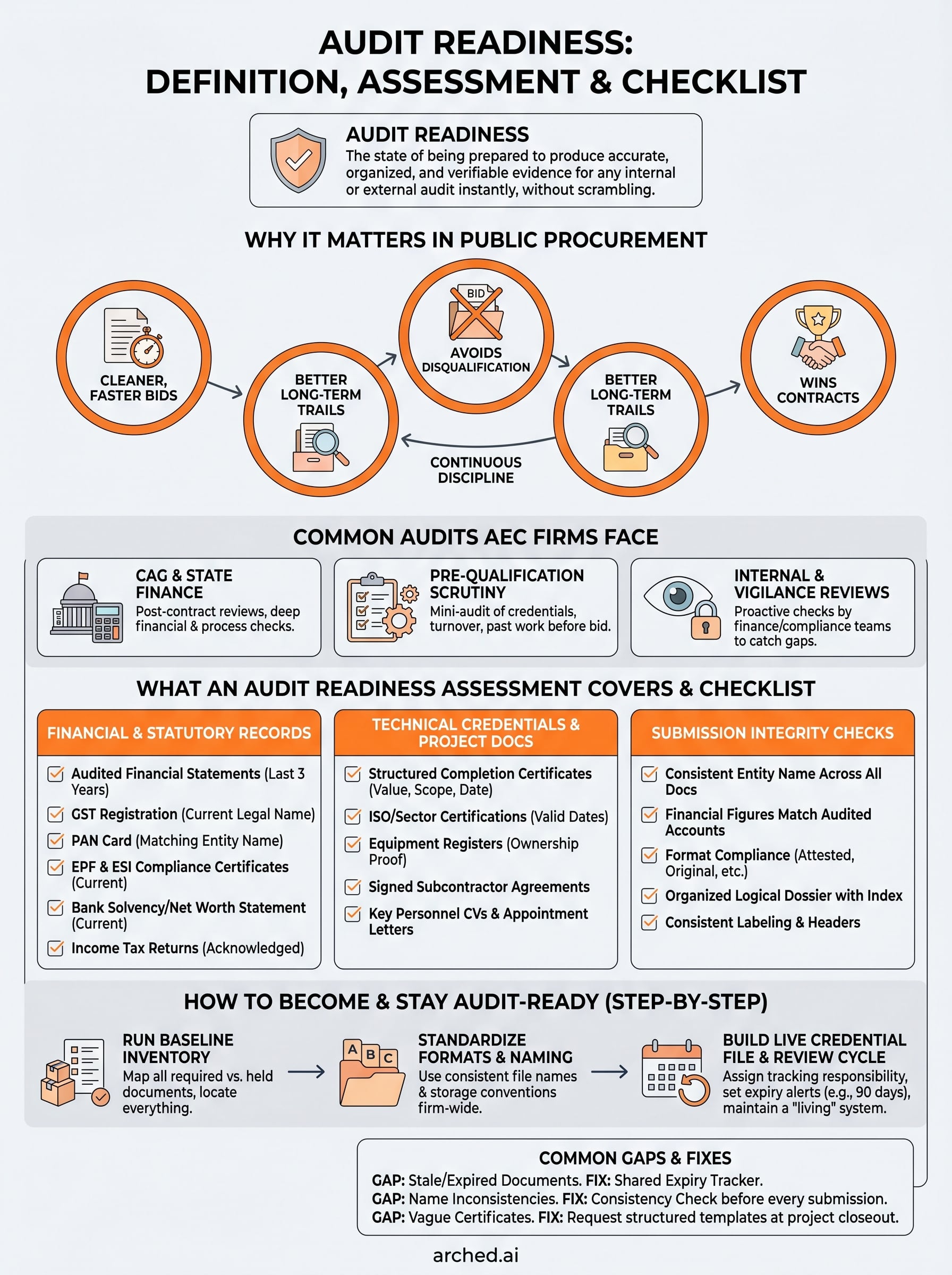
Audit readiness means your organization can face an audit at any point, internal or external, and produce the right evidence, in the right format, without scrambling. For infrastructure firms and consultancies bidding on public contracts, this isn't abstract compliance theory. It's the difference between qualifying for that ₹200 crore bridge project and watching it go to a competitor who simply had their paperwork in order.
This article breaks down the full definition of audit readiness, walks through the assessment process, and gives you a practical checklist you can apply immediately. We'll also show how platforms like Arched, which already parse tender documents and run gap analysis on your credentials, connect directly to keeping your firm audit-ready, so you're not just finding opportunities, but actually positioned to win them.
Why audit readiness matters in public procurement
Public procurement in India moves on documentation. Every bid you submit on GeM, CPPP, or a state e-tender portal triggers a chain of verification events, and each of those events is an opportunity for an auditor to either confirm your eligibility or flag a discrepancy. Understanding what is audit readiness in this context means recognizing that your records are not just paperwork; they are the primary signal of your firm's credibility to every evaluating authority in the process.
Procurement trails run long and deep
When your firm wins a contract under India's public works framework, the paper trail starts at the bid stage and runs through execution, completion, and beyond. CAG audits, state finance audits, and internal vigilance reviews can revisit a contract years after the work is concluded, which means your readiness cannot be a one-time sprint before a submission deadline. Firms that treat documentation as an ongoing discipline consistently perform better in these long-tail reviews, because they never have to reconstruct records from memory or incomplete files.
Audit findings tied to documentation gaps are among the most common reasons technically capable firms lose their contract eligibility or face blacklisting, even when the actual work was completed on time and to specification.
Keeping records current as a continuous practice also has a direct effect on bid team speed and accuracy. When your BD managers can pull a specific past project certificate, a turnover statement, or an ISO certification within minutes rather than hours, the time saved compounds across every tender cycle your firm runs throughout the year.
Disqualification rarely happens for technical reasons
Most AEC firms lose high-value tenders not because they lacked the technical capability to deliver, but because their submitted documentation did not adequately prove that capability to the evaluation committee. A road widening project worth ₹150 crore requires evidence of similar past work, financial soundness, and equipment availability, all in formats that match the tender's qualifying criteria exactly. If any document is outdated, inconsistent with stated figures, or missing entirely, the committee has no discretion: they must disqualify the bid, regardless of how strong the firm's actual track record is.
This is where audit readiness connects directly to revenue. A firm that maintains clean, current, and consistently formatted records can respond to pre-qualification audits and technical bids faster and with higher accuracy. The same discipline that helps you survive a CAG review also helps you submit a stronger, more verifiable bid package on tenders with tight submission windows.
The compliance window is shrinking
India's public procurement systems are digitizing rapidly, with platforms like GeM and CPPP generating structured data trails that are far easier to cross-reference and audit than the paper-based systems they replaced. State vigilance departments and central auditors now have access to more granular contract data than they did five years ago. That visibility works both ways: it surfaces irregularities faster, but it also allows disciplined firms to demonstrate a clean record and build a verifiable track history that supports future bids.
For your firm, this means the old approach of assembling documents reactively when an audit notice arrives is no longer practical. The window between when an audit is triggered and when evidence must be produced is compressing. Firms that keep their financial statements, statutory registrations, project completion certificates, and legal compliance records organized and current will navigate this environment far more smoothly than those that scramble at the last moment. The standard is no longer whether you have the documents; it is whether you can produce them quickly, in the right format, without creating internal chaos.
The audits AEC firms commonly face in India
Before you can build a practical answer to what is audit readiness, you need to map the specific audit types your firm is likely to encounter. AEC firms operating in India's public procurement space face several distinct audit categories, each triggered by different authorities, timelines, and evidence requirements. Knowing which audits apply to your work directly shapes how you organize your records and what documents you keep current.
CAG and state finance department audits
The Comptroller and Auditor General of India holds the broadest mandate in public contract oversight. CAG audits can reach back several years into completed contracts and examine financial records, procurement processes, and contract execution decisions with significant depth. State finance departments run parallel reviews at the project level, particularly for infrastructure contracts funded through state plan budgets.
These audits often surface documentation gaps that were created at the bid stage, not the execution stage, which means your pre-submission records carry long-term legal weight.
For your firm, this means project completion certificates, joint measurement records, and payment receipts must be preserved in retrievable formats long after the work is signed off. Auditors in these reviews are specifically trained to identify inconsistencies between submitted bid documents and actual contract performance.
Pre-qualification and technical scrutiny
Many high-value tenders on CPPP and state e-procurement portals include a pre-qualification stage that functions as a mini-audit of your firm's credentials. Evaluation committees verify your claimed turnover figures against audited financial statements, cross-check past project values against completion certificates, and confirm that statutory registrations and certifications are valid on the date of submission, not just the date of issue.
Firms that maintain a continuously updated credential file, covering ISO certifications, GST registration, PAN, EPF, and ESI compliance documents, move through this stage significantly faster than those assembling documents from scratch for each tender.
Internal compliance and vigilance reviews
Internal audits are often underestimated by AEC firms because they carry no immediate external consequence. That underestimation is costly. Internal compliance reviews conducted by your finance team or an appointed auditor catch record-keeping gaps before they become liability during external scrutiny. Firms with a regular internal review cycle also produce cleaner bid submissions because the same discipline that satisfies an internal auditor produces the consistent formatting and current dates that evaluation committees look for.
Vigilance committees within large public sector clients also conduct independent reviews of awarded contracts, particularly for works exceeding specific threshold values. Keeping your subcontractor agreements, site diaries, and BOQ reconciliation records organized gives you a defensible position if such a review reaches your project.
What an audit readiness assessment covers
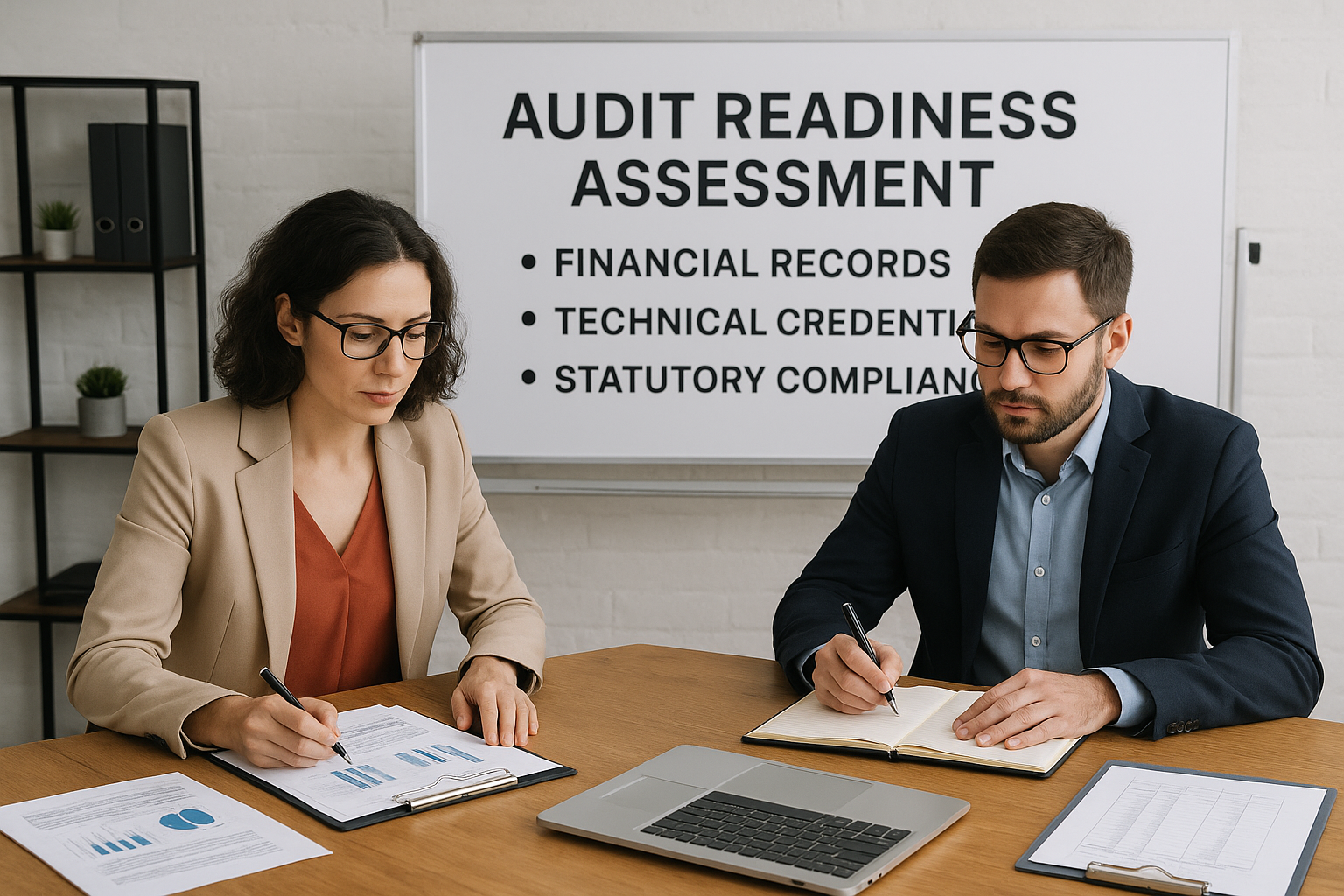
An audit readiness assessment is a structured review of everything your firm would need to produce if an auditor walked in tomorrow. For AEC firms, what is audit readiness at the assessment level means checking three core areas: your financial records, your technical credentials, and your statutory compliance documents. Most firms discover during their first structured assessment that the gaps are not in the records themselves, but in how those records are stored, dated, and formatted for external review.
Financial and statutory records
Your financial records form the backbone of any audit review, and assessors look first at the consistency between your stated figures and your audited accounts. This means turnover figures cited in bid submissions must match your chartered accountant-certified statements for the same financial years. Your GST registration, PAN, EPF, and ESI compliance certificates need to be current and clearly linked to your legal entity name as it appears across all registered portals.
A single mismatch between your trading name on a tender submission and the legal name on your statutory registrations is enough to trigger a formal inquiry during pre-qualification scrutiny.
Assessors also check that your bank solvency certificates, credit lines, and net worth statements are dated within the window specified by the tender authority. Documents that were accurate six months ago may no longer satisfy the evaluation criteria if the tender requires statements from within the current or immediately preceding financial year.
Technical credentials and project documentation
Your past project records carry the most scrutiny in any assessment tied to government contracting eligibility. Each project cited as qualifying experience must be supported by a completion certificate that states the project value, the client name, the scope of work, and the date of completion in a format the evaluating authority can verify. Vague or generic completion certificates fail this test routinely, even when the actual work was substantive and well-executed.
Assessors also examine your equipment registers, subcontractor agreements, and key personnel CVs to confirm that the resources you claim are available actually exist in documented form. A table that maps each claimed resource to its supporting document is a practical tool many firms use to close this gap quickly:
| Resource Type | Document Required | Current Status |
|---|---|---|
| Key personnel | CV and appointment letter | Confirm dates |
| Owned equipment | Registration or purchase record | Verify valuation |
| Subcontractors | Signed agreements | Check expiry |
Running this check systematically before any bid submission gives your team a clear view of what is ready and what still needs to be gathered, which removes last-minute pressure from your BD managers and bid coordinators.
How to become audit-ready step by step
Becoming audit-ready is a process, not a one-time sprint before a submission deadline. Many firms understand what is audit readiness in concept but struggle to turn it into a repeatable internal practice. The practical path runs through three distinct steps: inventorying what you currently hold, standardizing how you store and label everything, and setting up a review cycle that keeps every record current as your portfolio of work grows.
Run a baseline records inventory
Your first action is to map every document category your firm needs for government contract eligibility against what you actually hold on file today. Financial statements, statutory registrations, project completion certificates, and key personnel credentials all belong on this list. Assign a specific team member to physically locate each document and log where it lives, whether that is a shared drive, a physical file, or an email thread buried in someone's inbox. Do not rely on assumptions about what exists.
Many firms discover during this inventory that they hold multiple versions of the same document with conflicting figures, which is exactly the kind of inconsistency that triggers formal auditor queries.
Once you have a complete map, mark each document with its issue date, expiry date, and the authority that issued it. This single exercise gives your bid team an honest, current picture of where your firm stands and surfaces gaps before an evaluation committee or auditor does it for you.
Standardize your document formats and naming
Your inventory will expose a second problem: documents saved under inconsistent file names, in formats that differ across projects, or attributed to slightly different versions of your firm's legal name. These inconsistencies look minor internally but create real friction during audit reviews, because evaluators cross-reference documents against each other and against portal records.
Set a firm-wide naming convention that includes the document type, the issuing authority, and the relevant financial year or project name. Apply it retroactively to your existing records during the inventory phase and enforce it for every new document your firm receives going forward. A shared drive with clearly labeled folders organized by document category cuts retrieval time and removes the risk of a coordinator submitting an outdated certificate under deadline pressure.
Build a live credential file and review cycle
The final step converts your cleaned-up records into a living system that updates as your firm's circumstances change. Assign one person the specific responsibility of tracking expiry dates on certifications, statutory registrations, and financial statements. A calendar reminder set ninety days before any document expires is enough to stay ahead of gaps before they surface during a tender evaluation or a surprise compliance review.
Your BD managers then pull from a file they can trust rather than one they have to verify from scratch each time a relevant tender appears.
How to organize evidence so auditors accept it
Knowing what is audit readiness is only half the work. The other half is presenting your evidence in a way that auditors can verify quickly and without confusion. Government auditors and evaluation committees work under tight review timelines, which means poorly organized evidence creates doubt even when the underlying records are accurate. Your goal is to make the reviewer's job as frictionless as possible, because any ambiguity in how you present documentation tends to resolve against you.
Structure your submission as a logical dossier
Think of your evidence package as a dossier with a clear internal logic rather than a collection of scanned files dropped into a folder. Group documents by category first, then by date within each category. Financial statements, statutory registrations, project completion certificates, and equipment records each belong in a distinct section with a cover sheet that lists every document inside and its relevance to the specific criteria being evaluated.
Auditors who can navigate your submission without asking clarifying questions are far less likely to flag marginal items for follow-up scrutiny.
Include a one-page index at the front of your submission that maps each eligibility criterion to the specific document and page number that satisfies it. This single addition removes the most common source of evaluator frustration and dramatically reduces the chance that a valid document gets overlooked during review.
Use consistent labeling across every document
Inconsistent labeling across your document set is one of the fastest ways to trigger an audit query, even when every individual record is accurate. Your firm's legal name must appear identically on your GST registration, your bank solvency certificate, and your bid submission form. The same applies to project values, contract dates, and client names, which must match exactly between your completion certificates and any figures you state in your eligibility declarations.
Apply a document header to every scanned file that states the document type, the issuing authority, and the date of issue. This practice takes seconds per document and removes ambiguity for any reviewer who encounters the file outside its original folder. Your bid coordinators should verify this consistency as a final check before any submission leaves your office.
Match evidence format to tender specifications
Each tender on GeM, CPPP, or a state e-procurement portal specifies the exact format it requires for financial statements, project certificates, and statutory documents. Submitting a valid document in the wrong format, such as a self-certified copy when the tender requires an attested original, results in disqualification regardless of how strong your underlying credentials are. Your bid team should read the evidence format requirements in the tender document before pulling files from your credential folder, not after, so the right version of each document reaches the evaluator on the first submission.
The audit readiness checklist for bid teams
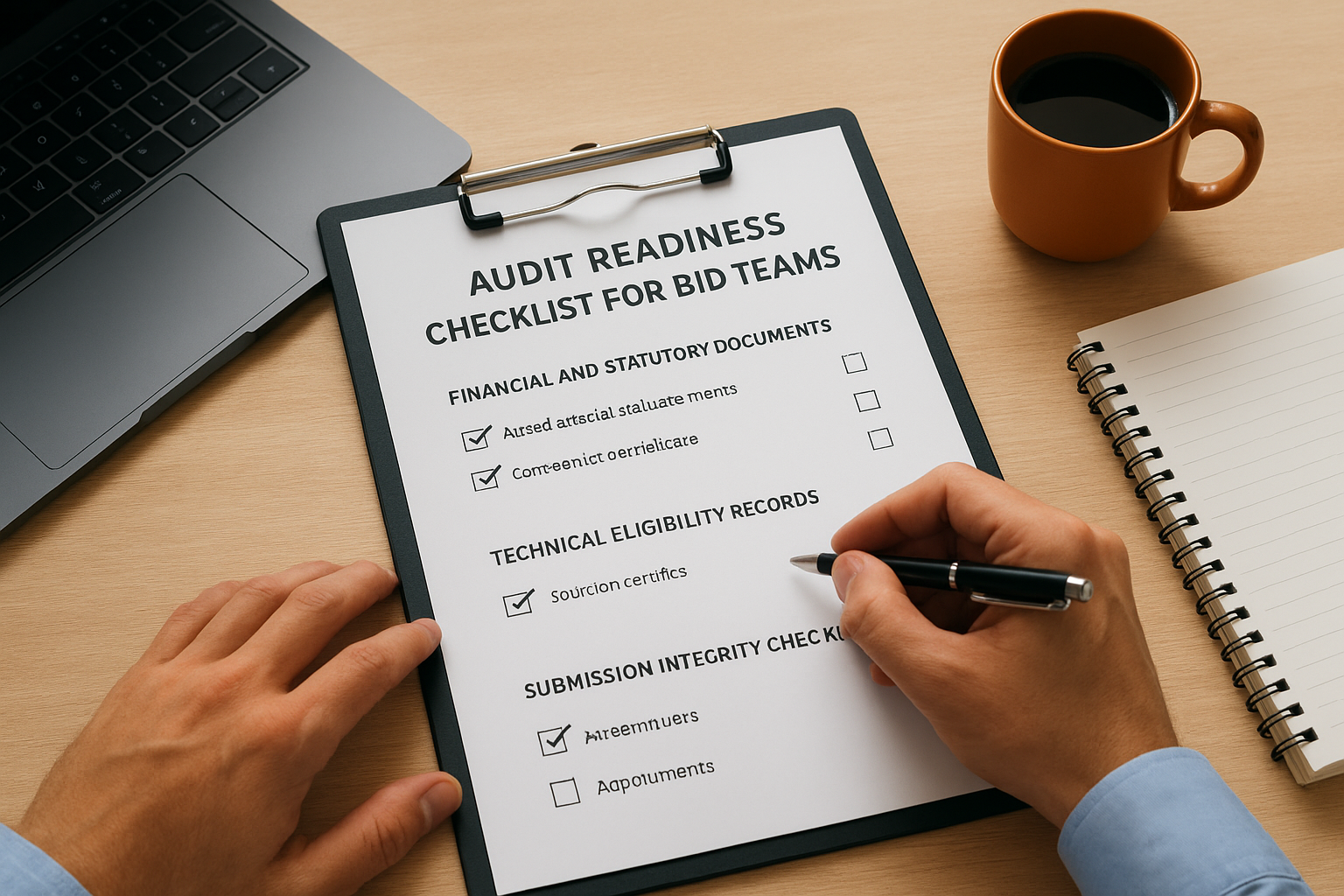
Understanding what is audit readiness at a conceptual level only produces results when your bid team translates it into a concrete pre-submission routine. The checklist below gives your BD managers and bid coordinators a structured sequence to run through before any tender package leaves your office, covering the three document categories that trigger the most disqualifications in Indian public procurement evaluations.
Financial and statutory documents
Your financial records must be current, consistent, and certified by a qualified authority before any submission. Run through each item on this list as a fixed step in your bid preparation cycle, not a final-hour scramble.
- Audited financial statements for the three most recent financial years, certified by a registered CA
- GST registration certificate with your current legal entity name matching every other submission document
- PAN card issued to the same legal name as your firm's registered entity
- EPF and ESI compliance certificates dated within the window specified by the tender
- Bank solvency certificate or net worth statement issued within the current or immediately preceding financial year
- Income tax returns filed and acknowledged for the relevant assessment years
A certificate that was accurate three months ago may no longer satisfy a tender's eligibility date window, so your bid coordinator must check issue dates against tender-specific requirements before pulling any file from your credential folder.
Technical eligibility records
Your past project documentation and key personnel records carry the heaviest scrutiny during evaluation. Each item below must be verifiable against an external source, whether that is a client organization, a statutory body, or a publicly accessible registration database.
- Completion certificates for each qualifying project, stating client name, contract value, scope, and completion date in full
- ISO or sector-specific certifications with current validity dates confirmed before submission
- Equipment registers backed by purchase records or registration documents that confirm ownership or lease status
- Signed subcontractor agreements with scope, value, and validity period clearly stated
- Key personnel CVs paired with appointment letters that confirm their current employment status at your firm
Submission integrity checks
After your documents are assembled, your final step is a cross-referencing pass that catches inconsistencies before an evaluator does. Check that your firm's legal name appears identically across every document in the package, that all financial figures stated in your eligibility declarations match your certified accounts exactly, and that every document is formatted to the specification the tender authority requires, whether that means attested originals, self-certified copies, or notarized translations. This pass takes under an hour and removes the most common disqualification triggers before your bid is formally submitted.
Common audit readiness gaps and fixes
Even firms that understand what is audit readiness in principle often carry the same recurring gaps into every bid cycle. These gaps are not random. They cluster around a predictable set of record-keeping habits, and once you know where they appear, you can fix most of them in a single dedicated review session rather than discovering them under deadline pressure.
Stale or expired documents submitted as current
The most frequent disqualification trigger in Indian public procurement evaluations is a document that was valid at some earlier point but has since expired. ISO certifications, bank solvency certificates, EPF compliance certificates, and state-specific contractor registrations all carry validity windows that your bid team must verify against the specific date requirements in each tender notice.
Your fix is a shared expiry tracker that lists every time-sensitive document your firm holds, the date it expires, and the team member responsible for renewing it at least sixty days before that window closes.
This single system removes the gap entirely because your credential file stays current as a default, not as an exception you manage under pressure.
Entity name inconsistencies across the document set
Your firm's legal name must appear identically on every document in your submission package. A minor variation between your name on a GST certificate and the name you registered on CPPP, such as "Pvt. Ltd." versus "Private Limited," is enough for an evaluating committee to flag your bid for clarification or reject it outright. This gap appears most often in firms that have undergone a name change, a restructuring, or a reregistration without systematically updating every statutory document.
Your fix is a name consistency check that compares the legal entity name across your GST registration, PAN, EPF, ESI certificate, bank solvency letter, and portal registrations before any submission leaves your office. Assign this check as a named responsibility in your bid preparation workflow so it runs on every tender, not just the high-value ones.
Vague completion certificates that fail verification
Generic completion certificates that omit the contract value, the specific scope of work, or the completion date in a verifiable format routinely fail scrutiny during pre-qualification reviews. Evaluators need to confirm that the work you cite actually meets the value and category thresholds the tender specifies, and a certificate that states only "civil works completed satisfactorily" gives them nothing to verify.
Your fix is to request structured completion certificates from clients at the point of project closeout, while the relationship is active and the details are fresh. A brief template you send to the client contact, specifying the fields the certificate must include, is far easier to act on immediately than chasing the same information months later for a bid submission.
Where to go from here
Understanding what is audit readiness gives your firm a concrete framework to stop losing tenders over documentation gaps and start submitting bids that hold up under scrutiny. Every section in this article has pointed to the same core discipline: keep your records current, consistent, and organized before an auditor or evaluation committee asks for them, not after.
The firms that consistently win high-value public contracts in India are not necessarily the most technically capable. They are the ones that can prove their capability on paper, in the right format, on short notice. That proof comes from treating audit readiness as an ongoing operational practice rather than a pre-submission scramble.
If your firm is ready to combine that discipline with smarter opportunity discovery and credential gap analysis, explore what Arched can do for your bid pipeline and see how the platform supports your readiness from the first search to final submission.