9 Request for Proposal Best Practices for Winning RFPs
Every bid manager knows the feeling. A tender lands with a 200-page RFP document, a two-week deadline, and a BOQ buried somewhere in annexure C. Get one qualification clause wrong and your firm is disqualified before anyone even reads your technical proposal. Request for proposal best practices exist precisely because most bids fail on preparation and process, not on price or capability.
If you're responding to government tenders in India, whether on GeM, CPPP, or a state e-procurement portal, winning consistently comes down to how you read the fine print and how you structure your response against what the evaluator actually scores. That means checking eligibility before you invest hours drafting, mapping every requirement to a proof point, and flagging risky clauses early instead of discovering them after submission.
This article walks through nine practices that separate firms with strong win rates from those that chase every tender and win few. We'll cover how to qualify tenders faster, structure a proposal that matches scoring criteria, catch hidden risks in BOQs and legal terms, and build a repeatable process your BD team can run on every bid, without burning out on manual portal checks.
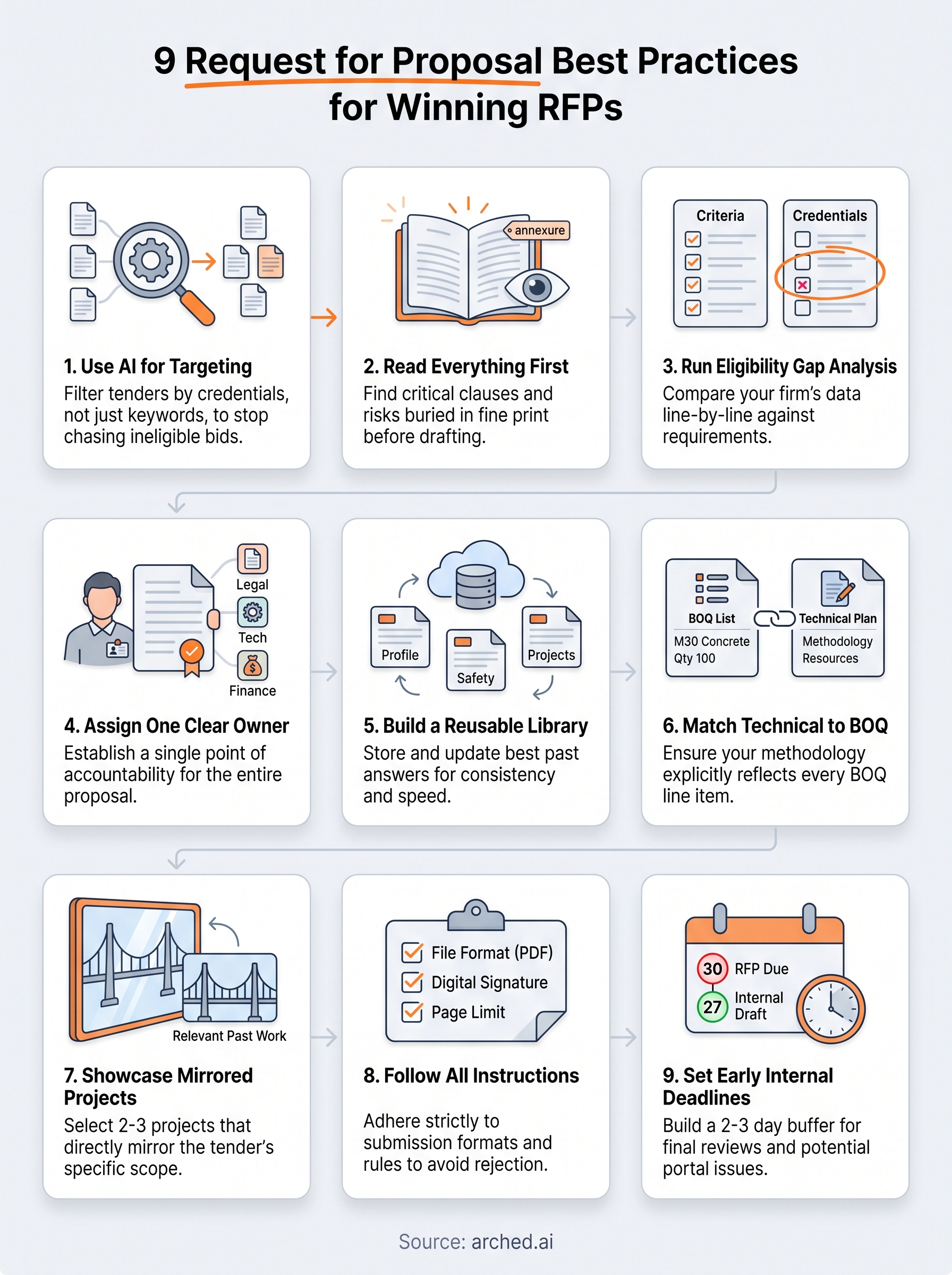
1. Use AI to target the right RFPs before you bid
Most bid teams still start their week by refreshing GeM, CPPP, and half a dozen state portals by hand, hunting for tenders that match their sector. That approach burns hours and still misses opportunities, because keyword search can't tell you whether your firm actually qualifies. AI-driven tender discovery changes the starting point of the whole process: instead of scanning everything, you only look at tenders your firm is realistically eligible to win.
Why it matters
Bid managers who chase every tender that mentions "road widening" or "irrigation" end up drafting proposals for contracts they were never going to qualify for in the first place. That's wasted BD hours and a lower win rate across the pipeline. A platform built for request for proposal best practices cross-references a tender's eligibility clauses against your firm's certifications, past project value, and turnover history before you spend a single hour on the response.
The fastest way to raise your win rate is to stop bidding on tenders you were never eligible for.
How to put it into practice
Set up your firm's credentials once, then let the system do the daily filtering instead of a person.
- Feed in your certifications, past project data, and turnover figures as a baseline profile
- Monitor all relevant portals continuously, including GeM, CPPP, IREPS, MSTC, and state e-procurement sites
- Get instant alerts only for tenders that match your actual eligibility, not just your sector keywords
- Review a shortlist each morning instead of scanning raw listings across a dozen tabs
Common mistakes to avoid
Teams new to this shift often make a costly assumption: that any AI tool matching on keywords is good enough. It isn't. Keyword matching still surfaces tenders you can't legally bid on, which means someone still has to manually verify eligibility after the fact. Skipping the setup step, feeding in incomplete certification data or outdated project history, is the other common failure. The tool is only as accurate as the firm profile behind it, so treat that setup as seriously as you'd treat a bid submission itself.
2. Read the entire tender document before responding
A 200-page tender rarely puts the critical clauses on page one. Turnover requirements, technical qualification criteria, and disqualification triggers often sit in annexures that bid teams skim past because the deadline pressure pushes them straight to the BOQ. Reading the entire tender document before you write a single line of response is the single cheapest risk-reduction step in the whole process, and it costs nothing but time.
Why it matters
Evaluators disqualify bids for missing a single eligibility clause buried in fine print, no matter how strong the technical proposal is. A firm that skips straight to pricing might spend three days drafting a response, only to find on submission day that a certification requirement in annexure D ruled them out from the start. Request for proposal best practices always start with full comprehension of the document, not partial reading driven by deadline anxiety.
A brilliant technical proposal can't save you from a disqualification clause you never read.
How to put it into practice
- Read the eligibility criteria and scope of work sections first, before touching the BOQ
- Flag every clause with legal or financial exposure, including penalty terms and performance guarantees
- Note submission mechanics separately: format, page limits, digital signature requirements
- Assign someone to summarize annexures so nothing gets lost in appendices
Common mistakes to avoid
The biggest failure is delegating the first read to whoever is available instead of a senior team member who knows what red flags look like. Skimming for the BOQ and skipping the legal clauses is another common shortcut that backfires during evaluation or, worse, during contract execution.
3. Run a gap analysis on eligibility and certifications
Once you've read the tender in full, the next question is blunt: does your firm actually meet every qualification clause, or are you missing a certification, a specific class of work experience, or a minimum turnover threshold? A gap analysis compares your firm's credentials line by line against the tender's eligibility criteria, before you commit BD hours to drafting anything.
Why it matters
Firms lose bids they were technically strong on because a single certification lapsed or a similar-value project fell just short of the required threshold. Spotting that gap early lets you decide whether to skip the tender, pursue a joint venture, or start building toward the missing credential for the next cycle. Request for proposal best practices treat eligibility gaps as strategic information, not just a pass/fail filter.
Knowing what you're missing is more valuable than knowing what you already qualify for.
How to put it into practice
- List every eligibility clause separately: turnover, similar work experience, certifications, technical staff
- Match each clause against your firm's current documentation, not assumptions
- Flag partial matches, like a project that's close in value but different in scope
- Use the gap list to identify stepping-stone tenders that build the missing credential for future high-value bids
Common mistakes to avoid
The most common error is assuming eligibility based on memory rather than verified documents, only to find a certificate expired last quarter. Teams also treat a gap as a dead end instead of a roadmap, when it's usually a signal to bid smaller now and qualify bigger later.
4. Assign one clear owner for the bid response
Most bid failures aren't about missing skill, they're about diffused ownership. When five people are "working on the proposal," nobody actually owns the eligibility check, the BOQ pricing, or the final proofread, and gaps only surface after submission. Naming a single bid owner who's accountable for the whole document, from first read to final upload, is one of the simplest request for proposal best practices teams skip because it feels obvious.
Why it matters
Committees don't catch errors, individuals do. A bid split across departments with no single point of accountability tends to have mismatched numbers between the financial and technical sections, or a certification that two people assumed someone else attached. Ownership isn't about doing all the work yourself, it's about being the person who signs off before submission and knows every section cold.
A bid with five owners has zero owners.
How to put it into practice
- Name one bid manager per tender, regardless of team size
- Give that person authority to pull in legal, technical, and finance inputs on a deadline
- Require a final sign-off from the owner before anything gets uploaded
- Keep a single version of the document under their control, not scattered drafts in email threads
Common mistakes to avoid
Rotating ownership mid-bid because someone's on leave creates blind spots nobody catches in time. Treating ownership as a formality, where the "owner" just forwards files without reviewing them, defeats the purpose entirely.
5. Build a reusable content library for RFP answers
Most tenders ask the same fifteen questions in slightly different words: company history, safety record, quality certifications, key personnel bios, past project summaries. Rewriting these from scratch every time wastes hours that should go into the parts of the bid that actually change: pricing, technical approach, and site-specific details. A reusable content library turns your best past answers into a searchable asset your whole BD team can pull from.
Why it matters
Firms that rebuild boilerplate every cycle lose days they could spend on differentiation, and rushed last-minute answers to standard questions often read weaker than they should. A strong library also protects consistency: your stated turnover figures, certification numbers, and project descriptions match across every submission instead of drifting bid to bid. This is one of the request for proposal best practices that pays off fastest, because the effort is one-time and the returns compound with every tender.
The proposals that win aren't written faster, they're assembled from answers you already perfected.
How to put it into practice
- Tag content by category: company profile, certifications, safety policy, key personnel, past projects
- Store the most recent, evaluator-approved version of each answer, not the first draft ever written
- Review and refresh entries quarterly so certifications and figures stay current
- Let bid owners pull from the library and customize, rather than starting blank
Common mistakes to avoid
Letting the library go stale is the biggest risk; an outdated turnover figure or expired certificate copied into a live bid can trigger disqualification. Treating library content as final, copy-pasted without tailoring to the specific tender's language, also reads as generic to evaluators scoring for relevance.
6. Match your technical response to the exact BOQ
Every line item in the Bill of Quantities implies a technical claim you need to back up somewhere in your proposal. If the BOQ specifies M30 grade concrete for a bridge deck and your technical methodology talks generically about "standard concrete mix," an evaluator scoring for compliance has grounds to mark you down, even if your pricing is competitive. Matching your technical response to the BOQ means every quantity, specification, and material grade in that schedule shows up explicitly in your methodology, equipment list, or work plan.

Why it matters
Evaluators score technical proposals against the BOQ line by line, not against a general impression of competence. A mismatch between what you priced and what you described technically signals to the evaluator that either your pricing team or your technical team didn't read the same document. Request for proposal best practices treat the BOQ as the backbone of the entire technical section, not a separate pricing exercise handled in isolation.
Your technical narrative and your BOQ should read like they were written by the same person, because they should be.
How to put it into practice
- Extract every specification and quantity from the BOQ before drafting the technical section
- Cross-check material grades, equipment capacity, and manpower numbers against what your methodology describes
- Have your pricing and technical teams review the same BOQ line by line together, not separately
- Flag any BOQ item you can't fully match, and clarify it with the procuring entity before submission where allowed
Common mistakes to avoid
Drafting the technical proposal from a template before the BOQ is finalized is a common shortcut that leaves gaps evaluators catch immediately. Letting pricing and technical teams work in silos, without a joint review, also produces mismatches that cost points on compliance scoring.
7. Showcase past projects that mirror the tender
Evaluators award experience marks based on relevance, not volume. Listing twenty past projects means nothing if none of them match the tender's scope, value bracket, or technical complexity. Showcasing past projects that mirror the tender means picking two or three examples that map directly onto what the procuring entity is asking for, a bridge project for a bridge tender, an irrigation canal for an irrigation tender, not your entire company portfolio.
Why it matters
Scoring sheets usually award points for "similar work experience," and evaluators define similarity narrowly: same sector, comparable contract value, similar technical scope. A firm that built ten highways but cites a shopping mall as its flagship reference loses points it didn't need to lose. Request for proposal best practices call for reading the tender's definition of "similar work" first, then selecting references that fit that exact definition.
Relevance beats volume every time an evaluator scores past experience.
How to put it into practice
- Check the tender's own definition of similar work experience, including value thresholds and technical scope
- Select two or three projects that match closely, rather than listing everything your firm has built
- Include completion certificates, client references, and measurable outcomes for each project cited
- Highlight scale and complexity that meets or exceeds the current tender's requirements
Common mistakes to avoid
Padding the reference list with older or unrelated projects dilutes the strongest examples and signals a weak fit. Omitting proof documents, like completion certificates or client sign-off letters, also weakens credibility even when the project itself is genuinely relevant.
8. Follow submission and formatting instructions exactly
Government tenders reject technically excellent bids over things that have nothing to do with quality: wrong file format, missing digital signature, a page limit exceeded by two pages. Following submission and formatting instructions exactly sounds obvious, but every bid manager has a story about a strong proposal disqualified for uploading a scanned PDF where the portal demanded a digitally signed one.
Why it matters
Procuring entities design formatting rules to make evaluation faster and fairer across dozens of bidders, and they enforce them mechanically. A portal that requires financial and technical bids as separate encrypted files will reject a combined upload without exception, regardless of content quality. This is one of the request for proposal best practices teams underestimate because it feels administrative rather than strategic, right up until it costs them a bid.
The best proposal in the world still loses if it's uploaded in the wrong format.
How to put it into practice
- Extract every submission requirement into a checklist: file format, size limits, naming conventions, signature type
- Confirm the portal's technical requirements (browser, plugin, certificate type) days before the deadline, not on submission day
- Do a test upload where the portal allows it
- Assign one person to verify the checklist before final submission
Common mistakes to avoid
Assuming formatting rules from a past tender still apply is a frequent trap; portals and departments change requirements between cycles. Leaving digital signature or certificate renewal until deadline day also causes avoidable last-minute failures.
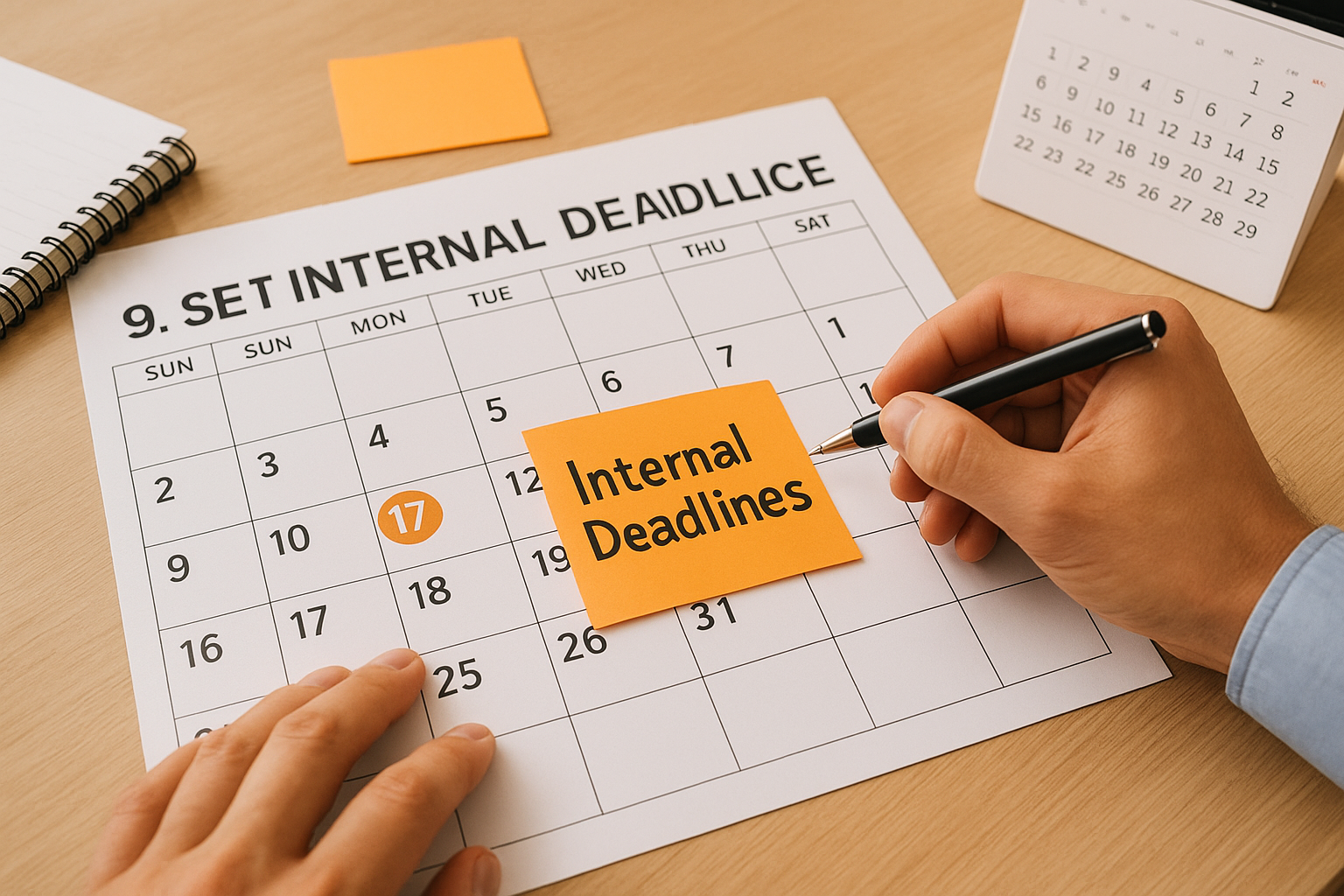
9. Set internal deadlines ahead of the RFP due date
The RFP portal deadline is not your team's deadline. It's the outer limit, the moment after which nothing can change, and treating it as your working target guarantees a scramble in the final 48 hours when a certificate needs renewal or a director needs to sign something. Setting internal deadlines ahead of the RFP due date builds in the buffer every bid actually needs for review, corrections, and portal glitches.
Why it matters
Government portals crash under load in the final hours before a deadline, and digital signature certificates fail to renew exactly when you need them most. A firm that plans to submit at 11:50 PM on the due date has zero room for either problem. Request for proposal best practices push every internal milestone at least two to three days earlier than the actual cutoff, so a bad afternoon doesn't cost you the whole bid.
Build your deadline calendar around the worst day, not the best one.
How to put it into practice
- Set an internal draft-complete date at least three days before the portal deadline
- Schedule a final review and sign-off milestone one full day before submission
- Reserve the last day solely for upload, portal issues, and last-minute corrections
- Calendar certificate renewals and signatory availability weeks in advance, not days
Common mistakes to avoid
Treating the portal deadline as the working deadline leaves no margin when something inevitably goes wrong. Skipping a buffer for signatory travel or certificate expiry is another recurring failure, since these delays are entirely predictable if someone checks the calendar early.
Putting these practices to work on your next bid
Winning tenders consistently isn't about outbidding everyone on price. It's about qualifying faster, reading more carefully, and treating your response as a structured match against what the evaluator scores, not a scramble against a deadline. Every practice above solves a specific failure point: wasted BD hours on ineligible tenders, disqualification from a missed clause, mismatched pricing and technical sections, or a last-minute portal crash with no buffer left.
You don't have to build this process by hand. If your team has more tenders than estimators, Arched can take the pricing off your plate: send us the project and we deliver a detailed estimate and BOQ, reviewed by an engineer, on your deadline. See how our estimating service works.
Have a package your team can’t get to? Send it to us. Our engineers check and sign off everything we deliver.