6 Request for Proposal Evaluation Criteria to Score Vendors
Use these 6 request for proposal evaluation criteria to score vendors. Learn how to assess technical capacity, past performance, and project delivery plans.
You've issued an RFP, and now 15 vendor responses sit on your desk. Each one reads like it was written by the same consultant. Without clearly defined request for proposal evaluation criteria, your team defaults to gut instinct, or worse, picks the lowest bid and hopes for the best. That approach burns time, burns budgets, and often lands you with a vendor who underdelivers halfway through the project.
The fix isn't complicated, but it does require structure. You need a scoring framework that accounts for technical capability, past performance, pricing, and risk, weighted in a way that reflects your project's actual priorities. Whether you're evaluating contractors for a highway widening project or consultants for urban infrastructure design, the criteria you set before reading a single response will determine the quality of the vendor you select.
This article breaks down six evaluation criteria that government contractors and infrastructure firms across India use to objectively score RFP responses. At Arched, we build AI tools that help AEC firms analyze tender documents, extract qualification benchmarks, and match against vendor credentials, so we've seen firsthand what separates a rigorous evaluation process from one that creates problems down the line. Below, you'll find practical scoring methods, real-world examples, and a framework you can adapt to your next procurement cycle.
1. Eligibility and compliance gates
Eligibility is the first filter every RFP evaluation runs through, and it deserves more attention than most teams give it. Before you score technical capability or pricing, you need to confirm that a vendor actually meets the minimum thresholds your procurement rules require. Skip this step, and you risk awarding work to a firm that lacks the legal standing, financial strength, or technical certification to deliver.
What this criterion covers in an RFP
This criterion covers the mandatory qualification requirements that vendors must satisfy before their proposals receive any further review. In Indian government contracting, these typically include valid registration certificates (GST, PAN, contractor registration), minimum annual turnover thresholds, and proof of similar work completed within a specified number of years. For infrastructure contracts, you'll also commonly see requirements for EMD submission, valid EPFO/ESIC registration, and sector-specific licenses from bodies like NHAI or state PWDs.
The scope of eligibility requirements varies by contract size and sector, so always extract the full list from the tender document before building your evaluation matrix.
Pass or fail rules that disqualify bids fast
Eligibility criteria function as pass/fail gates, not scored items. A vendor either meets the threshold or they don't, so assign a binary check (Pass/Fail) to each requirement and document which exhibits were reviewed to confirm it. This protects your evaluation from disputes during audits.
Treating any eligibility item as a matter of degree opens your process to challenges the moment a losing bidder files a complaint.
Build a compliance checklist with every mandatory requirement as a row and each vendor as a column. If a single cell reads "Fail," that vendor goes no further, which saves evaluators from reading 40 pages of a non-compliant bid.
How to score compliance consistently across evaluators
Different evaluators interpret the same documents differently, which is exactly where your request for proposal evaluation criteria can break down in practice. Use standardized document reference codes so every evaluator checks the same exhibit against the same requirement. Hold a short pre-evaluation briefing to resolve edge cases, for example, whether a joint venture's combined turnover qualifies or only the lead partner's figures count.
How Arched applies eligibility checks from tender PDFs
Arched's document parsing engine reads tender PDFs and automatically extracts qualification criteria such as minimum turnover, prior experience thresholds, and required certifications. Rather than your BD team manually scanning each clause, Arched flags credential gaps between a tender's eligibility requirements and your firm's current profile, telling you whether you clear the gate before you invest hours preparing a bid.
2. Technical requirements and solution approach
Once a vendor clears the eligibility gate, technical evaluation becomes the heart of your request for proposal evaluation criteria. This criterion tests whether the vendor actually understands your scope and has a credible plan to deliver it. In AEC and infrastructure projects, technical depth separates firms that execute well from those that win contracts and then struggle through delivery.
How to map requirements to a scoring matrix
Pull every technical requirement from the RFP and list them as individual rows in a scoring matrix. Assign point values to each row based on project priority, and give evaluators a 0-to-5 scale with written anchors for each score level. This keeps results consistent regardless of which evaluator reviews which bid.

Scoring anchors eliminate the ambiguity that turns evaluation meetings into drawn-out disputes.
A simple three-tier anchor works well: 0 for no response, 3 for a partial or generic answer, and 5 for a site-specific, evidence-backed solution with supporting documentation.
What evaluators look for in method statements and technical bids
Strong technical bids show site-specific thinking rather than templates. Look for vendors who reference your actual drawings, site constraints, and applicable Indian standards rather than copying boilerplate from previous submissions. The following elements signal a substantive technical response:
- Work sequencing tied to your project's specific phases
- Resource allocation linked to defined milestones
- Explicit references to IS codes or sector-specific specifications
Red flags that signal overpromising or non-compliance
Watch for vendors who promise compressed timelines without explaining the resourcing logic behind them. Vague phrases like "as per client requirements" substituting for an actual methodology are a consistent warning sign across poorly prepared bids.
Flag submissions where the proposed team composition doesn't align with the scale or complexity of your scope. If a firm lists three engineers for a project that clearly needs ten, that shortfall will surface during execution, not before.
3. Relevant experience and past performance
A vendor's past performance tells you more than their pitch does. This criterion tests whether the firm has delivered work of comparable scale, complexity, and sector to yours, and whether the people they propose have actually done the work before. In AEC contracting, relevant experience is one of the most reliable predictors of on-time, on-budget delivery.
How to score comparable projects in AEC and infrastructure
Score past projects across three dimensions: contract value relative to your scope, sector relevance, and recency. Award full points to projects completed within the last five years at 80% or more of your contract's value, and apply a scaled reduction for adjacent sectors.

- Contract value match: Full points if the cited project falls within 80% of your contract value
- Sector relevance: Full points for an exact match, partial credit for adjacent sectors like urban roads versus highway works
- Recency: Full points for work completed within five years, reduced thereafter
Evaluators who treat a highway drainage project as equivalent experience for a bridge construction contract often discover that gap during site execution.
How to evaluate the proposed project team and key personnel
Check that the proposed project manager and key technical staff hold credentials that match your scope's complexity. Look at their actual role on previous contracts, not just their employer's project list.
Someone listed as "team member" on a large infrastructure scheme tells you far less than one who served as the lead engineer with documented decision-making responsibility on a comparable project.
How to verify claims without slowing the evaluation down
Require completion certificates and client contact references as mandatory attachments in your submission checklist, not optional inclusions. Your request for proposal evaluation criteria should define the exact evidence format upfront so vendors know precisely what to submit.
Cross-referencing declared contract values against completion certificates before scoring begins filters inflated claims early and keeps your evaluation moving without repeated follow-up rounds.
4. Delivery plan, timeline, and resourcing
A technically capable vendor who can't sequence a project or deploy resources on time creates just as many problems as one who lacks expertise. This criterion tests whether a vendor's execution plan is realistic and whether their proposed resources match the actual demands of your scope.
What this criterion covers in an RFP
This criterion examines a vendor's project schedule, milestone sequencing, and resource deployment plan. Look for these elements in a substantive delivery plan:
- Named resource assignments for each project phase
- A critical path that shows how milestones connect
- Equipment availability confirmed against your schedule dates
How to score the implementation plan and milestones
Score the implementation plan on clarity of sequencing and the logic connecting each milestone to the next. Award full points when vendors tie dates to specific deliverables with defined acceptance criteria, and reduce scores for plans that list dates without explaining dependencies.
A timeline that ignores known project interdependencies signals that the vendor hasn't read your scope carefully.
How to assess staffing, equipment, and subcontractors
Check that staffing levels and equipment commitments are proportional to the schedule the vendor proposes. When subcontractors appear in the plan, your request for proposal evaluation criteria should require vendors to identify them by name and describe their specific scope of work, not list them as TBD.
Treat vague subcontractor entries as a scoring deduction, not a minor omission. A firm that hasn't confirmed its supply chain at bid stage frequently loses schedule control during execution.
How to factor in mobilization, approvals, and site constraints
Penalize plans that assume immediate full mobilization without accounting for regulatory approvals, utility clearances, or seasonal constraints. Vendors who build in realistic lead times for these steps demonstrate genuine familiarity with Indian infrastructure delivery.
Score higher when vendors explicitly reference site-specific constraints such as monsoon windows or right-of-way acquisition timelines that your scope documents already identify.
5. Commercials, risk, and long-term value
Price is the criterion that every vendor watches most closely, but it should never be the one that drives your final decision. When you treat cost as a standalone metric, you miss contract terms, performance obligations, and risk exposure that often cost more than the difference between the lowest and highest bid.
Cost and total cost of ownership
Look beyond the quoted price and calculate the total cost of ownership across the full contract period. For infrastructure contracts, that means accounting for variation provisions, price escalation clauses, and mobilization costs that some vendors bury in assumptions rather than their commercial schedule.
Risk, security, and contract terms
Your request for proposal evaluation criteria should include a structured review of how each vendor handles risk allocation. Score vendors on whether they accept standard indemnity clauses, provide adequate performance security, and limit their own liability in ways that leave your organization exposed during delivery disputes.
Vendors who push back on every risk clause at bid stage rarely become easier to manage once work is underway.
Support, SLAs, and performance guarantees
Evaluate what each vendor commits to after mobilization, not just at contract start. Look for clearly defined service level agreements, defect liability periods with teeth, and response time commitments backed by penalties rather than goodwill.
How to set weights so price does not drown out quality
Assign commercial criteria a weight of 20 to 30 percent of your total score, leaving the majority for technical and experience factors. When price dominates your scoring matrix, vendors optimize for low bids and cut scope during execution to recover their margins.
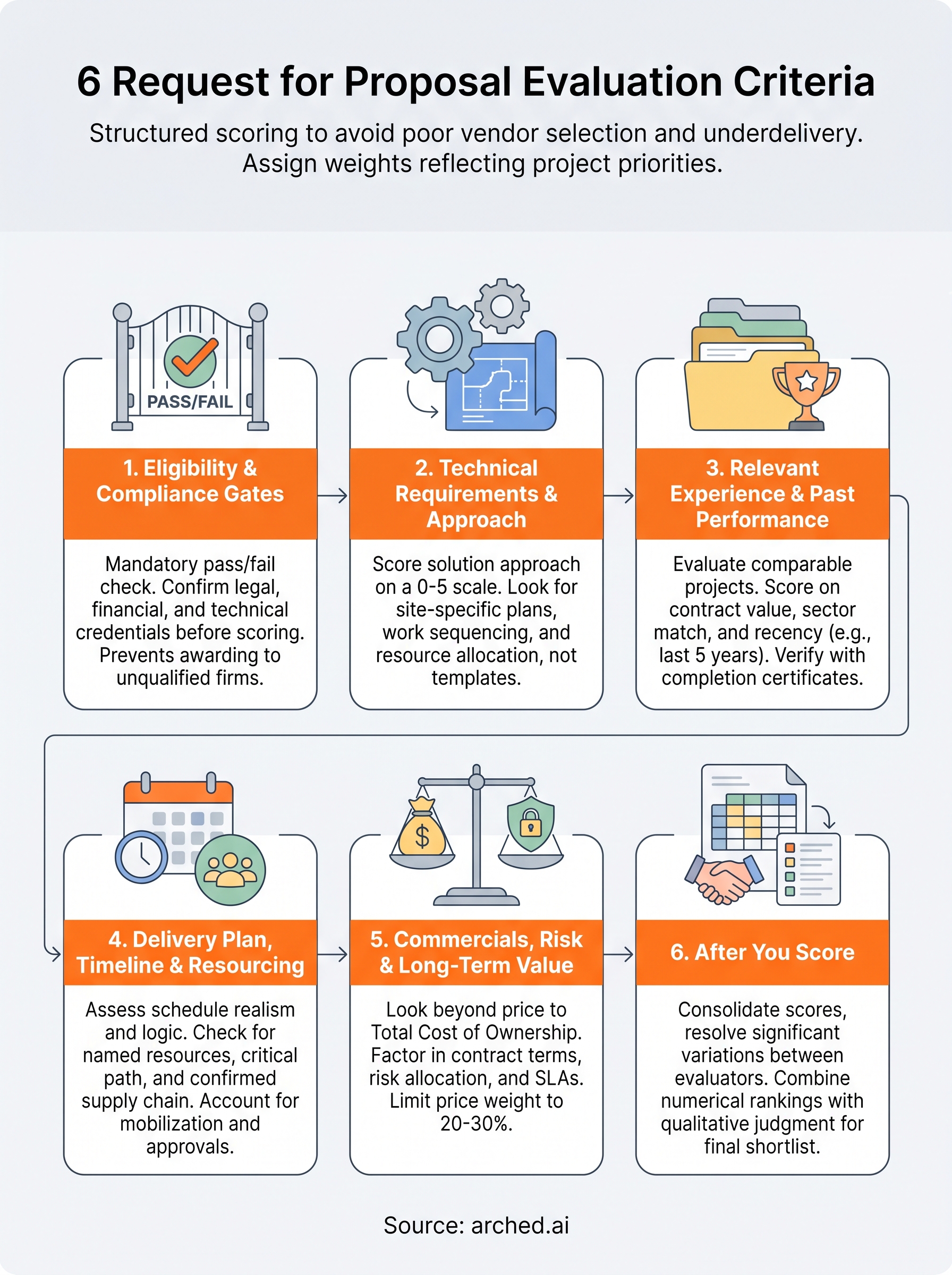
After you score the proposals
Scoring completes the analytical work, but your next steps determine whether that structure translates into a defensible decision. Compile each evaluator's scores into a consolidated matrix, calculate weighted totals, and document the rationale behind any significant score variations between reviewers. Where two evaluators diverge by more than one full point on the same criterion, resolve the gap before you rank vendors, not after.
Your final shortlist should reflect both numerical rankings and qualitative judgment. A vendor who scores highest on commercials but shows thin experience on comparable infrastructure projects warrants a harder look before you issue a letter of intent. Use your request for proposal evaluation criteria as a reference point throughout any clarification rounds, not just at initial scoring. If you want to reduce the manual effort of extracting eligibility benchmarks, qualification thresholds, and credential gaps directly from tender documents, explore what Arched can do for your BD pipeline.