AI Tender Analysis: What It Is and How It Automates Bids
Automate bid screening with ai tender analysis. Learn how to parse documents, flag risks, and identify winnable Indian government contracts faster.
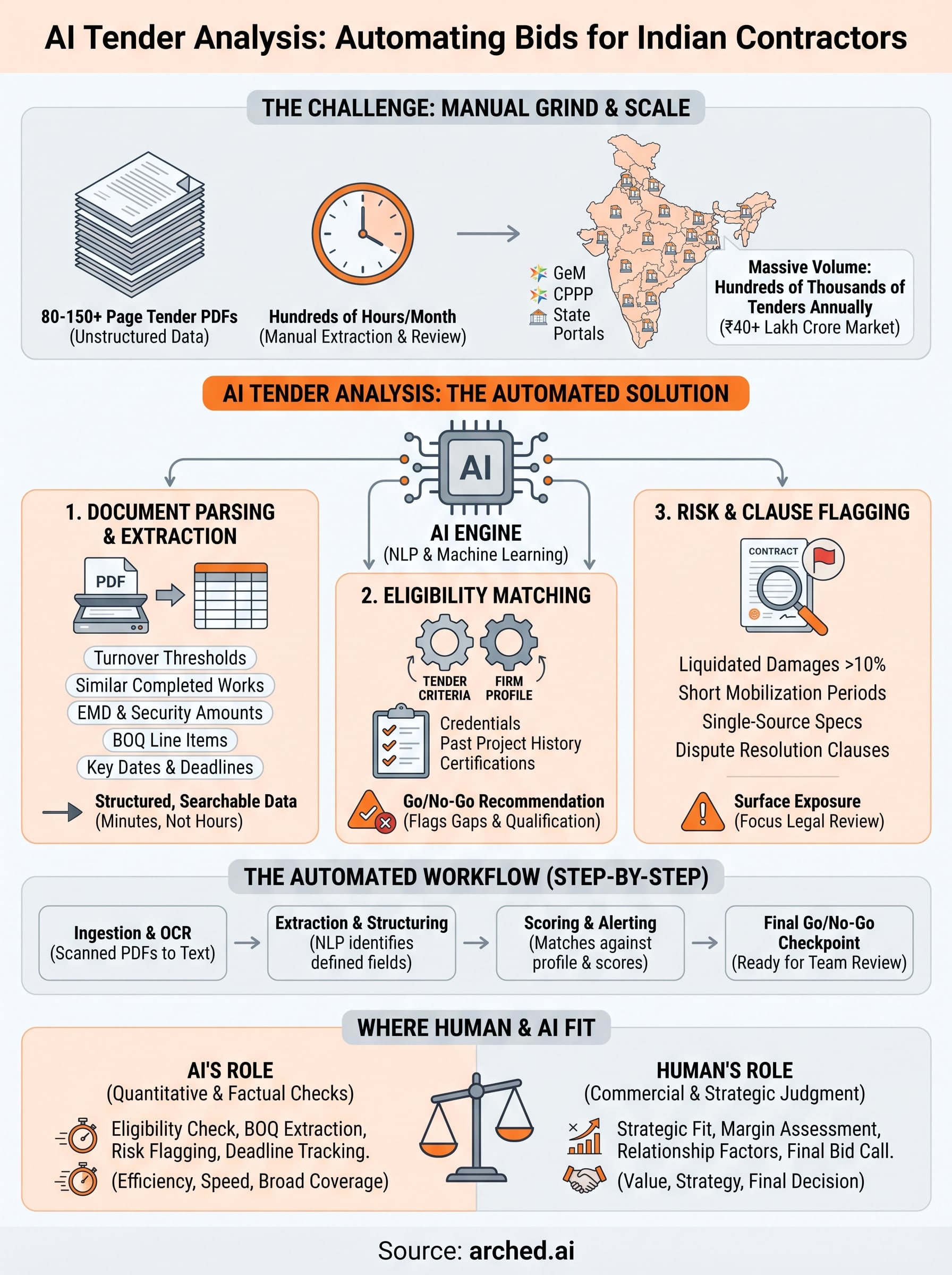
A single government tender document can run 80–150 pages. Buried inside are eligibility criteria, BOQ line items, legal clauses, and submission deadlines, all of which a BD team needs to extract, cross-reference, and evaluate before deciding whether to bid. Multiply that across dozens of tenders per week from portals like GeM, CPPP, and state e-procurement sites, and you have a process that eats hundreds of hours every month. AI tender analysis replaces that manual grind with software that reads, parses, and evaluates tender documents automatically.
At its core, the technology uses natural language processing and machine learning to pull structured data out of unstructured PDFs, things like qualification thresholds, financial requirements, scope definitions, and risk flags. The output isn't just a summary. Done right, it's a go/no-go recommendation backed by data your team can actually act on, matched against your firm's specific credentials and past project history.
This is exactly what we built Arched to do. Our platform already analyzes tenders across 500+ Indian government portals, extracting BOQs, flagging disqualifying clauses, and matching opportunities to your firm's profile. In this article, we'll break down what AI tender analysis actually involves, how the underlying technology works, and what to look for when evaluating tools that claim to do it, so you can tell real capability from marketing noise.
What AI tender analysis covers in real bids
Most people assume AI tender analysis is just faster keyword search. It isn't. Real AI analysis works at the document level, breaking down every section of a tender notice to extract specific data fields, check them against defined criteria, and return structured outputs your team can act on immediately. The scope covers three distinct functions that together replace most of what a BD analyst does manually during the initial screening phase.
Document parsing and data extraction
Government tenders rarely come in clean formats. You're typically dealing with scanned PDFs or multi-section documents that mix technical specifications, legal terms, and financial requirements across 80 to 150 pages. AI parsing uses optical character recognition combined with natural language processing to locate and extract specific fields regardless of how the original document is laid out. The result is structured, searchable data your team can act on in minutes rather than hours.
Common fields AI parsers extract from tender documents:
- Required annual turnover thresholds (typically last 3 to 5 years)
- Similar completed work experience requirements
- Earnest money deposit and performance security amounts
- Bill of Quantities quantities, units, and line item descriptions
- Key dates including bid submission, pre-bid meetings, and document opening
Eligibility matching against your firm's profile
Extracting data from a tender is only useful if you can compare it against what your firm actually qualifies for. AI eligibility matching takes the criteria pulled from the document and checks them against your firm's credentials, past project values, certifications, and sector history. If a tender requires three similar completed works above Rs. 5 crore and your firm has two, the system flags that gap before your team invests hours in a bid you cannot win.
The gap between knowing a tender exists and knowing whether you can win it is exactly where most BD teams lose time.
Risk and clause flagging
Beyond eligibility, AI also scans legal and technical sections for clauses that increase your exposure. BD teams often skip these sections during initial screening because working through them manually takes significant time. AI surfaces them automatically, so your legal or technical lead only reads the tenders that have already cleared an eligibility check and still need human judgment on specific contractual terms.
Common risk flags AI surfaces in tender documents:
- Liquidated damages set above 10% of contract value
- Mobilization periods under 30 days
- Single-source or proprietary material specifications
- Dispute resolution clauses that exclude standard arbitration
Why AI tender analysis matters for Indian contractors
India's public procurement market processes hundreds of thousands of tenders annually across central, state, and local government bodies. For an infrastructure firm trying to grow, that volume sounds like opportunity. In practice, it creates a filtering problem that manual processes simply cannot solve at the pace your business needs to move.
The scale of Indian government procurement
The Indian government alone spends over Rs. 40 lakh crore annually through public procurement, spanning roads, irrigation, urban infrastructure, defense, and railways. Opportunities are fragmented across portals like GeM, CPPP, IREPS, MSTC, and dozens of state-level systems, each with its own document formats, eligibility structures, and submission requirements. Without a systematic way to screen and analyze these tenders, your BD team ends up covering only a fraction of the actual market.
If your competitors are using AI tender analysis and you're still screening manually, they are reviewing three times more opportunities in the same working week.
Manual screening creates blind spots
When your team manually checks portals and reads tender PDFs, time pressure forces shortcuts. Analysts focus on familiar sectors and known portals, which means tenders from less-visited state sites or new procurement categories never get reviewed. Beyond missed opportunities, manual screening also misses buried risk clauses in contracts your team does pursue, which only surface after significant time has already been spent preparing a bid. AI tender analysis removes both problems by covering more ground and reading every section of every document, not just the ones your team has time to reach.
How AI automates tender analysis step by step
When you upload a tender document to an AI tender analysis platform, a sequence of automated steps runs in the background before any result appears on your screen. Understanding those steps helps you set realistic expectations about what the technology can and cannot do, and where human review still adds value.
Ingestion and text recognition
The first step converts the source file into machine-readable text. Most government tender documents arrive as scanned PDFs, which contain images rather than actual characters. The platform runs optical character recognition to digitize the content, then normalizes formatting so the AI can process it consistently across sections.
Common source formats the ingestion layer handles:
- Scanned multi-page PDFs from state e-procurement portals
- Native digital PDFs from GeM and CPPP
- Mixed-format documents combining text, tables, and embedded images
Extraction and structuring
Once the text is readable, the platform's natural language processing models scan each section to identify and extract defined data fields: turnover thresholds, completion certificates, BOQ line items, and submission dates. The models are trained on procurement document structures specific to Indian formats, which differ significantly from generic contracts. Structured outputs replace the raw PDF, giving your team a summary they can review in under two minutes.
The difference between a raw PDF and a structured tender summary is the difference between an hour of reading and a 90-second review.
Scoring and alerting
The platform then scores each tender against your firm's stored profile, checking extracted criteria against your credentials, past project values, and certifications. Tenders that clear your thresholds trigger an alert. Those that don't get flagged with specific gap reasons, so your team immediately understands what disqualified the opportunity without opening the original document.
Where AI fits in the go or no-go workflow
The go or no-go decision is the most time-sensitive checkpoint in your bid process. Before your team commits hours to a technical submission, someone has to confirm the tender is worth pursuing at all. AI tender analysis accelerates that checkpoint by handling the first two screening layers automatically, so your BD team only applies judgment where it genuinely adds value.
Initial screening and triage
When a new tender alert arrives, AI handles the first pass immediately. It checks the extracted eligibility data against your firm's stored profile and returns a preliminary verdict within seconds. Your team sees a score, the matched criteria, and any specific disqualifying gaps, without opening the original PDF. That means faster triage across a larger volume of opportunities than any manual process can match.
This shift moves your BD team from document readers to decision-makers, which is where their time creates the most value.
Where human judgment still applies
AI covers the factual and quantitative checks efficiently. What it doesn't replace is commercial judgment: whether the client relationship is worth building, whether the margin justifies the workload, or whether a borderline eligibility gap is worth contesting. Your senior team should focus their review on tenders that have already cleared the automated filters, not on documents the system has already ruled out.
A practical split for most infrastructure firms:
- AI handles: eligibility check, BOQ extraction, risk clause flagging, deadline tracking
- Your team handles: strategic fit, margin assessment, relationship factors, final bid call
How to evaluate AI tender tools and control risk
Not every platform that claims AI tender analysis capability delivers the same quality of output. The difference often comes down to what the models were trained on and how the vendor handles errors, two questions most buyers forget to ask before signing a contract.
Check what the model is trained on
Generic large language models are trained on broad internet data, which means they have no specific understanding of Indian procurement document structures, GeM formats, or CPPP eligibility frameworks. A platform built specifically for Indian government contracting will extract BOQ line items and turnover thresholds more accurately than a general-purpose tool that has simply been prompted to try. Before you commit, ask the vendor which portals and document types their models were trained on and request examples from actual Indian tender documents, not demos.
The quality of extraction degrades quickly when a model encounters document formats it has never seen before.
Verify accuracy before you commit
Run any platform you're evaluating against tenders your team has already analyzed manually. Compare what the AI extracted against what your analysts found. This test reveals extraction gaps and misclassified clauses before they affect a live bid. Pay particular attention to risk clause detection, since missed liquidated damages provisions or unusual indemnity terms carry direct financial consequences.
Two things to confirm during your evaluation:
- Does the platform surface clauses your team flagged as risky in your test documents?
- Does it correctly identify disqualifying eligibility gaps without false positives that waste your team's review time?
Platforms that pass both checks earn a place in your actual workflow.
Conclusion
AI tender analysis removes the two biggest drags on your BD team's productivity: hours spent reading documents that don't qualify your firm, and eligibility gaps discovered only after a bid is already underway. The technology handles document parsing, eligibility matching, and risk flagging automatically, so your team spends time on decisions rather than data extraction.
The firms that win more contracts in India's public procurement market are not necessarily the ones with the largest BD teams. They are the ones with the most accurate, most complete view of the opportunity landscape, combined with a disciplined process for evaluating each tender against their actual credentials.
If you want to see how this works in practice across 500+ Indian government portals, including GeM, CPPP, and state e-procurement systems, explore the Arched platform and find out how it maps your credentials to the tenders you can actually win.