10 Best RFP Management Software Tools in 2026
Every bid manager knows the drill. A tender lands, the clock starts, and suddenly your team is juggling BOQs, eligibility criteria, and a dozen email threads just to submit one response on time. Finding the best rfp management software means picking a tool that actually fits how Indian infrastructure and consultancy firms work, not a generic template built for software sales teams in the US.
This guide answers that search directly by comparing platforms built to handle real procurement workflows: document parsing, compliance tracking, collaborative drafting, and version control for large tender packages. We look at tools that manage the entire lifecycle, from tracking government portals like GeM and CPPP to assembling a final, submission-ready proposal, so you can compare pricing and feature depth without spending a week on trial signups.
What follows are 10 tools worth shortlisting in 2026, ranked by how well they serve teams juggling multiple bids at once. We cover strengths, limitations, and who each tool suits best, whether you're a small BD team chasing state tenders or a large contractor managing a high-volume pipeline across sectors like roads, bridges, and irrigation, where every missed deadline or overlooked clause carries real financial weight.
1. Loopio, best for enterprise content libraries
Loopio built its reputation on one core idea: a searchable content library that turns every past proposal answer into reusable material. For enterprise teams responding to dozens of RFPs a month, that library becomes the backbone of the entire response process, cutting down the endless copy-paste hunting through old Word docs. If you're comparing best rfp management software options for a large, established proposal team rather than a lean BD group, Loopio consistently makes the shortlist.
How it works
Teams tag and organize approved answers inside a centralized repository, then use Loopio's search and auto-fill features to populate new RFP templates in minutes. The platform's Magic feature suggests best-fit answers from your library based on the question asked, and project managers can assign sections to subject matter experts with built-in deadline tracking. Integrations with Salesforce and Microsoft Teams keep the workflow inside tools teams already use daily.
A strong content library only pays off when your team actually maintains it.
Who it's for
Loopio suits mid-size to enterprise proposal teams handling high response volumes, especially in SaaS, professional services, and financial sectors where question sets repeat often. It's less useful for teams whose work centers on government tender discovery or document parsing, since it assumes you already know which RFPs you're pursuing.
Pricing
Loopio doesn't publish public pricing; quotes are custom based on seat count and content volume, and most enterprise deployments start in the five-figure annual range. Expect a sales call and a demo before you see a number.
Limitations
The learning curve for organizing content taxonomy properly can take weeks, and smaller teams often find the platform's depth exceeds their actual needs. It also offers no native support for government portal monitoring, so procurement discovery still happens elsewhere.
2. Responsive, best for large multilingual RFP teams
Responsive, formerly known as RFPIO, built its name serving global enterprises that juggle RFPs, RFIs, and security questionnaires across dozens of languages and business units. Its strength lies in scale: massive question libraries, granular permission controls, and an AI-powered answer engine that pulls from thousands of prior responses across regions and teams. For companies operating across multiple countries and languages, this depth of coordination is hard to replicate with smaller tools.
How it works
Responsive centers around a shared content library that auto-populates answers as new RFPs are imported, supported by machine translation for teams working across markets. Project leads assign sections to specific reviewers, track completion status on a live dashboard, and run approval workflows before final submission. Its Ask Genie AI assistant drafts first-pass answers directly from your existing knowledge base, which speeds up first drafts considerably for teams with mature content already in place.
Multilingual support only helps if your source content is already accurate and current.
Who it's for
This platform suits large, distributed organizations with proposal teams spread across regions, particularly in tech, healthcare, and professional services where RFPs arrive in multiple languages. Smaller Indian infrastructure firms focused on domestic tenders rarely need this level of multilingual complexity, since most government portals operate in English and regional languages tied to specific states rather than a global spread.
Pricing
Responsive keeps pricing private and negotiates per contract, with most enterprise deals landing well into five figures annually depending on user seats and modules activated. Expect a lengthy sales cycle before you see any concrete numbers.
Limitations
Setup takes real investment: content migration and taxonomy design often stretch across several weeks before the AI features perform reliably. It also offers no tender discovery functionality, so teams still need a separate system for finding and monitoring government procurement opportunities.
3. Inventive AI, best for full RFP workflow automation
Inventive AI positions itself as an end-to-end automation layer for RFP response, aiming to handle everything from initial intake to final formatting without much manual intervention. Rather than acting as a searchable library you dip into, it behaves more like an autonomous drafting engine that reads the incoming RFP document and produces a structured first draft on its own. Teams tired of stitching together three or four separate tools for import, drafting, and review often look here first.

How it works
Upload the RFP file and Inventive AI parses the questions, matches them against your connected knowledge sources, and generates draft answers using generative AI models trained on your historical proposals. The platform then routes sections to reviewers automatically based on rules you set, tracks edit history, and compiles a final formatted document ready for export. Its auto-assignment logic removes a lot of the project management overhead that usually falls on a bid manager's shoulders.
Automation only saves time when the underlying content it draws from is already accurate.
Who it's for
Inventive AI suits mid-size to large proposal teams in software, consulting, and services sectors that respond to a steady volume of RFPs and want to cut manual drafting time significantly. It's a poor fit for firms whose real bottleneck is finding relevant government tenders in the first place, since discovery and portal monitoring sit entirely outside its scope.
Pricing
Inventive AI uses custom quotes tied to seat count and usage volume, with published starting tiers generally landing in the low five-figure annual range for smaller teams and scaling up from there.
Limitations
AI-generated first drafts still need thorough human review, and firms with thin or outdated content libraries will see weaker output quality. There's also no procurement monitoring built in, so Indian AEC firms would still need a separate system for tracking GeM, CPPP, and state portals.
4. AutoRFP.ai, best for fast structured RFP drafts
AutoRFP.ai focuses on one job: turning a messy tender document into a structured draft response fast. Rather than positioning itself as a full content management suite, it works more like a drafting accelerator, parsing the incoming file and mapping out sections before your team writes a single word. Bid managers under tight deadlines often reach for this when they need a usable skeleton within minutes, not days.
How it works
Upload the RFP and AutoRFP.ai extracts questions, groups them by topic, and generates draft answers pulled from your uploaded reference documents and past proposals. The platform flags missing information, suggests formatting based on the original document's structure, and exports a clean file ready for editing in Word or Google Docs. Its question extraction engine handles inconsistent PDF formatting reasonably well, which matters when tender documents arrive scanned or poorly structured.
A fast draft only helps if someone still checks it against the actual eligibility criteria.
Who it's for
Smaller proposal teams and consultancies evaluating best rfp management software for speed over depth tend to like AutoRFP.ai, especially those without a dedicated content library team. It's less suited to firms needing government portal monitoring or deep eligibility matching, since it starts working only after you already have the document in hand.
Pricing
AutoRFP.ai offers tiered monthly plans starting in the low hundreds of dollars, with higher tiers unlocking more document uploads and team seats. There's no free tier beyond a limited trial.
Limitations
Output quality depends heavily on the reference material you upload, and thin documentation produces generic, unusable answers. It also lacks any tender discovery feature, so Indian infrastructure firms still need a separate system to find relevant opportunities across GeM, CPPP, and state portals before drafting even begins.
5. Tribble, best for Slack-native distributed teams
Tribble takes a different approach from most RFP tools by living inside Slack rather than asking your team to open yet another browser tab. It's built for distributed sales engineering teams who already answer product and security questions in Slack threads all day, and it turns those scattered answers into a searchable knowledge base without forcing anyone to change habits. If your bid team is remote and already Slack-heavy, this fits into the existing rhythm instead of competing with it.

How it works
You connect Tribble to your Slack workspace, and it indexes past conversations, uploaded documents, and CRM notes to build a living knowledge base that updates as your team talks. When a new RFP question comes in, someone posts it in a channel, and Tribble's bot responds with a suggested answer pulled from prior context, tagging the source so reviewers can verify accuracy quickly. It also connects to Google Drive and Confluence, so content doesn't need to live in one rigid repository.
A tool that lives where your team already works gets used far more than one that demands a new habit.
Who it's for
Tribble suits distributed technology and sales engineering teams that field a steady stream of ad hoc questions, not just formal RFPs, and want answers surfaced without leaving Slack. It's a weak match for Indian infrastructure firms managing formal tender submissions, since it has no BOQ parsing, no eligibility matching, and no government portal monitoring built in.
Pricing
Tribble prices per seat with custom quotes based on team size and integration count, and most deployments land in the mid four-figure to low five-figure monthly range for mid-size teams.
Limitations
Slack dependency is both its strength and its weak point: teams without a Slack-first culture gain little value here. It also offers no document generation for full proposal packages, so you'll still need another tool to assemble and format the final submission.
6. 1up, best for instant pre-sales question answers
1up positions itself as a quick-answer engine for the moments before an RFP even exists, the Slack messages, emails, and discovery calls where a prospect asks a technical question and expects a fast, accurate reply. Rather than managing full proposal documents, it works as a browser-based assistant that surfaces the right answer the second someone types a question into a form, ticket, or chat window. Sales engineers and pre-sales teams tired of digging through old decks for the same answer tend to adopt this fastest.
How it works
You connect 1up to your existing knowledge sources, past proposals, product docs, and CRM notes, and it indexes everything into a searchable answer layer accessible through a browser extension. When a rep is filling out a security questionnaire or replying to a prospect's email, 1up suggests a pre-written answer inline, pulling from the most recent approved source rather than an outdated doc buried in a shared drive. Its confidence scoring flags answers it's less sure about, prompting a human check before anything gets sent.
Instant answers only build trust when the source behind them stays current.
Who it's for
1up suits pre-sales and sales engineering teams at SaaS and tech companies fielding constant one-off technical questions, not formal government tender responses. Indian AEC firms managing structured BOQ submissions and eligibility documentation will find little use here, since 1up has no tender monitoring or document parsing built for procurement portals.
Pricing
1up runs on a per-seat subscription model with custom quotes, generally starting in the low hundreds of dollars monthly per user for smaller teams.
Limitations
The tool assumes your knowledge base is already well organized; messy source content produces unreliable suggestions. It also offers no formal proposal assembly or tender discovery, so it works best as a companion tool rather than a full RFP management system.
7. Conveyor, best for security questionnaire automation
Conveyor built its entire product around one specific pain point: security questionnaires that eat up hours of an engineer's week. Instead of trying to cover general RFP drafting, it focuses narrowly on automating security and compliance responses, the SOC 2 attestations, vendor risk forms, and infosec questionnaires that show up alongside almost every enterprise deal. Teams drowning in repetitive security paperwork tend to find this the most targeted fix on this list.
How it works
Upload your past security answers, SOC 2 report, and compliance documentation once, and Conveyor's AI matching engine scans incoming questionnaires to auto-fill responses based on prior approved language. It also offers a public-facing trust page where prospects can self-serve answers to common security questions without ever sending you a form, cutting inbound volume before it even reaches your team. A review layer lets security leads approve or edit flagged answers before anything goes out the door.
Automating security answers only works if someone still owns keeping the compliance documents behind them current.
Who it's for
Conveyor suits SaaS companies and vendors who face constant security due diligence requests from enterprise buyers, particularly infosec and vendor management teams. Indian AEC and infrastructure firms rarely need this tool, since government tender submissions revolve around BOQs and eligibility criteria rather than SOC 2 attestations and vendor risk questionnaires.
Pricing
Conveyor prices per seat with tiered plans, and published starting rates generally sit in the low thousands of dollars annually, scaling with document volume and the number of trust page visitors.
Limitations
Scope stays narrow by design: Conveyor doesn't handle general proposal drafting, BOQ parsing, or tender discovery, so firms need a separate platform for actual bid management. Its value also depends heavily on how current your compliance library stays, since outdated certifications produce answers that fail review anyway.
8. QorusDocs, best for Microsoft-native proposal teams
QorusDocs built its platform around a simple bet: proposal teams already live inside Word, Outlook, and SharePoint, so the RFP tool should meet them there instead of forcing a switch. Rather than pulling your team into a separate web app, it embeds directly into the Microsoft 365 ecosystem, letting bid managers draft, review, and assemble proposals without leaving the tools they already open every day. Firms with heavy Microsoft investment and IT policies that resist new SaaS logins tend to gravitate here fastest.

How it works
QorusDocs connects to SharePoint and Outlook to pull past proposal content, then uses its AI content engine to suggest relevant sections as you build a new document inside Word itself. Bid managers assign sections through familiar Microsoft permissions, track version history natively, and export a formatted proposal without a separate conversion step. Its Qorus Content Hub indexes approved language so reviewers always pull the latest version rather than an outdated attachment buried in someone's inbox.
A tool that lives inside Microsoft 365 removes the friction of asking IT for another login.
Who it's for
QorusDocs suits mid-size to large organizations already standardized on Microsoft infrastructure, particularly consulting, technology, and government services firms with existing SharePoint governance. Indian AEC firms managing BOQ-heavy tenders and multi-portal monitoring will find little dedicated support here, since QorusDocs assumes your discovery work happens elsewhere.
Pricing
QorusDocs sells through custom annual contracts based on seat count and content volume, with most deployments landing in the low five-figure range for smaller teams and scaling upward for enterprise rollouts.
Limitations
Deep Microsoft integration becomes a constraint for teams using Google Workspace or other stacks, since much of the value depends on that ecosystem fit. QorusDocs also offers no government portal monitoring, so tender discovery and eligibility checks still require a separate system entirely.
9. RocketDocs, best for financial services DDQ teams
RocketDocs carved out a niche most general RFP tools ignore: due diligence questionnaires for asset managers, insurers, and institutional investors. Where a typical RFP asks for a proposal, a DDQ (Due Diligence Questionnaire) demands granular answers about compliance history, risk controls, and fund performance, often running hundreds of questions long. Firms in banking, wealth management, and institutional finance built their bid processes around this specific document type, and RocketDocs answers that exact demand.
How it works
The platform maintains a centralized answer library tagged by compliance category, fund type, and regulatory jurisdiction, then auto-populates incoming DDQs and RFPs by matching question phrasing against prior approved responses. A workflow engine routes flagged sections to compliance officers or portfolio managers for sign-off before anything goes back to the client, and version tracking keeps an audit trail that satisfies internal risk teams. RocketDocs also supports RFI and RFQ formats alongside DDQs, so teams juggling multiple document types don't need separate tools.
A DDQ answer library only holds value when compliance reviewers keep it audit-ready.
Who it's for
RocketDocs suits proposal and compliance teams at asset management firms, insurers, and institutional investment shops answering frequent, detailed due diligence requests. Indian AEC and infrastructure firms managing government tenders won't find much use here, since RocketDocs has no BOQ parsing, no eligibility matching, and no monitoring for portals like GeM or CPPP.
Pricing
RocketDocs sells through custom annual contracts based on user count and document volume, with typical deployments landing in the mid five-figure range for mid-size financial firms.
Limitations
The platform's financial services focus makes it a poor fit outside that sector, and firms with light DDQ volume often find the workflow overhead unnecessary. It also lacks tender discovery entirely, so procurement-heavy sectors need a dedicated system elsewhere.
10. Qvidian, best for enterprise proposal governance
Qvidian, now part of Upland Software, has been around long enough to become the default choice for large enterprises that care more about proposal governance than flashy AI drafting. It built its reputation on structured content control: locking down which language, pricing tables, and legal clauses get used across hundreds of proposals a year. Firms with strict compliance sign-off requirements and a large, distributed sales organization tend to land here after outgrowing simpler tools.
How it works
Qvidian centralizes approved content inside a rules-based content library, where administrators control which sections writers can access based on region, product line, or client type. Its automation engine assembles first drafts from stored answers and templates, then routes sections through configurable approval workflows before anything reaches a client. Reporting dashboards track win rates and content usage across teams, giving proposal operations leaders visibility that smaller platforms rarely offer.
Governance tools earn their cost when a single wrong clause could cost far more than the software itself.
Who it's for
Qvidian suits large enterprises, particularly in insurance, healthcare, and financial services, where legal and compliance teams need strict control over what gets published in a proposal. Indian AEC firms responding to government tenders will find the governance focus mismatched to their needs, since BOQ parsing, eligibility matching, and portal monitoring sit entirely outside its design.
Pricing
Qvidian sells through Upland's custom enterprise contracts, with pricing quoted per seat and typically landing in the mid to high five-figure annual range once implementation and support are included.
Limitations
Setup and content migration take considerable time, often months, given the platform's emphasis on governance rules and approval chains. It also offers no tender discovery capability, so procurement-heavy sectors still need a dedicated monitoring tool running alongside it.
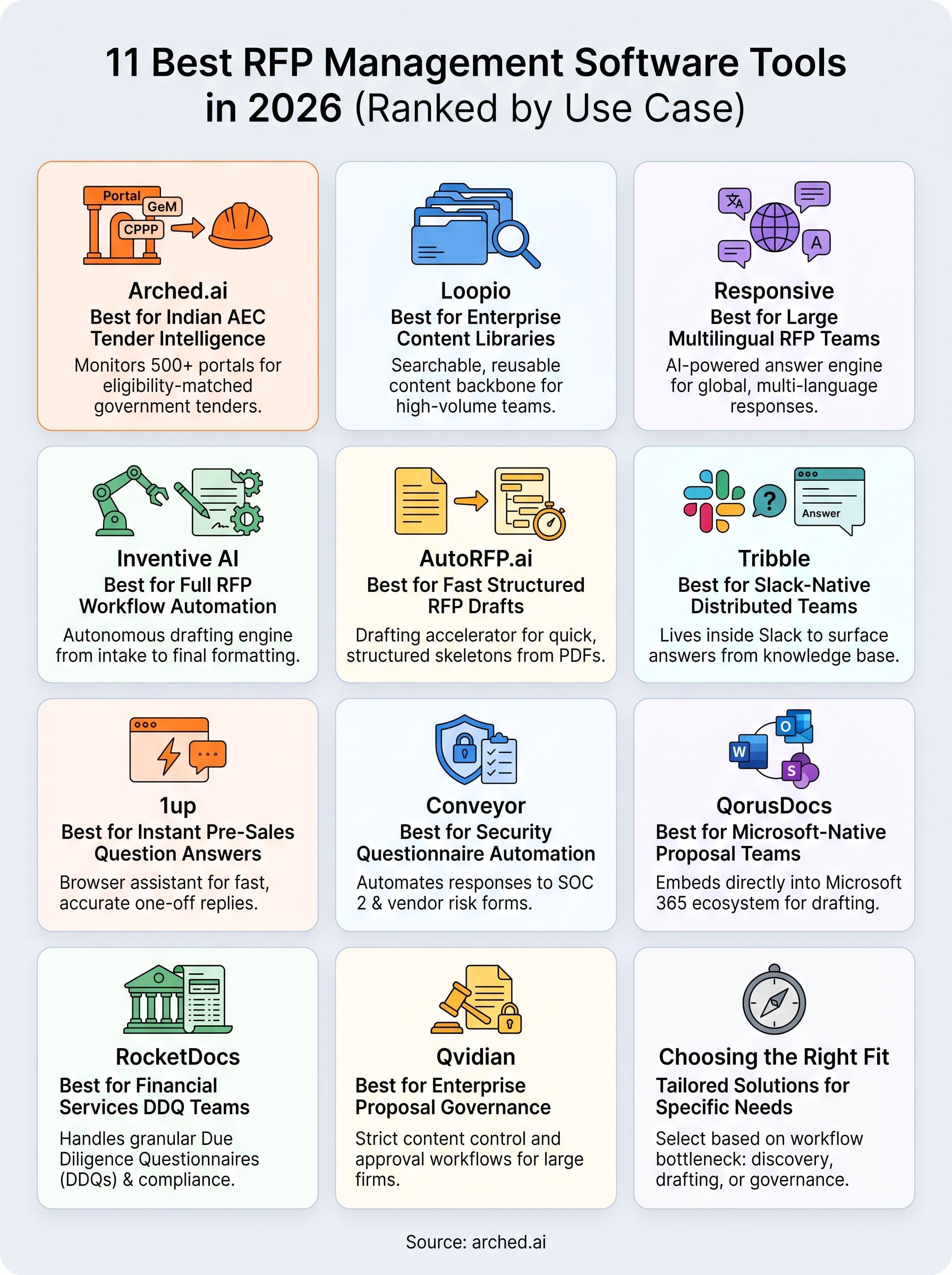
Choosing the right fit for your team
Most tools on this list solve a narrow problem well: content libraries, security questionnaires, DDQs, or Slack-based answers. That works fine if you already know which tenders you're chasing. Indian AEC firms rarely have that luxury. Your biggest cost isn't drafting, it's finding eligible tenders buried across 500+ portals before a competitor does, then reading a 200-page BOQ without missing a disqualifying clause.
That's the gap general-purpose RFP management software can't close. If your team would rather hand off the estimate and BOQ than add another tool, Arched prepares priced BOQs for contractors' tenders, reviewed by an engineer.
See how our estimating service works, or send us the project.
Have a package your team can’t get to? Send it to us. Our engineers check and sign off everything we deliver.