What Is a Request for Proposal (RFP)? Steps, Uses, Examples
Learn what is a request for proposal, key steps, and examples. Master the RFP process to win Indian infrastructure and government contracts.
Every government contract starts with a document most professionals encounter early in their careers but few truly master: the request for proposal (RFP). Whether you're bidding on a highway expansion through CPPP or competing for an urban infrastructure project on a state e-procurement portal, the RFP is the document that defines the rules of engagement between a procuring agency and the firms vying for the work.
An RFP does more than list what the government wants built. It lays out technical requirements, evaluation criteria, eligibility conditions, and submission deadlines, all packed into PDFs that can run dozens or even hundreds of pages. For infrastructure companies and contractors operating in India's public procurement space, understanding how RFPs work isn't optional. It's the difference between chasing every tender blindly and building a focused, winnable pipeline.
This guide breaks down what an RFP actually is, how it differs from related documents like RFQs and RFIs, the typical steps involved in issuing and responding to one, and real examples that ground the concept in practice. We'll also cover how platforms like Arched use AI to parse RFP documents automatically, extracting BOQs, flagging qualification gaps, and matching opportunities to your firm's credentials, so you spend less time reading and more time winning contracts.
Why RFPs matter in procurement and contracting
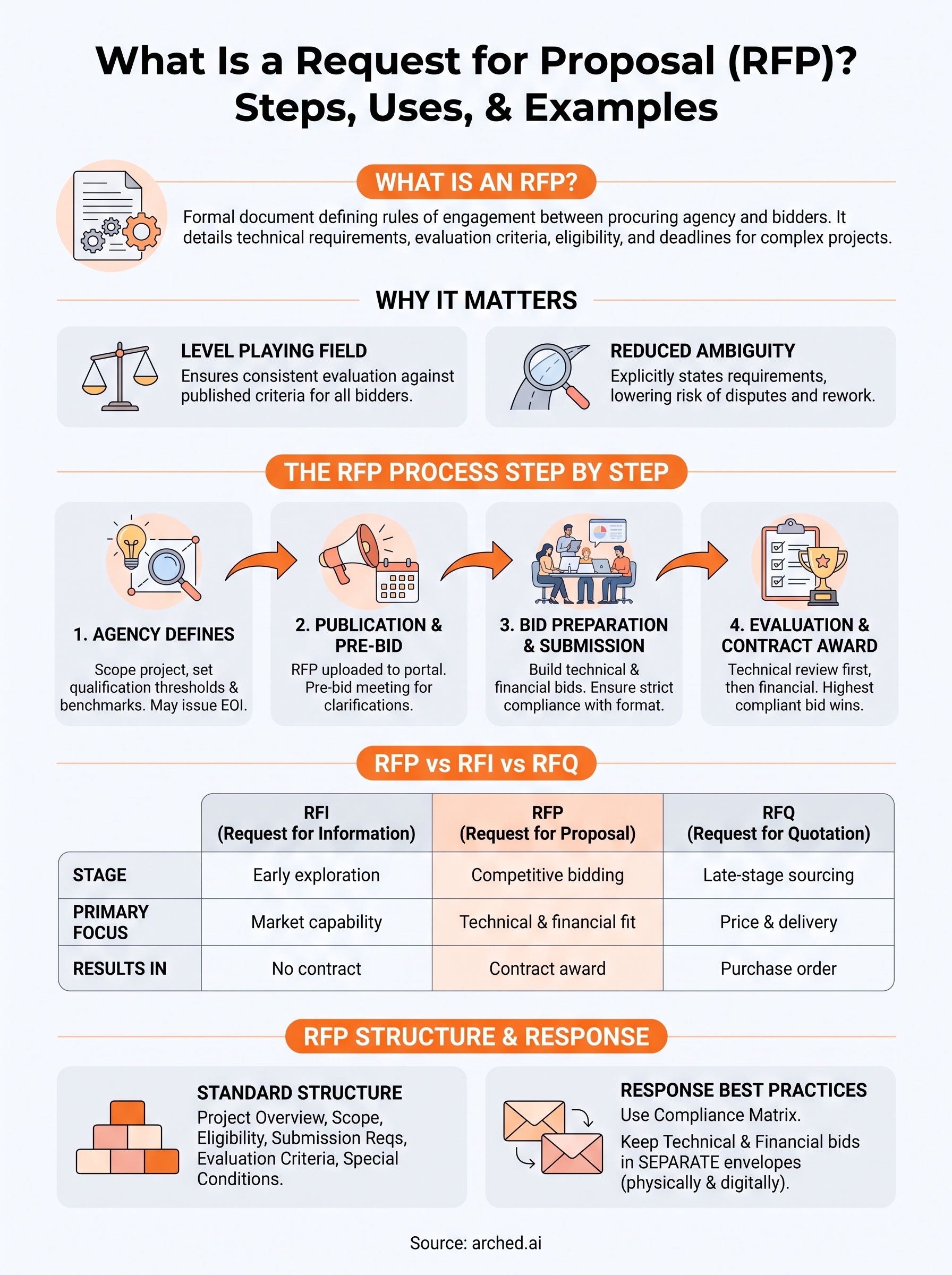
When you ask "what is a request for proposal," the answer goes beyond a simple definition. An RFP is the formal mechanism that governments and public agencies use to invite competitive bids for complex projects, and it carries significant weight in how contracts are ultimately awarded. In India's public procurement sector, where billions of rupees flow through infrastructure tenders every year, the RFP is the document that separates serious, qualified bidders from firms that submit paperwork and hope for the best.
RFPs create a level playing field
Government procurement agencies face a consistent challenge: they need to award contracts to the most capable firms without exposing themselves to favoritism or legal challenges. The RFP solves this by publishing identical requirements to all potential bidders, ensuring every firm evaluates the same technical criteria, deadlines, and scoring methodology. When a state road authority issues an RFP for a bridge rehabilitation project, every firm reading that document receives the same information at the same time.
This structure matters for your business because it means your bid is evaluated against a consistent benchmark, not against shifting goalposts. Agencies compare responses directly because all bidders answered the same questions and submitted documentation in the same format. For firms operating across multiple state portals and national platforms like GeM or CPPP, this consistency is what makes a disciplined response process worth building.
A well-structured RFP protects both the agency issuing it and the firms responding to it, because every evaluation decision has a documented basis that can withstand scrutiny.
RFPs reduce ambiguity in complex projects
Infrastructure projects involve hundreds of interdependent technical decisions. A road widening contract in Maharashtra might touch on environmental clearances, soil testing requirements, right-of-way acquisition timelines, and contractor qualification thresholds, all within a single document. Without an RFP that spells out each requirement explicitly, both agencies and bidders operate with incomplete information, and that gap produces costly disputes, rework, and contract amendments.
From your firm's perspective, the RFP is a risk management tool as much as it is a bidding document. When you read the qualification criteria and find your firm lacks a specific certification or doesn't meet the minimum turnover threshold, you know before you spend weeks preparing a submission. When the document clearly states the evaluation weightage between technical and financial scores, you can decide whether the project fits your competitive position. The RFP hands you the information you need to make a rational go-or-no-go decision without guesswork.
Firms that treat RFPs as strategic intelligence, rather than just paperwork to fill out, consistently build stronger pipelines. They learn which agencies favor certain project structures, which qualification criteria they repeatedly fall short on, and where their bid-to-win ratio is highest. Over time, that reading habit becomes one of the most valuable inputs into your business development strategy, giving you a clearer picture of where to invest pursuit effort and where to walk away early.
What an RFP includes and how to structure it
When you look closely at what is a request for proposal, the structure reveals as much as the content itself. Government agencies in India follow fairly consistent formatting conventions across platforms like CPPP and state e-procurement systems, which means once you understand the standard components of an RFP, you can navigate any tender document far more efficiently. Recognizing each section on first read also helps your team divide review responsibilities and avoid wasting time on documents your firm cannot realistically bid on.
Core components every RFP contains
Most RFPs in the Indian public infrastructure space include the same set of sections, regardless of which agency issues them or which portal hosts the document. Knowing what each section covers lets you build a faster internal review checklist and assign the right team member to assess each part.
- Project scope and objectives: Describes the work, location, and expected deliverables.
- Eligibility and qualification criteria: Lists minimum turnover, experience, certifications, and joint venture conditions.
- Technical requirements: Covers specifications, materials, methodologies, and compliance standards.
- Bill of Quantities (BOQ): Breaks down work into measurable items with estimated quantities.
- Evaluation criteria: States how technical and financial scores are weighted in the selection process.
- Submission requirements: Specifies format, deadline, and the portal through which you submit your bid.
- Special conditions and risk clauses: Flags unusual legal terms, liquidated damages, or project-specific obligations.
Reading the evaluation criteria section before any other part of the document tells you immediately whether a tender is worth pursuing.
How agencies structure the evaluation
Agencies split evaluation into two or three envelopes: technical, financial, and sometimes a pre-qualification stage. Your technical submission gets scored first, and only bids that clear the technical threshold move on to financial evaluation. This means a weak technical response eliminates your bid regardless of price, so your resource allocation between the two submissions matters considerably.
Firms that understand this envelope structure front-load their effort on eligibility documentation and technical compliance before touching the financial figures. That shift in sequencing alone reduces the wasted hours spent preparing cost sheets for bids that were never going to survive the technical stage.
The RFP process step by step
Understanding what is a request for proposal is only half the work. The process that surrounds an RFP has distinct stages, each with its own deadlines and decision points. Knowing where you sit in that sequence on any active tender helps your team allocate time and resources more precisely instead of scrambling at the last minute.
Step 1: Agency defines the requirement
Before any document goes public, the procuring agency works internally to scope the project and set qualification thresholds. This stage determines the minimum turnover requirements, experience credentials, and technical benchmarks that will eventually appear in the published RFP. Agencies often issue a pre-bid notification or Expression of Interest (EOI) at this point to gauge market interest and refine their requirements.
Step 2: Document publication and pre-bid meeting
Once the RFP is drafted and uploaded to the relevant portal, whether CPPP, GeM, or a state e-procurement system, the clock starts. Agencies typically schedule a pre-bid meeting or clarification window where firms can submit written questions about ambiguous requirements. Participating in this window is one of the most underused advantages available to bidders, because the official responses become part of the binding tender document.
Submit your clarification questions early in the pre-bid window so the agency has time to issue a formal response before the deadline closes.
Step 3: Bid preparation and submission
Your team now reads the full RFP, maps eligibility criteria against your credentials, and builds both the technical and financial submissions according to the specified format. Missing a mandatory document or submitting the wrong file format results in outright disqualification, so your internal compliance checklist should mirror the submission requirements section exactly.
Step 4: Evaluation and contract award
The agency reviews technical submissions first, scores them against the published criteria, and invites qualifying firms to open the financial envelope. The highest-scoring compliant bid wins the contract. Agencies publish award notices on the same portals where they issued the RFP, giving your team a record of competitor pricing and evaluation outcomes you can study for future bids.
RFP vs RFI vs RFQ and when to use each
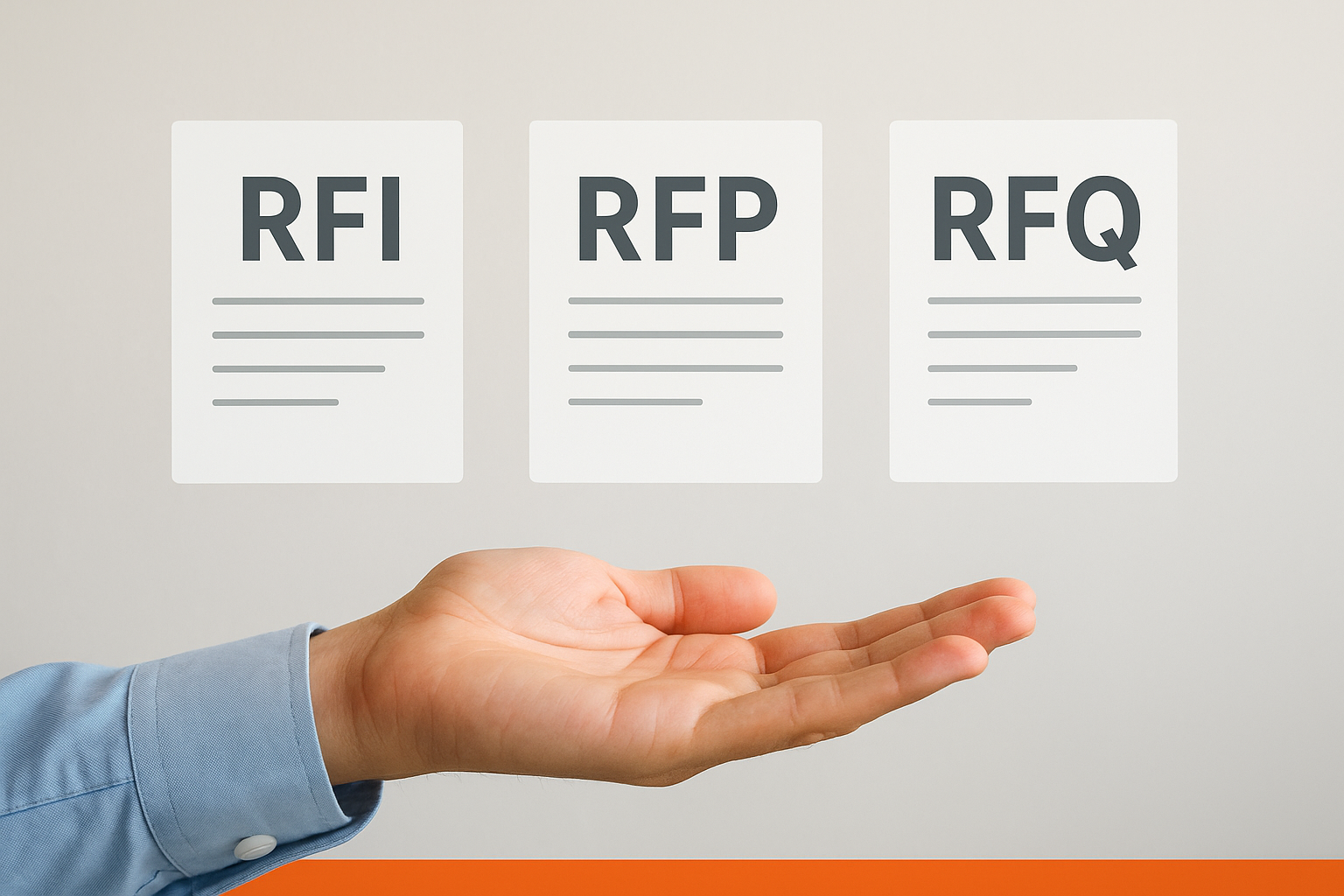
When you research what is a request for proposal, you quickly run into two related documents: the Request for Information (RFI) and the Request for Quotation (RFQ). All three trigger procurement activity, but they serve different purposes and appear at different stages of a project lifecycle. Using the wrong document at the wrong stage wastes your firm's time and signals to the agency that your team doesn't understand how the procurement process works.
What an RFI does
An RFI is a preliminary market survey, not a solicitation for bids. Agencies issue RFIs when they haven't fully scoped a project and want to understand what the market can deliver before committing to detailed requirements. Responding to an RFI doesn't bind your firm to anything, and it doesn't result in a contract award. What it does do is give you early visibility into an upcoming opportunity and a chance to shape the qualification criteria before the formal bidding document is drafted.
What an RFQ does
Price and delivery terms are the primary focus of an RFQ. Agencies use it when the scope is already well-defined and the main variable is cost. Unlike an RFP, an RFQ typically skips detailed technical evaluation entirely. If the product or service is standardized and easily compared across suppliers, an RFQ is the faster, simpler route. In Indian government procurement, RFQs appear frequently on the GeM portal for supply contracts involving goods with clear, fixed specifications.
Responding to an RFQ with a detailed technical narrative wastes everyone's time because agencies scoring RFQs look almost entirely at price and delivery schedules.
How to choose the right document
The stage of procurement and the complexity of the requirement determine which document fits the situation. Use the table below as a quick reference before deciding how much pursuit effort to invest:
| Document | Stage | Primary focus | Results in |
|---|---|---|---|
| RFI | Early exploration | Market capability | No contract |
| RFP | Competitive bidding | Technical and financial fit | Contract award |
| RFQ | Late-stage sourcing | Price and delivery | Purchase order |
Tracking tenders across multiple portals becomes more efficient once your team can immediately identify the document type and calibrate the response effort accordingly.
RFP examples and simple templates you can copy
When you understand what is a request for proposal in theory, seeing one in practice accelerates the learning curve considerably. The examples below reflect the structure and language that Indian government agencies commonly use across infrastructure tenders on platforms like CPPP and state e-procurement portals. Use these as working references when reviewing incoming tenders or building your own internal bid templates.
A standard infrastructure RFP structure
Most infrastructure RFPs your team encounters follow a predictable skeleton, even when the project type changes. Mapping that skeleton once lets you build a reusable review checklist that your bid team applies to every new document without starting from scratch.
Copying this structure into an internal template and filling it in as you read each new RFP cuts your initial document review time significantly.
Here is the core structure you can adapt:
- Section 1 - Project Overview: Name, location, procuring agency, estimated contract value, and completion timeline.
- Section 2 - Scope of Work: Detailed description of deliverables, site conditions, and technical standards.
- Section 3 - Eligibility Criteria: Minimum annual turnover, relevant project experience (value and type), and required certifications.
- Section 4 - Submission Requirements: Documents needed, file format, portal submission steps, and hard deadline.
- Section 5 - Evaluation Methodology: Technical score weightage, financial score weightage, and minimum qualifying thresholds.
- Section 6 - Special Conditions: Liquidated damages, performance security, and unusual contractual obligations.
What a real RFP response looks like
Your response to an infrastructure RFP typically mirrors the structure the agency published, because evaluators score submissions against each section in sequence. Start with a compliance matrix that maps every requirement from the tender document to the corresponding page in your submission. This matrix shows evaluators that your team read the document carefully and addressed every criterion rather than submitting a generic company profile.
Financial bids belong in a completely separate envelope from your technical submission, both physically and digitally. Mixing them together is grounds for disqualification on most Indian government portals, so your internal submission checklist should flag this as a hard stop before your team uploads anything.
Conclusion
Now that you understand what is a request for proposal and how each stage of the process works, the next step is applying that knowledge to your actual pipeline. Every RFP your team encounters carries eligibility criteria, evaluation weightage, and risk clauses that directly affect your probability of winning, and reading each one with a structured approach separates firms that build strong pipelines from those that chase every tender without a clear strategy.
Your ability to identify the right opportunities, parse complex documents quickly, and map your credentials against each requirement determines how efficiently your business development effort converts into actual contract wins. Arched automates the heaviest parts of that process, from document parsing and BOQ extraction to gap analysis and real-time portal monitoring across 500+ procurement portals. If you want to see how it works for your firm, explore the Arched platform and start building a more focused, data-driven bid strategy today.