Multilateral Tenders: How To Find And Bid On MDB Projects
Every year, organizations like the World Bank, the Asian Development Bank, and the African Development Bank pour billions of dollars into infrastructure projects across developing nations, and India consistently ranks among the top recipients. Multilateral tenders funded by these Multilateral Development Banks (MDBs) represent some of the highest-value, most stable contract opportunities available to AEC firms. Yet most Indian contractors never bid on them, either because they don't know where to find them or because the procurement processes feel unfamiliar compared to standard GeM or CPPP workflows.
That's a costly blind spot. MDB-funded projects often come with transparent evaluation criteria, reliable payment timelines, and contract values that can dwarf typical state-level tenders. The catch? These opportunities are scattered across multiple international portals, each with its own documentation standards, eligibility frameworks, and submission protocols. For a BD team already stretched thin across domestic tenders, taking on multilateral bids as well feels like a second full-time job, especially when each one needs a detailed, defensible estimate.
This guide breaks down what multilateral tenders actually are, where to find active MDB-funded opportunities, and how to structure a winning bid. Whether you're a mid-size contractor looking to break into World Bank projects or an established firm expanding into new multilateral pipelines, you'll walk away with a clear, actionable process for identifying and competing for these contracts.
What counts as a multilateral tender
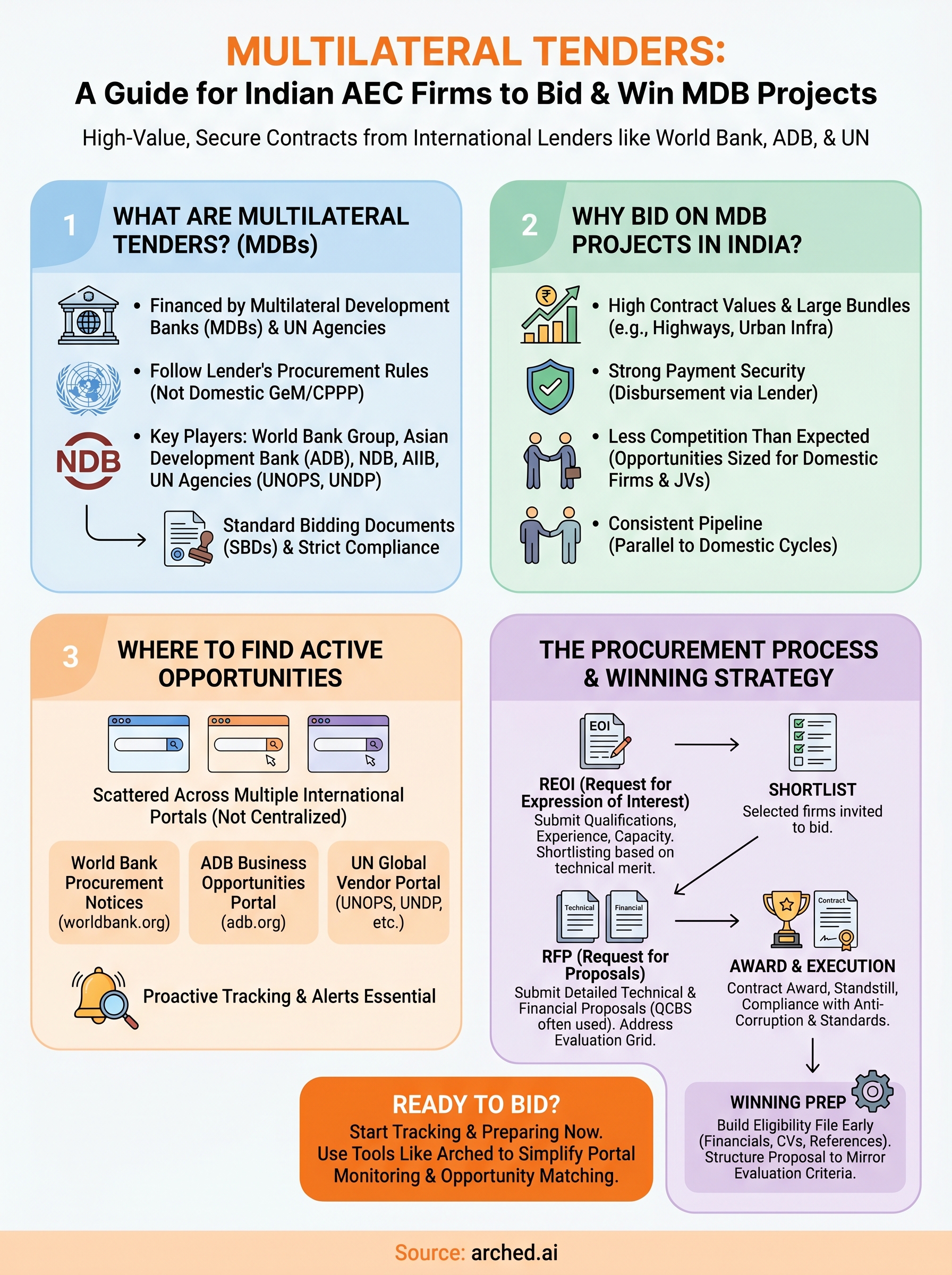
A multilateral tender is a procurement opportunity issued for a project financed or co-financed by a multilateral organization, such as a Multilateral Development Bank or a United Nations agency. The key distinction is the funding source: the money comes from a pooled international fund, not a single government's national budget. That means the procurement rules follow the lending institution's guidelines, not the standard domestic frameworks you'd find on GeM or CPPP.
The core funding structure
When a multilateral organization like the World Bank or the Asian Development Bank approves a loan or grant for an infrastructure project in India, it attaches strict procurement conditions to that funding. The borrower, usually a government ministry or state agency, must follow the lender's procurement procedures when hiring contractors, consultants, or suppliers. This setup ensures competitive bidding happens in a standardized, auditable way and protects the integrity of how funds are disbursed.
The procurement rules are set by the lender, not the implementing agency, which is why identifying the funding source matters before you read a single line of the bidding document.
Who issues multilateral tenders
Several categories of organizations fund these contracts, and each operates under its own procurement framework. The major players active in the Indian market include:
- Multilateral Development Banks (MDBs): The World Bank Group (IBRD and IDA), the Asian Development Bank (ADB), the New Development Bank (NDB), and the Asian Infrastructure Investment Bank (AIIB).
- United Nations agencies: UNDP, UNICEF, UNOPS, and UN-Habitat issue tenders covering urban development, public health infrastructure, and capacity-building programs.
- Multilateral climate funds: The Green Climate Fund (GCF) and the Global Environment Facility (GEF) finance climate-related infrastructure and environmental projects.
The implementing agency on the ground, whether it's NHAI, a state PWD, or a municipal body, issues the actual bidding documents. But the eligibility criteria, evaluation methodology, and contract conditions all reflect the financing institution's standards, not the domestic agency's preferences.
What separates multilateral from domestic procurement
Domestic tenders follow national or state-level rules. Multilateral tenders operate under a different legal and procedural framework entirely. The Standard Bidding Documents (SBDs) used in MDB-funded projects come directly from the lending institution and include clauses on anti-corruption, conflict of interest, and debarment that you won't find in a typical e-tender notice. Firms debarred by one MDB are frequently cross-debarred by others, which means maintaining compliance is non-negotiable from the moment you express interest in any of these opportunities.
Why multilateral tenders matter in India
India sits at the center of multilateral development finance in Asia. The World Bank holds an active India portfolio exceeding $20 billion, spread across transport, urban development, water, and energy sectors. The ADB has committed several billion dollars to road, metro, and irrigation projects across multiple states over the past decade. For AEC firms seeking high-value, stable contract pipelines, this investment scale is significant. These multilateral tenders run parallel to domestic procurement cycles throughout the year, meaning new work enters the market consistently regardless of seasonal fluctuations in state-level budgets.
Contract values and payment reliability
MDB-funded contracts tend to be significantly larger than comparable state-level tenders. A single World Bank-financed highway package can run into hundreds of crores, often structured as large bundles to attract technically capable contractors rather than only the lowest-cost bidders. Beyond the size, payment security is notably stronger in MDB-funded projects because the disbursement mechanism runs through the lending institution's oversight framework, materially reducing the risk of delayed payments that routinely affect domestic government infrastructure contracts.
For firms that have dealt with payment delays on state-level work, the structured disbursement model of MDB-funded projects is a material financial advantage worth pursuing.
Less competition than you expect
Most mid-size Indian contractors assume multilateral procurement is reserved for large multinational firms or Tier-1 companies. That assumption is widely held but factually outdated. In practice, many MDB-funded packages are explicitly sized for domestic contractors, and joint venture structures let smaller firms pool credentials to meet qualification thresholds.
The pool of firms actively tracking and bidding these opportunities remains far smaller than the domestic tender space, which means your probability of shortlisting improves considerably once you understand the process. Building this capability now positions your firm ahead of competitors who have not yet entered this channel.
Where to find live MDB and UN opportunities
Finding multilateral tenders requires knowing which portals each institution uses to publish active opportunities. Unlike domestic procurement, which centralizes listings on GeM and CPPP, MDB and UN opportunities scatter across separate, institution-specific platforms. Knowing where to look before a deadline appears is what separates firms that bid consistently from those that discover opportunities after the submission window closes.
World Bank and ADB portals
The World Bank's primary procurement portal is the Procurement Notices section within its Projects & Operations database at worldbank.org. Every project financed by IBRD or IDA lists procurement notices there, including Expressions of Interest, Requests for Proposals, and contract award notices. The ADB runs a parallel system through its Business Opportunities portal, where you can filter by country, sector, and procurement type to surface active packages in India.

AIIB and NDB are newer institutions with smaller but growing pipelines in India. Both publish contract notices on their official websites, and India-focused infrastructure packages from these lenders are increasing steadily as both banks scale their lending activity across the region.
Set up saved searches or email alerts on each portal using India as the country filter, because new notices can go live and close within 30 to 45 days.
UN agency procurement platforms
UNOPS runs its Global Vendor Portal where suppliers and contractors can register and access active solicitations directly. UNDP publishes opportunities through its Procurement Notices page, which lists tenders by country and sector. For firms focused on urban development or public health infrastructure, UNICEF and UN-Habitat also post contractor solicitations through their own procurement pages. Checking these platforms regularly alongside MDB portals gives your BD team full visibility into the complete range of multilateral opportunities available in India.
How MDB procurement works from REOI to award
MDB procurement for multilateral tenders follows a defined sequence of stages that differ meaningfully from the single-stage e-tendering process you're used to on domestic portals. Understanding this sequence upfront lets you plan your resource investment at each phase rather than scrambling to respond at the last minute.
From REOI to shortlist
Most MDB-funded consulting and larger civil works packages begin with a Request for Expression of Interest (REOI). At this stage, the implementing agency is not asking for a price. They're asking whether your firm is technically qualified and interested. You submit a short document covering your firm's relevant experience, key staff credentials, and organizational capacity. The agency then evaluates submissions against the minimum qualification criteria and produces a shortlist, typically six firms for consulting assignments, of candidates invited to the next stage.
Treating the REOI as a formality is a common mistake. A weak EOI eliminates your firm before you ever see the full bidding documents.
From RFP to contract award
Once shortlisted, you receive the Request for Proposals (RFP), which contains the full Terms of Reference or technical specifications, the evaluation methodology, and the contract conditions. For consulting assignments, MDBs use a Quality and Cost-Based Selection (QCBS) framework where your technical score carries more weight than price. Civil works packages follow a standard competitive bidding process where the lowest evaluated responsive bid typically wins.
After technical and financial evaluation, the implementing agency notifies the selected firm, publishes a contract award notice on the MDB portal, and opens a standstill period during which unsuccessful bidders can request a debriefing. Signing the contract triggers the formal commencement timeline, and you must comply with the lender's anti-corruption and reporting requirements throughout execution.
How to prepare a compliant winning bid
Winning multilateral tenders requires more than technical capability. MDB procurement committees evaluate submissions against a formal checklist, and a single missing document or non-conforming format is enough to get your bid declared non-responsive before evaluators read a word of your technical content. Preparation has to happen before the RFP lands in your inbox, not after.
Build your eligibility file before you need it
Your eligibility file is a living document package that you update continuously rather than assemble under deadline pressure. It should contain audited financial statements for the past three to five years, a formatted list of similar completed contracts with contract values, client contact details, and completion certificates, plus CVs for your key personnel formatted to the MDB's standard template. Most MDBs publish sample CV and project reference formats on their procurement portals, and using those exact formats from the start saves significant revision time.
Firms that maintain a ready eligibility file can respond to an REOI in two to three days; firms that don't often miss the window entirely.
Structure your technical proposal for the evaluation grid
Every RFP includes an evaluation methodology table that assigns specific point values to methodology, team composition, work plan, and understanding of the assignment. Read that table first, then structure your proposal to directly mirror each scoring criterion. Evaluators work through the grid in sequence, so a proposal that addresses every criterion in order consistently outscores one that buries key information in narrative paragraphs.
For civil works packages, your bid must also confirm compliance with environmental and social standards required by the lending institution. The World Bank's Environmental and Social Framework and the ADB's Safeguard Policy Statement both impose contractor obligations that you need to acknowledge explicitly in your submission to avoid disqualification on procedural grounds.
Next steps
Multilateral tenders offer Indian AEC firms a legitimate path to larger contracts, more reliable payments, and less crowded competition, but only if your BD process can actually track and respond to them consistently. Most firms lose these opportunities not because they lack the credentials, but because they discover the tender after the submission window has already closed.
Start by registering on the World Bank, ADB, and UNOPS portals this week and setting up country-filtered alerts. Then build your eligibility file so you can respond to an REOI within days, not weeks. If your team is already stretched monitoring domestic portals on GeM and CPPP, adding multilateral procurement manually will strain your capacity faster than you expect.
That's where Arched can help. For multilateral and domestic bids alike, send us the project and we deliver a detailed, engineer-reviewed estimate and BOQ on your deadline. See how our estimating service works.
Have a package your team can’t get to? Send it to us. Our engineers check and sign off everything we deliver.