Construction Arbitration in India: Process, Law & Key Steps
Every large infrastructure contract eventually runs into a disagreement, whether it's a delayed payment, a disputed BOQ variation, or a claim over site conditions. Construction arbitration in india is how most of these disputes get resolved, since almost every government contract now carries an arbitration clause instead of sending parties to civil court. If you're a contractor, consultant, or BD manager staring down a notice invoking arbitration, you need to know what happens next and why.
This article walks through exactly that. We cover the legal framework under the Arbitration and Conciliation Act, 1996, how tribunals get constituted, what the process looks like from notice to award, and the practical issues that trip up contractors, like limitation periods, interim relief, and enforcement against government departments. You'll also see where the 2015 and 2019 amendments changed timelines and arbitrator appointments.
We wrote this because disputes rarely start at the arbitration stage. They start with a clause buried in the tender document that nobody flagged during bidding. Understanding the arbitration process now helps you read those clauses differently before you sign, and negotiate better terms when you still can.
Why construction arbitration matters for Indian contractors
Government contracts in India rarely leave room for civil litigation. Nearly every tender floated by the Central Public Works Department, National Highways Authority of India, state PWDs, or irrigation departments carries a mandatory arbitration clause, usually buried in the general conditions of contract. That single clause determines how you'll fight for your money if a dispute erupts over a delayed handover, a rejected variation claim, or a disputed measurement in the BOQ. If you don't understand what that clause commits you to, you're negotiating blind, and you'll only discover the consequences when a payment gets withheld and you're told to invoke arbitration instead of filing a suit.
The financial stakes are larger than most contractors expect
Construction disputes in India aren't small change. A single road-widening or irrigation contract can carry claims running into tens of crores once you add up escalation, idle machinery costs, and interest on delayed payments. Arbitration awards in infrastructure disputes routinely exceed the original contract value once claims and counterclaims are netted out. For a mid-sized contractor, an unresolved dispute can freeze working capital for years, since banks and sureties often treat pending arbitration as a red flag when renewing bank guarantees or extending credit lines.
A contractor who doesn't understand the arbitration clause before signing is negotiating the outcome of a future dispute without knowing the rules.
Civil courts aren't a realistic backup plan
Courts in India take years, sometimes over a decade, to resolve commercial disputes through trial. Arbitration was written into the Arbitration and Conciliation Act, 1996 specifically to give commercial parties, including government departments, a faster and more technically informed route. Tribunals made up of engineers, retired judges, or subject-matter experts can evaluate a disputed BOQ variation far more efficiently than a civil judge handling a general docket. Section 8 of the Act also lets a party push a case out of civil court and into arbitration if a valid clause exists, so trying to sue a government department directly when your contract mandates arbitration usually just wastes time and legal fees.
Reputation and future bidding eligibility ride on how disputes get handled
How you handle a dispute affects more than the immediate claim. Government departments track litigation and arbitration history against contractors, and some tenders ask bidders to disclose pending disputes above a certain value. A contractor seen as combative or one who loses arbitrations repeatedly can face quiet blacklisting or extra scrutiny during technical evaluation on future bids. On the flip side, contractors who use arbitration correctly, documenting claims properly and settling where it makes sense, tend to preserve working relationships with departments they'll bid against again next year.
What's typically at stake in a construction dispute
The range of issues that end up in arbitration is fairly consistent across Indian infrastructure projects:
- Payment delays for certified work, including retention money released late or not at all
- Variation and escalation claims where the department disputes the rate or quantity
- Extension of time claims tied to force majeure events, land handover delays, or design changes
- Termination disputes, where either party alleges breach and claims damages
- Quality and defect claims, usually raised by the employer during the defect liability period
Why understanding this now beats reacting later
Contractors who wait until a notice invoking arbitration lands on their desk are already behind. The clause dictating your seat, the number of arbitrators, and the applicable rules was fixed the day you signed the contract, often without any real negotiation because government tenders rarely allow changes to standard conditions. Knowing how construction arbitration in India actually plays out, from tribunal constitution through award enforcement, means you can flag risky clauses during the bidding stage, price disputes into your bid where needed, and build a paper trail of correspondence and site records from day one instead of scrambling to reconstruct it after a claim gets contested. That preparation is often the difference between an award that gets paid within months and one that drags through a Section 34 challenge for years.
How the construction arbitration process works step by step
Once a dispute crosses the point where site meetings and letters stop working, the process follows a fairly fixed sequence. Knowing each stage in advance helps you avoid the two biggest mistakes contractors make: missing a limitation deadline, or walking into the first tribunal hearing without your documentary evidence organized.
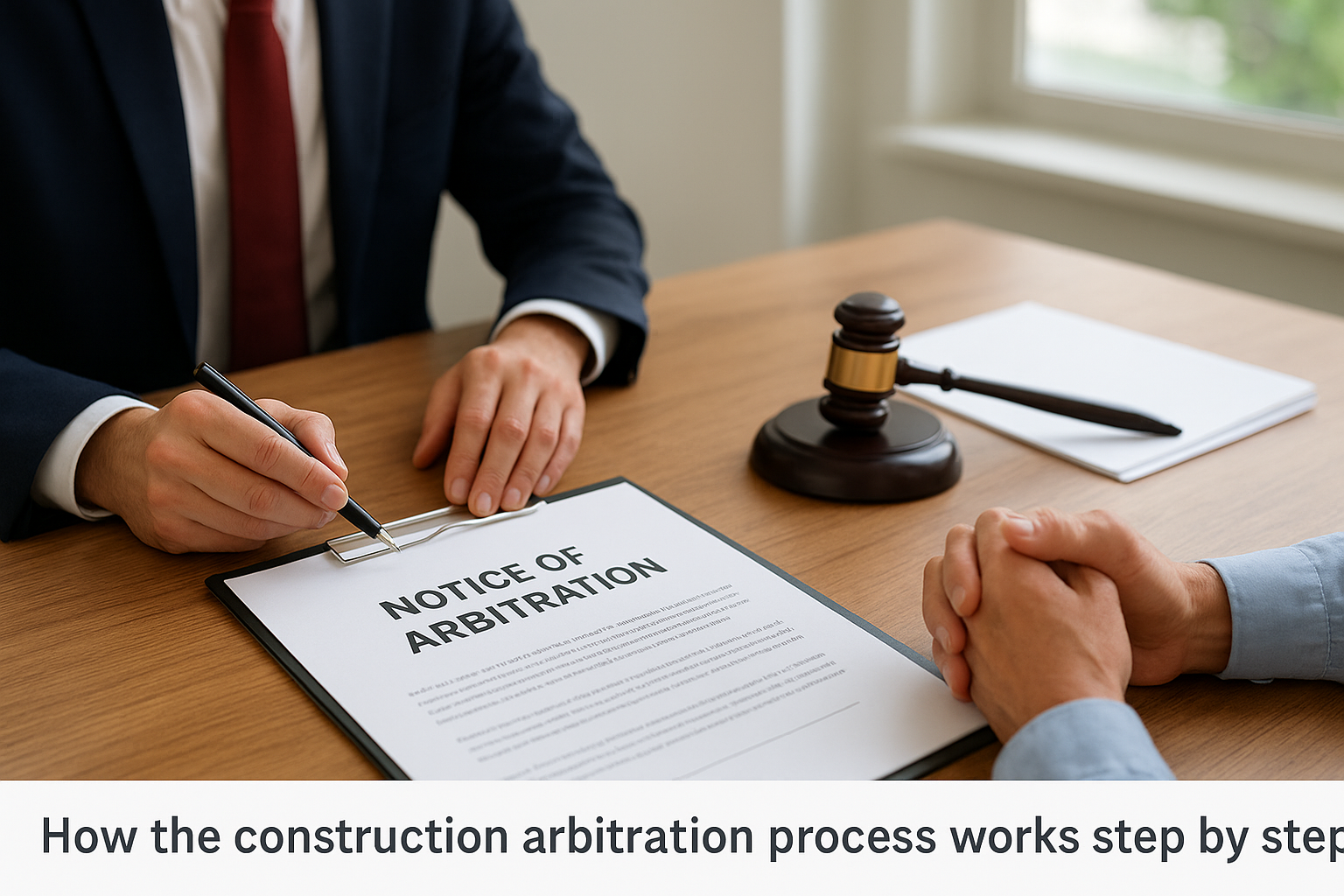
Notice invoking arbitration
Everything starts with a written notice under Section 21 of the Arbitration and Conciliation Act, 1996. This notice sets out the disputes, the relief you're claiming, and a request to appoint an arbitrator. The date of this notice matters more than most contractors realize, since it fixes the start of arbitration proceedings for limitation purposes and triggers the timeline for the other side to respond or nominate their arbitrator, usually within 30 days as specified in the contract's arbitration clause.
Constituting the tribunal
Government contracts typically specify either a sole arbitrator or a three-member panel, often with one arbitrator nominated by each party and a presiding arbitrator agreed jointly. If the other side drags its feet on appointment, Section 11 lets you approach the High Court or Supreme Court to get an arbitrator appointed. Courts have gotten stricter here since the 2015 amendment, and appointments now move faster than they used to.
Pleadings and document exchange
After the tribunal forms, both sides file a statement of claim and statement of defense, followed by a rejoinder if needed. This stage is where your project records earn their keep. A well-documented claim includes:
- Correspondence showing delay causes and who caused them
- Measurement books and BOQ records supporting variation claims
- Site diaries and progress photographs
- Bank guarantee and payment certificates
- Expert reports on quantum, where claims involve technical calculations
Hearings and evidence
The tribunal then holds hearings for evidence and cross-examination, similar to a court trial but usually faster and less formal. Witnesses, including your project engineers or site managers, get examined on affidavits filed earlier. Technical arbitrators, often retired engineers, tend to ask sharper questions about BOQ discrepancies than a generalist judge would, so prepare your witnesses accordingly.
The strength of your arbitration claim is decided long before the hearing, by whether your site records can actually prove what happened.
Award and post-award steps
Under Section 29A, the tribunal must render its award within 12 months of completing pleadings, extendable by 6 months with party consent, and beyond that only with court permission. The award is binding once issued, but either side can still challenge it under Section 34 within 90 days if there are grounds like patent illegality or a breach of public policy. If no challenge succeeds, the award moves to execution under the Code of Civil Procedure, which is where enforcement against a government department can still take time even after you've won.
| Stage | Typical Duration |
|---|---|
| Notice to tribunal constitution | 30 to 90 days |
| Pleadings and document exchange | 2 to 4 months |
| Hearings and evidence | 4 to 8 months |
| Award (statutory cap) | 12 to 18 months from pleadings closing |
| Section 34 challenge, if filed | 1 to 3 years |
Key laws governing construction arbitration in India
Construction arbitration in India runs on a handful of statutes, and knowing which one governs which situation saves you from citing the wrong provision when you're arguing before a tribunal or a court. The Arbitration and Conciliation Act, 1996 is the backbone, but it doesn't operate in isolation. Contract law, procedural codes, and sector-specific rules all shape how a dispute actually plays out once you invoke the clause.
The Arbitration and Conciliation Act, 1996
This is the primary statute, modeled on the UNCITRAL framework, and it covers everything from appointing arbitrators to challenging and enforcing awards. Section 7 defines what counts as a valid arbitration agreement, Section 11 governs appointment when parties can't agree, Section 17 lets the tribunal itself grant interim relief, and Section 34 sets out the narrow grounds for challenging an award. The 2015 amendment introduced strict timelines and limited judicial interference at the referral stage, while the 2019 amendment pushed for institutional arbitration and tried to speed up appointments further. You can read the full text of the Act on the India Code portal, maintained by the Ministry of Law and Justice.
Every construction arbitration in India traces back to this one Act, so misreading a section here usually means losing an argument later.
The Indian Contract Act, 1872
Arbitration doesn't exist in a vacuum. Whether a variation claim, a termination, or a liquidated damages clause is even valid depends on basic contract principles from the Indian Contract Act, 1872. Tribunals routinely fall back on Sections 73 and 74 of this Act when calculating damages for breach, especially in extension-of-time and compensation claims where the arbitration clause itself is silent on quantum.
The Code of Civil Procedure, 1908
Once an award survives challenge, enforcement follows the Code of Civil Procedure. Sections 36 of the Arbitration Act direct you here for execution, and government departments are notoriously slow to release payment even after losing, so knowing the execution provisions in the CPC matters as much as knowing arbitration law itself.
Sector-specific frameworks and standard contract conditions
Beyond the core statutes, most disputes are actually shaped by the general conditions of contract issued by bodies like CPWD, NHAI, or state PWDs. These documents fix your seat of arbitration, the number of arbitrators, and sometimes even pre-arbitral steps like conciliation or a dispute review board. A few things worth checking in any government contract before you sign:
- Whether the clause mandates a sole government-appointed arbitrator or a panel with party nominees
- What pre-arbitral steps, like a Dispute Resolution Board, are mandatory before invoking arbitration
- Whether the seat is fixed at the department's headquarters, which affects which High Court has jurisdiction
- Any clause capping interest on delayed payments or excluding certain claims from arbitration entirely
These clauses often get less attention than the technical bid documents, but they decide the legal terrain you'll be fighting on if a dispute actually arises.
Common causes of construction disputes in India
Most construction disputes in India trace back to a handful of recurring triggers, and if you've handled more than a couple of government contracts, you've probably seen each of these play out already. Recognizing the pattern early lets you build your paper trail before the dispute even starts, instead of scrambling for evidence after a notice invoking arbitration lands on your desk.
Payment delays and disputed certifications
Delayed payment against certified bills is by far the most common trigger for construction arbitration in India. Departments often certify work but release payment months later, citing budget cycles or internal approvals, and retention money frequently gets held back well past the defect liability period. Escalation claims tied to steel, cement, or bitumen price rises also get disputed constantly, since the department's engineer and your billing team rarely agree on the index or formula to apply.
Payment disputes rarely start as legal fights, they start as unanswered emails that pile up until someone finally invokes arbitration.
Site conditions and scope changes
Ground conditions on Indian infrastructure sites almost never match the tender drawings exactly. Unexpected rock strata, utility shifting, or delayed land acquisition force variation orders, and disagreements over the rate for that extra work generate a steady stream of claims. Design changes issued mid-project by the client's engineer create similar friction, especially when the BOQ has no clear rate for the revised item and both sides end up negotiating a new rate under duress.
Extension of time and delay attribution
When a project runs late, the fight over who caused the delay becomes its own dispute, separate from the money involved. Contractors claim extension of time for force majeure events, late handover of land, or utility shifting delays outside their control, while departments often push back and try to attribute the same delay to slow mobilization or resourcing failures on the contractor's side. This is where daily site diaries and progress photographs matter most, since tribunals weigh contemporaneous records far more heavily than reconstructed timelines submitted after the fact.
Quality, defects, and termination disputes
Quality disputes usually surface during the defect liability period, when the employer flags cracks, seepage, or material deviations and either withholds the retention money or invokes the performance bank guarantee. Termination disputes sit at the more severe end of the spectrum, arising when either party alleges breach serious enough to end the contract, and these almost always carry the largest claim values because they combine unpaid work, mobilization losses, and reputational damage in a single dispute.
| Dispute type | Typical trigger |
|---|---|
| Payment delay | Certified bills unpaid, retention withheld |
| Escalation claim | Disputed price index or formula application |
| Variation dispute | Unrated extra work, changed site conditions |
| Extension of time | Land handover delay, force majeure, utility shifting |
| Quality/defect claim | Defects flagged during defect liability period |
| Termination dispute | Alleged breach by either party, contract foreclosed |
Knowing which category your dispute falls into shapes the evidence you'll need and, often, whether settlement talks are even realistic before you commit to a full arbitration.
Choosing arbitrators, seat, and institutional rules
Most contractors treat the arbitrator-appointment clause as boilerplate until a dispute actually arises, and by then it's too late to change anything. The choices baked into your contract, who picks the arbitrator, where the arbitration is seated, and whether institutional rules apply, decide how fast your case moves and how much it costs before a single hearing happens. Reading these clauses at the bidding stage, not after a notice invoking arbitration lands, is what separates contractors who manage disputes from those who get managed by them.

Picking the right arbitrator matters more than picking a fast one
Government contracts often nominate a serving or retired government engineer as sole arbitrator, a practice courts have scrutinized closely after the 2015 amendment introduced stricter independence requirements under the Fifth and Seventh Schedules of the Act. If your contract still allows a panel with party nominees, push for arbitrators with actual construction or engineering background rather than a generalist lawyer, since technical arbitrators read a disputed BOQ variation far faster than someone unfamiliar with measurement books and rate analysis. Retired High Court judges bring credibility on legal questions like limitation or public policy, but pairing at least one engineer-arbitrator on a three-member tribunal usually produces sharper questioning on quantum.
The arbitrator you get is only as good as the independence and technical grounding your contract clause allows for.
Seat versus venue changes which court can touch your award
The seat of arbitration fixes which High Court has supervisory jurisdiction over Section 9 interim relief and Section 34 challenges, and it's rarely negotiable in government contracts since departments almost always fix the seat at their headquarters. Venue, by contrast, is just where hearings physically happen and can shift for convenience without affecting jurisdiction. Confusing the two costs contractors real money, since filing a challenge in the wrong High Court means starting the limitation clock over while the correct court gets sorted out.
Institutional rules bring structure that ad hoc arbitration often lacks
Ad hoc arbitration, where parties and the tribunal set their own procedural timetable, is still the default in most Indian government contracts. Institutional arbitration under bodies like the Mumbai Centre for International Arbitration or the Delhi International Arbitration Centre brings fixed fee schedules, administrative support for appointments, and procedural rules that reduce the back-and-forth over scheduling and document formats. The 2019 amendment pushed hard for institutional arbitration specifically to cut down on the delays ad hoc proceedings tend to accumulate.
| Factor | Ad hoc arbitration | Institutional arbitration |
|---|---|---|
| Appointment process | Parties negotiate directly, court intervenes if stuck | Institution appoints from a panel |
| Fee structure | Negotiated per arbitrator, can escalate | Fixed schedule, more predictable |
| Procedural rules | Set by tribunal and parties as they go | Pre-defined institutional rules |
| Common in | Most government contracts currently | Growing in larger infrastructure deals |
Contractors bidding on larger contracts should flag during pre-bid queries whether institutional rules can be adopted, since it's one of the few arbitration terms departments sometimes remain open to discussing before the contract gets signed.
Costs, timelines, and recent reforms to watch
Money and time are the two things every contractor worries about most once arbitration starts, and neither behaves quite the way the statute promises. Arbitration costs in construction disputes can run into lakhs before a single hearing concludes, and delays beyond the statutory caps happen more often than the Act's drafters probably intended. Budgeting for both realistically, rather than assuming a quick and cheap resolution, keeps a dispute from draining working capital you still need for active projects.
Arbitrator fees and administrative costs
Fee structures vary sharply depending on whether your contract uses a sole arbitrator, a three-member panel, or an institution. The Fourth Schedule of the Arbitration and Conciliation Act, 1996 sets a recommended fee scale based on claim value, though many government contracts still let a nominated arbitrator charge outside that scale entirely. Costs worth planning for include:
- Arbitrator fees, charged per sitting or as a fixed percentage of claim value
- Venue and administrative charges, especially for multi-day hearings
- Legal fees, which often exceed arbitrator fees on high-value claims
- Expert witness costs, common in quantum-heavy variation and delay claims
Going with a three-member tribunal roughly multiplies most of these costs threefold, which is why smaller contractors sometimes push for a sole arbitrator clause during pre-bid negotiations wherever the department leaves that door open.
Timelines: statutory caps versus reality
Section 29A caps the award timeline at 12 months from completion of pleadings, extendable by 6 months with party consent and beyond that only with court approval, but government-related disputes routinely blow past this once appointment delays and adjournments enter the picture. Filing a Section 34 challenge, when either side pursues one, can tack on another one to three years before the award actually gets enforced and paid.
A cheap, fast arbitration on paper can still turn into an expensive, multi-year fight once appeals and enforcement enter the picture.
Recent reforms shaping the process
Reforms since 2015 have consistently chased one goal: closing the gap between the Act's promised timelines and what actually happens on the ground. The 2019 amendment created the Arbitration Council of India to accredit institutions and arbitrators, though its rollout has moved slowly compared to what the amendment envisioned. Proposals under discussion have floated ideas like emergency arbitrator provisions and tighter court deadlines for disposing of Section 34 challenges, though none of this has been notified into law yet. Watching these developments matters because a change to appointment or challenge procedures can shift your strategy on an ongoing dispute overnight, particularly around which High Court retains supervisory jurisdiction over your seat. For official updates, the Ministry of Law and Justice periodically publishes consultation papers on its website.
Practical tips for stronger arbitration outcomes
Winning an arbitration in India usually comes down to preparation that started months, sometimes years, before the notice went out. Contractors who fare best treat every project as a potential dispute from day one, not just after a claim gets rejected. The tips below reflect what actually moves the needle in front of a tribunal, not generic advice about hiring good lawyers.
Document everything as if you're already in a dispute
Site records win or lose claims more often than legal arguments do. Contemporaneous documentation carries far more weight with tribunals than reconstructed timelines built after a notice invoking arbitration lands, since arbitrators, especially engineer-arbitrators, know exactly how paperwork gets manufactured after the fact. Build a habit around these records from mobilization onward:
- Daily site diaries signed by both your engineer and the department's representative
- Photographs and videos timestamped against progress milestones
- Written correspondence for every delay, variation, or instruction, even informal ones
- Measurement book entries cross-checked against your own billing records
A claim is only as strong as the paper trail sitting behind it, and that trail has to start on day one, not after the dispute begins.
Respond to notices and deadlines without delay
Limitation periods under the Arbitration and Conciliation Act, 1996 don't bend for contractors who were busy on-site. Missing a response deadline to a Section 21 notice, or sitting on your hands while the other side nominates an arbitrator, can cost you procedural ground you never recover. Calendar every deadline the moment a notice arrives, and treat the 30-day nomination window as non-negotiable.
Weigh settlement before committing to a full hearing
Not every dispute needs a tribunal to resolve it. Conciliation or negotiated settlement, sometimes through a Dispute Resolution Board written into the contract, can close out a claim faster and cheaper than months of hearings. Settlement discussions work best when you've already built your evidence file, since a department negotiates more seriously with a contractor holding a documented, well-quantified claim than one making vague demands.
Get quantum right before you file
Tribunals reject or discount claims constantly because the quantum calculation doesn't hold up under cross-examination. Expert reports on quantum, particularly for escalation, idle machinery, or extension-of-time claims, need to trace back to verifiable formulas and contract clauses, not estimates pulled together at the last minute. Bringing in a quantity surveyor or claims consultant early, rather than right before pleadings close, usually produces a number that survives scrutiny.
Choose your legal and technical team deliberately
A lawyer unfamiliar with construction contracts will miss issues a specialist catches immediately, and the reverse is true too. Pair legal counsel with someone who understands BOQ structure, rate analysis, and site sequencing, since tribunals in construction disputes reward parties who can explain technical failures clearly rather than just legally. This combination, more than any single tactic, tends to separate awards that hold up on challenge from ones that don't.
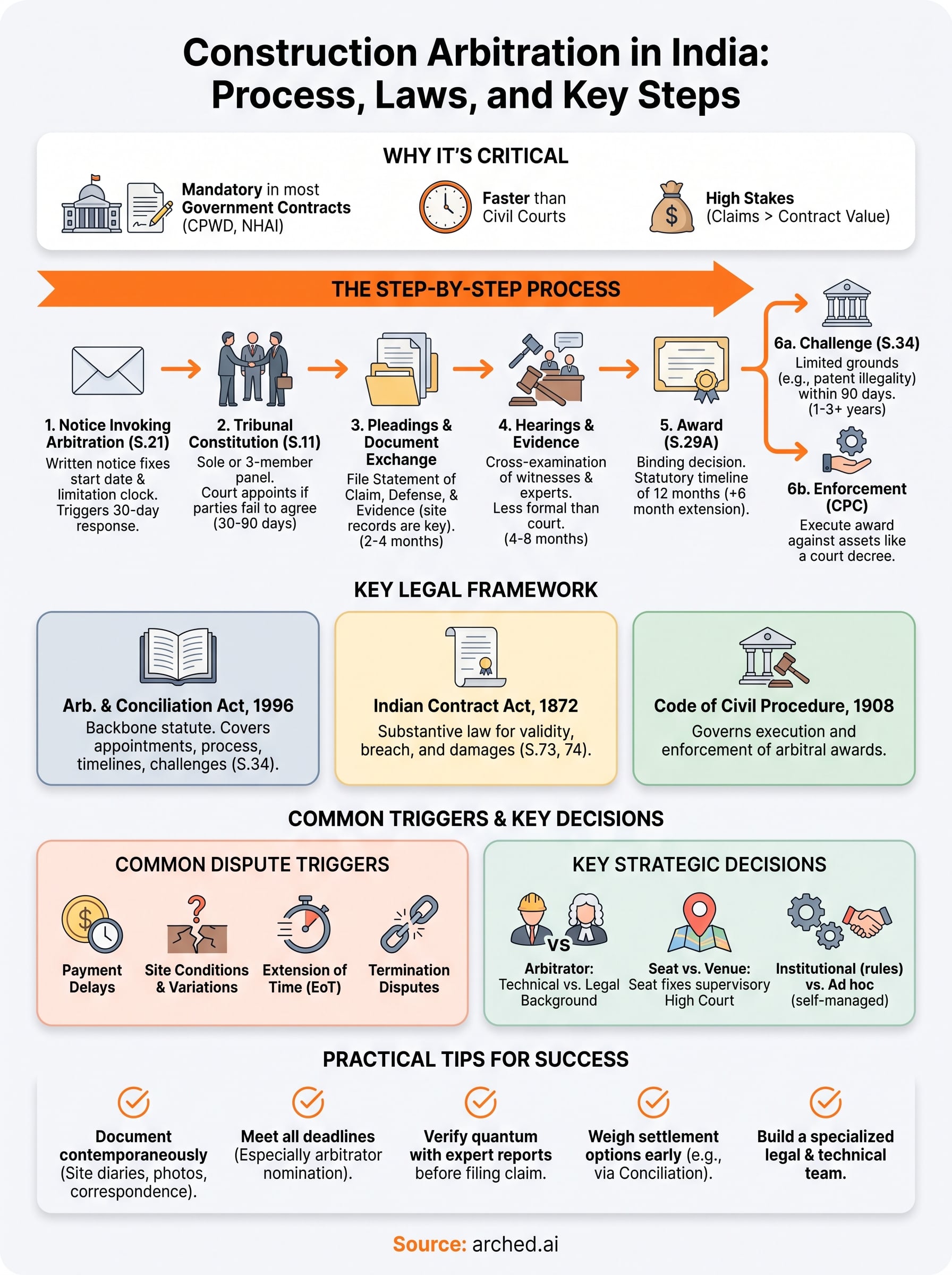
Staying prepared for construction disputes
Construction arbitration in India rewards contractors who prepare long before a notice ever gets served. The clause you barely read during bidding decides your seat, your arbitrator pool, and your timeline once a dispute erupts, so treat every contract review as dispute preparation, not paperwork. Documentation, quick responses to deadlines, and a realistic view of costs and timelines separate contractors who recover their money in months from those stuck in Section 34 challenges for years.
Most disputes, though, trace back to something visible at the bidding stage: an unclear BOQ, a risky termination clause, or a certification requirement your firm hasn't met yet. Catching those risks early matters as much as knowing arbitration law itself. If you would rather have the BOQ priced and checked before you bid than fight over it in arbitration later, see how Arched's estimating service works: we deliver a reviewed estimate and BOQ, and can verify an existing BOQ on request.
Have a package your team can’t get to? Send it to us. Our engineers check and sign off everything we deliver.