Government Contract Negotiation Process: Step-By-Step Guide
Learn to navigate the government contract negotiation process in India. Master L1 price reductions, justify technical costs, and protect your profit margins.
Winning a government contract doesn't end when you submit your bid. For infrastructure firms and consultancies operating in India's public procurement space, the government contract negotiation process is where terms get shaped, pricing gets scrutinized, and the actual deal takes form. Yet most BD managers and bid teams spend so much energy on discovery and document preparation that negotiation strategy becomes an afterthought, often at a real cost.
Whether you're responding to tenders on GeM, CPPP, or state-level e-procurement portals, understanding how negotiations work within the government framework is non-negotiable. The process follows structured procedures, from establishing competitive ranges to finalizing price and technical terms, and each stage has specific rules that determine what you can and can't push back on. Getting this wrong doesn't just lose you one contract; it can damage your standing for future opportunities.
This guide breaks down the government contract negotiation process into clear, actionable steps. You'll learn how to prepare your negotiation position, handle discussions on pricing and technical scope, and close on terms that protect your margins. At Arched, we help firms identify high-probability tenders and parse complex bid documents using AI, but once you've found the right opportunity, knowing how to negotiate effectively is what turns a qualified bid into a signed contract. Consider this your step-by-step playbook for that critical phase.
How the process works in India vs FAR Part 15
India's public procurement system and the US Federal Acquisition Regulation (FAR) Part 15 both govern how government bodies negotiate contracts, but they operate from very different philosophies. In India, the framework is shaped by the General Financial Rules (GFR) 2017, Central Vigilance Commission (CVC) guidelines, and procurement manuals issued by bodies like CPWD and MoRTH. In the US, FAR Part 15 governs competitive negotiation for federal contracts, covering source selection, proposal evaluation, and the Best and Final Offer (BAFO) process. Understanding both frameworks helps you prepare for different negotiation environments, particularly if your firm works with multilateral agencies like the World Bank or ADB where FAR-influenced procedures sometimes apply.
How India's public procurement framework handles negotiation
India's procurement system is built primarily around transparency and audit accountability, which means the government contract negotiation process is far more constrained than most BD teams expect. The default approach across central and state tenders is the L1 system: the lowest technically qualified bidder wins, and price negotiation is not permitted unless the L1 price exceeds the approved estimate. When that happens, the procuring authority may negotiate downward with the L1 bidder only, and the entire discussion must be documented to satisfy CVC and audit requirements.
You generally cannot renegotiate scope or payment terms the way you would in a private contract, but you can flag BOQ discrepancies or qualify specific line items during the clarification stage.
State-level procurement rules vary considerably, so procedures under Maharashtra's GCC may differ from those in Rajasthan or Karnataka. Always check the specific state's procurement manual alongside central GFR 2017 guidelines before entering any discussion.
How FAR Part 15 contrasts with India's approach
FAR Part 15 treats negotiation as a built-in phase of source selection, not an exception. After establishing a competitive range, the Contracting Officer conducts written or oral discussions with shortlisted offerors, then formally requests a Best and Final Offer (BAFO) before making an award decision. Vendors have genuine room to revise both technical proposals and pricing, and the Contracting Officer must document trade-off rationale.
This stands in direct contrast to India's L1 model, where selection is largely mechanical once technical qualification is confirmed. If your firm bids on ADB or World Bank-funded projects, those agencies use competitive negotiation frameworks that resemble FAR Part 15 more closely than GFR 2017, making cross-framework awareness a practical asset.
| Dimension | India (GFR 2017 / CVC) | FAR Part 15 (US Federal) |
|---|---|---|
| Default method | L1 lowest bid wins | Competitive negotiation with discussions |
| Negotiation trigger | Price exceeds approved estimate | Standard part of selection process |
| Who negotiates | L1 bidder only, in most cases | All offerors in competitive range |
| BAFO equivalent | Revised financial bid, conditional | Formally required before award |
| Scope revisions | Rarely permitted pre-award | Permitted during discussion phase |
Step 1. Prepare your negotiation file and team
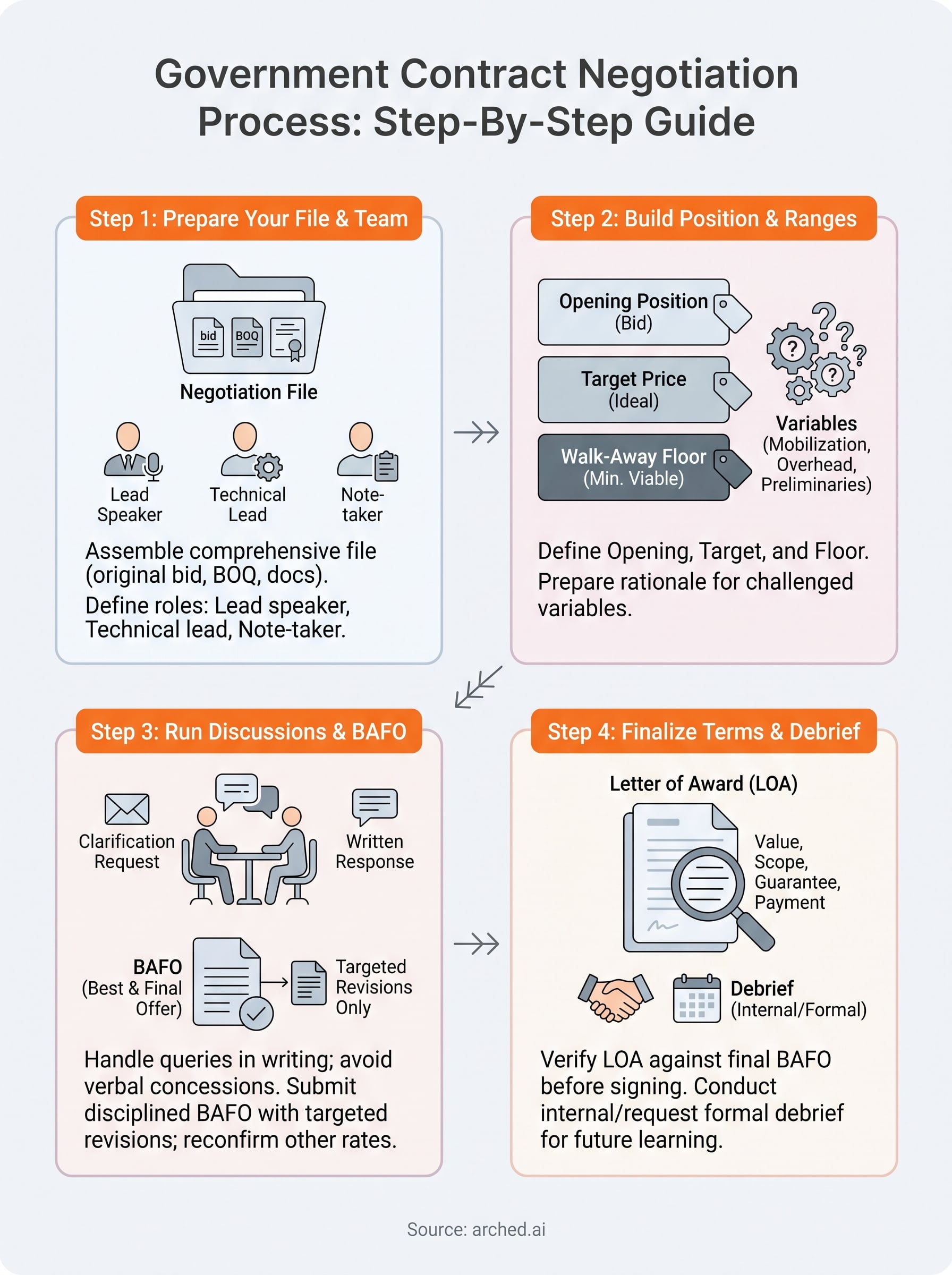
Before you enter any discussion with a procuring authority, your groundwork determines how well you hold up under scrutiny. The government contract negotiation process rewards firms that arrive with organized documentation and clearly defined internal roles, not those who improvise on the spot. Most negotiation failures trace back to this preparation stage, not to what happens at the table.
Assemble your negotiation file
Your negotiation file is the single folder, physical or digital, that your team draws from during every discussion or clarification exchange. At minimum, it should contain your original bid submission, the tender document with all corrigenda, your BOQ breakdown at the line-item level, your cost build-up sheet showing unit rates and assumptions, and any correspondence with the procuring authority. Pull together your firm's past project completion certificates and relevant credentials as well, because eligibility questions can surface during price discussions.
Use this checklist as your baseline:
- Original bid and cost breakdown (line-item level)
- Tender document and all issued corrigenda
- Cost build-up with unit rate assumptions noted
- Firm credentials and past project completion certificates
- Pre-bid queries and all official replies received
A missing document during a negotiation discussion can stall proceedings and, in some cases, disqualify your position entirely, so verify your file at least 48 hours before any scheduled meeting.
Define your team roles before the meeting
Every person in the room needs a specific function, not a general presence. Assign one person as the lead speaker who handles all direct responses to the procuring authority. Designate a technical lead who addresses BOQ queries and scope clarifications, and a separate note-taker who logs every point raised and every commitment made. Keeping these roles fixed prevents contradictory statements and gives your team a professional appearance that carries real weight in government settings.
Step 2. Build your negotiation position and ranges
Before any formal discussion begins, you need a clear internal position that defines what you're willing to accept, what you're aiming for, and where you will not go. Most firms enter the government contract negotiation process without setting these boundaries in advance, which means they concede ground reactively rather than by design. Set your ranges before the meeting, not during it.
Define your walk-away point and target price
Your negotiation range has three numbers: your target price (what you ideally want), your acceptable floor (the lowest you can go and still deliver profitably), and the opening position you present. In India's L1 framework, your floor matters most because if the procuring authority asks you to bring down your price to match the approved estimate, you need to know instantly whether that figure still works. Build your floor from your actual cost build-up, not from guesswork.
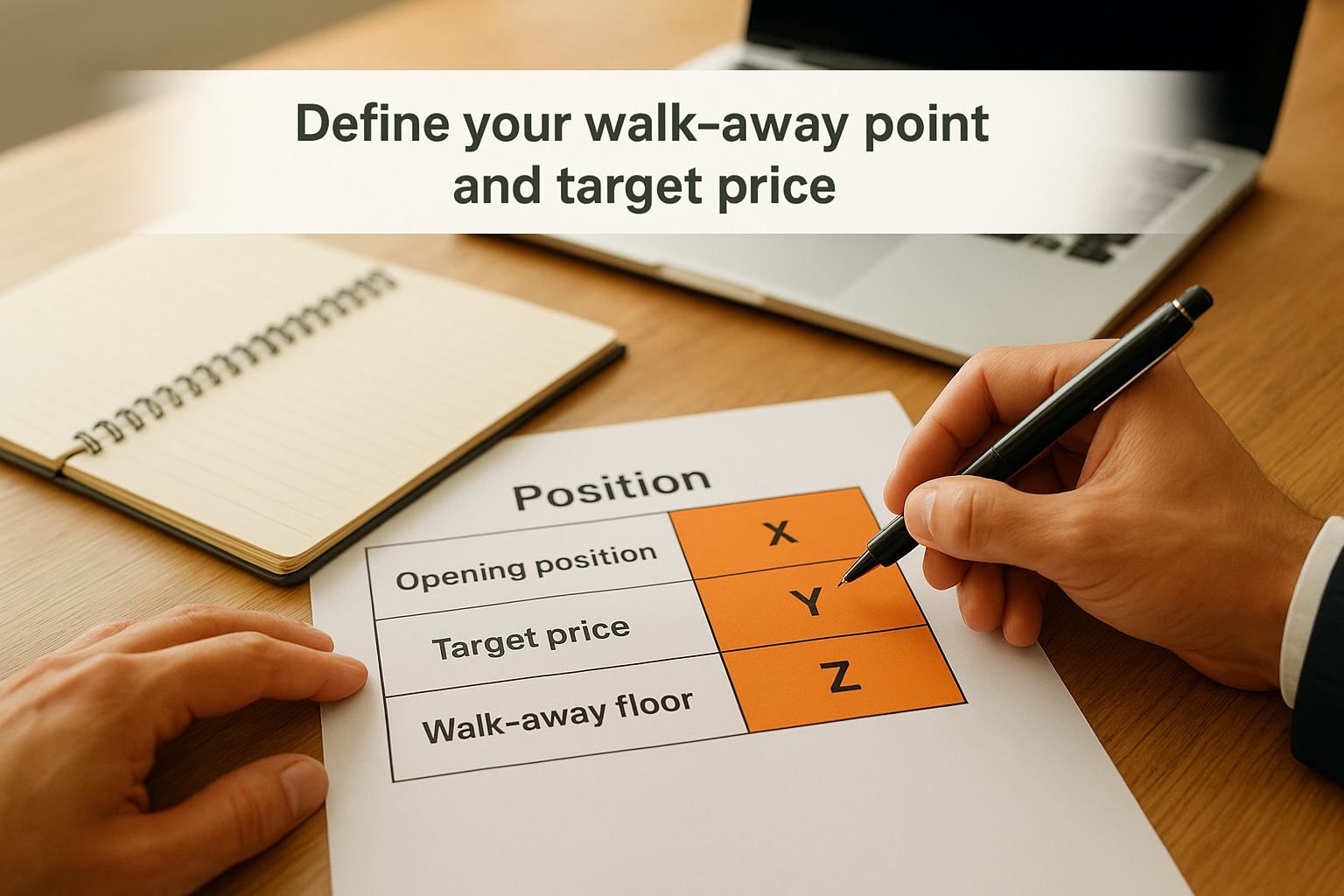
Your floor must include overhead recovery and a minimum margin that accounts for project risk, payment delays from government clients, and retention amounts held until completion.
Use this simple template to map your three positions before any discussion:
| Position | Amount (INR) | Notes |
|---|---|---|
| Opening position | X | Your submitted bid price |
| Target price | Y | Preferred negotiated outcome |
| Walk-away floor | Z | Minimum to remain viable |
Account for the variables the government will challenge
Procuring authorities typically question mobilization costs, preliminary items, and overhead percentages because these are the line items with the least visible justification. Prepare a written rationale for each of these before you sit down, with reference to market rate data or comparable past project costs.
Your technical lead should also prepare written explanations for any unit rates that sit above the Schedule of Rates (SOR) for that state, since auditors will flag those discrepancies.
Step 3. Run discussions, clarifications, and BAFO
Once you've built your position, the actual exchange with the procuring authority begins. This stage of the government contract negotiation process typically involves written clarification requests, pre-bid or post-bid meeting exchanges, and in some frameworks, a formal Best and Final Offer (BAFO) round. Your goal throughout is to respond precisely, protect your floor price, and avoid making verbal commitments that aren't backed by your negotiation file.
Handle clarification queries without conceding ground
Procuring authorities commonly issue queries in writing, and you should respond the same way, even when discussions happen in person. Every clarification you provide becomes part of the contract record, so your responses need to be specific and tied to your original submission. When asked to justify a unit rate or mobilization cost, refer directly to your cost build-up sheet and cite comparable project data where available.
Never revise a line-item price verbally during a clarification meeting. Always confirm changes in writing through the official channel the procuring authority designates.
Use this response structure when replying to written clarification queries:
- Reference the query number and the specific tender clause it relates to
- State your original submitted position clearly
- Provide the justification with supporting data
- Confirm whether your position stands, or detail any revision with the revised figure
Submit your BAFO with discipline
When the procuring authority requests a revised financial bid or formal BAFO, treat it as a single, final opportunity to sharpen your position. Do not use it as a chance to make dramatic price cuts, since large last-minute drops signal weak original costing and can raise audit flags. Instead, make targeted revisions to the two or three line items where you have genuine room, and reconfirm all other rates explicitly.
Check that your BAFO package includes your revised BOQ, a cover letter summarizing the changes, and updated supporting calculations for any revised rates.
Step 4. Finalize terms, award, and debrief
Once the procuring authority confirms your bid as the selected offer, the government contract negotiation process enters its final administrative phase. This stage moves quickly, and the details buried in the Letter of Award (LOA) or work order carry real legal and financial weight. Read every line before you sign.
Review the Letter of Award before signing
Your LOA or work order will specify the contract value, scope of work, timelines, payment schedule, and performance guarantee requirements. Cross-reference every figure against your final submitted BOQ and BAFO to catch any discrepancy before it becomes a contractual obligation. Pay particular attention to the mobilization advance conditions and the retention percentage, since these directly affect your cash flow from day one.

If the LOA contains any figure or clause that differs from your final offer, raise a written objection with the procuring authority immediately, before you sign.
Use this checklist to verify your LOA against your submission:
- Contract value matches your final submitted price exactly
- Scope of work reflects the agreed clarifications, not the original unamended tender
- Performance guarantee amount and submission deadline are workable
- Payment milestones align with your project delivery schedule
- Retention percentage and release conditions match the tender document
Conduct a debrief after every outcome
After award, schedule an internal debrief within two weeks while the details are still fresh. If you won, document which preparation steps and clarification responses gave you the strongest position. If you lost, request a formal debrief from the procuring authority, which is your right in most central and state procurement frameworks, and record that feedback directly in your bid file for reference on the next submission.
Treat every debrief as a direct input into your next negotiation file, not a formality.
What to do after you sign
Signing the work order marks the start of execution, not the end of the government contract negotiation process. Your first action is to distribute the final contract package to every project team member who needs it, including your site engineer, finance lead, and contract administrator. Flag the key dates immediately: performance guarantee submission deadline, mobilization advance request window, and the first payment milestone. Missing any of these in the first 30 days sets a poor precedent with the procuring authority and creates cash flow problems that compound over the project lifecycle.
Your second priority is to log everything you learned from this cycle into a master bid file your team can reference next time. Note which clarification responses landed well, which line items drew the most scrutiny, and what your actual margin looks like against your projected floor. That institutional knowledge compounds over every bid you run. If you want to find and qualify for the right tenders before the negotiation stage even begins, explore what Arched can do for your firm.