What Is Price Benchmarking? Methods, Stages, And Examples
Every government tender in India comes down to a number. You can have the right credentials, the right experience, and a flawless technical bid, but if your pricing is off, you lose. Too high, and you're out. Too low, and you win a project that bleeds money. So what is price benchmarking, and why does it matter so much in public procurement?
Price benchmarking is the process of comparing your prices against competitors, market standards, and historical data to figure out where you actually stand. For infrastructure firms bidding on government contracts, road projects, bridges, irrigation works, this isn't an academic exercise. It's the difference between a bid that wins at healthy margins and one that either gets rejected or becomes a financial liability. BOQ line items, material costs, labor rates, every element needs a reference point.
Benchmarking gives contractors the pricing evidence they need before they commit to a number. This article breaks down how price benchmarking works, the methods you can use, the stages involved, and real examples that show it in action.
Why price benchmarking matters for pricing and procurement
Government procurement in India is intensely competitive, and pricing is often the deciding factor. When you submit a bid for a road project or an irrigation contract, you're competing against firms that study market rates as carefully as they study the scope of work. Understanding what is price benchmarking and applying it before you finalize your bid gives you a defensible number built on evidence, rather than a figure assembled from instinct and outdated cost sheets.
The cost of pricing blind
When you skip benchmarking, you lose visibility into where your numbers sit relative to competitors and current market rates. Bid too high on a state highway tender, and a lower-ranked firm wins on price alone. Bid too low, and you win the contract but absorb losses on material cost overruns that no amount of project management can recover. Both outcomes damage your business, one immediately and the other slowly over months of execution.
Firms that benchmark their BOQ rates consistently report stronger win rates without sacrificing margin, because they know exactly where to compete and where to hold firm.
Why procurement teams rely on benchmarks
Procurement officers on the government side use official benchmark rates from Schedules of Rates (SOR) and previous contract awards to assess whether your bid is realistic. If your line items deviate too far from these reference points, your bid raises a red flag during evaluation, regardless of how strong your technical submission is. Your pricing needs to tell a story that matches what the evaluating committee sees as the going rate for that particular scope and geography. Knowing these benchmarks in advance lets you align your pricing to evaluator expectations while still protecting your margin.
Benchmarking as a strategic tool
Price benchmarking isn't only about avoiding disqualification. It tells you which project types you can compete on profitably and which ones are dominated by firms with lower overhead or better supplier relationships. That intelligence shapes how you build your pipeline and where you direct your BD resources. Instead of chasing every tender, you concentrate effort on opportunities where your cost base gives you a real edge, improving both your win rate and your long-term profitability.
Methods and data sources for price benchmarks
Understanding what is price benchmarking means understanding where your data comes from. Not all sources carry the same weight, and using an outdated or mismatched benchmark can be just as damaging as using none. Combining multiple data sources gives you a pricing corridor grounded in both official standards and real market behavior, which is what you actually need before committing to a BOQ submission.

Government-published rate schedules
The most reliable starting point for infrastructure bids is the Schedule of Rates (SOR) published by bodies like CPWD, state PWDs, and the Ministry of Road Transport. These documents set official unit rates for labor, materials, and equipment across specific geographies. Procurement evaluators reference these directly when assessing your BOQ, so your line items must align with current SOR figures or justify any deviation with a clear cost basis. Ignoring these schedules puts your bid at risk of rejection before the technical evaluation even begins.
Historical contract award data
Past tender awards give you a direct window into what winning L1 prices looked like for comparable scope and geography. Government portals publish awarded contract values, and analyzing this data shows you the pricing range where bids have historically succeeded.
Historical L1 data combined with current SOR rates gives you a defensible pricing band, not just a single number to guess at.
Direct market intelligence
Supplier quotes and subcontractor rate cards reflect input costs as they stand today, not six months ago when the last SOR revision was published. Polling your supply chain before you finalize a bid grounds your line items in actual current prices and prevents margin erosion from cost gaps you didn't account for.
The 4 stages of price benchmarking
Knowing what is price benchmarking means understanding it as a structured four-stage process, not a one-time lookup. These stages move you from raw data to a bid price you can defend, and skipping any one of them leaves gaps that cost you either the contract or your margin.
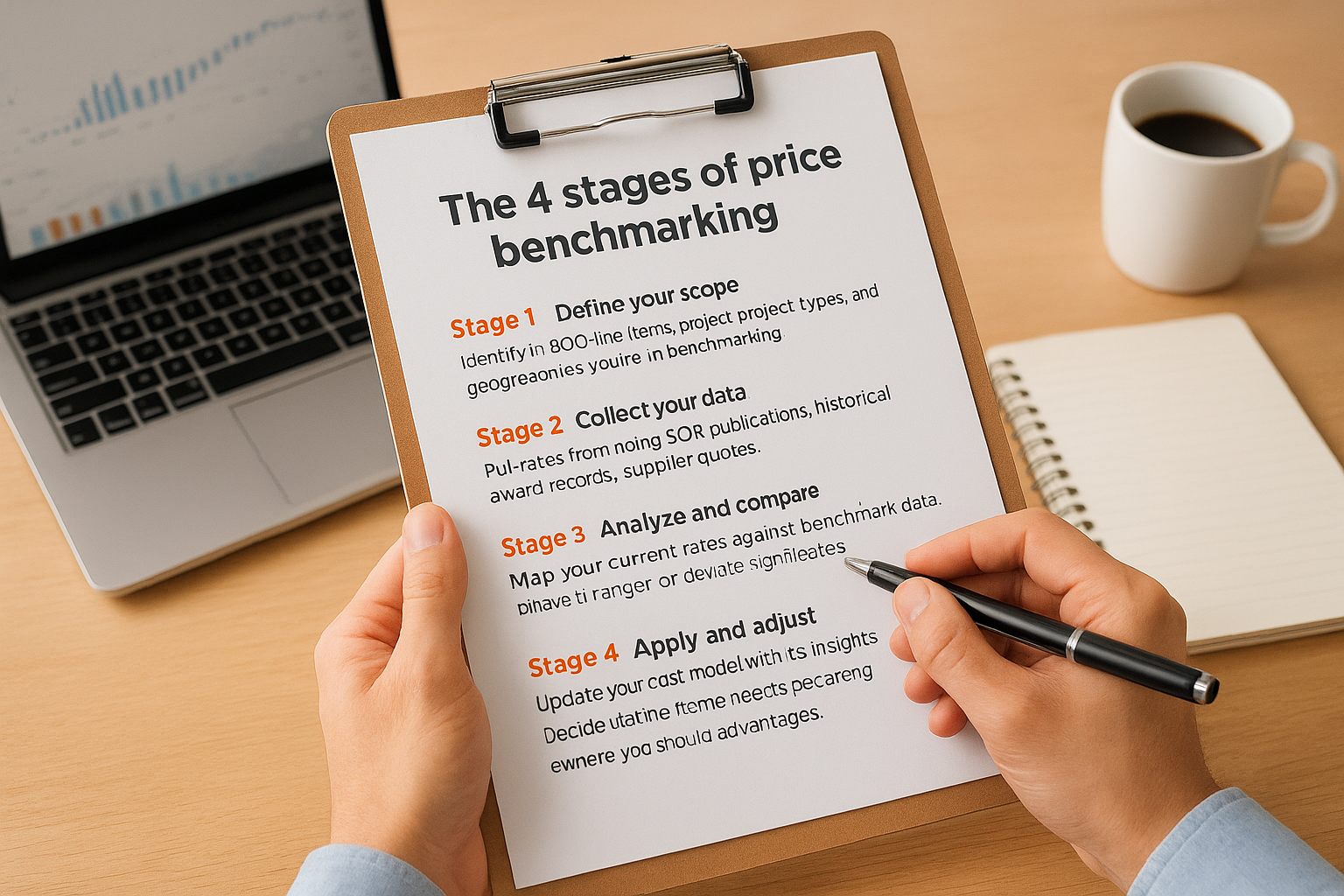
Stage 1: Define your scope. Identify which BOQ line items, project types, and geographies you're benchmarking. Without clear boundaries, you end up comparing incompatible data.
Stage 2: Collect your data. Pull rates from SOR publications, historical award records, and supplier quotes. Cross-reference multiple sources to build a realistic pricing corridor.
Stage 3: Analyze and compare. Map your current rates against the benchmark data. Flag line items where your costs sit above the L1 range or deviate significantly from official schedules.
Stage 4: Apply and adjust. Update your cost model with the insights. Decide which line items need supplier renegotiation, which reflect genuine cost advantages, and where you should hold firm.
Running these four stages before every significant bid turns benchmarking from a background task into a core part of your bid preparation process.
Keeping benchmarks current
Benchmark data expires faster than most firms realize. Material prices shift with commodity markets, and SOR schedules get updated periodically, so treat each bid cycle as a fresh benchmarking exercise rather than a repeat of the last one. Refresh your benchmarks at least quarterly or after any major SOR revision to ensure your cost model reflects what competitors are actually pricing against today.
How to run a price benchmark step by step
Understanding what is price benchmarking in theory is one thing. Running it on an actual bid is another. This process works best when you treat it as a repeatable workflow tied directly to your bid preparation cycle, not something you do when time allows.
Pull your baseline costs first
Before you compare anything external, lock down your internal cost model for the specific tender. List every BOQ line item with your current estimated unit rates for labor, materials, and equipment. This baseline is your reference point. Without it, you have nothing concrete to measure against the SOR schedules and historical award data you collect next.
Gather your external data in parallel: download the relevant state or CPWD Schedule of Rates, pull at least three comparable past tender award values from government portal records, and collect fresh supplier quotes for high-value line items. Keeping these data sources organized by category prevents confusion when you start running comparisons.
Run the comparison and flag outliers
Map your internal rates against the external benchmarks line by line, not as a single aggregate number. Flag any item where your rate sits more than 10-15% above the historical L1 range for that geography. These flagged items either need supplier renegotiation or a clear cost justification before you submit.
Outliers you ignore at this stage become the exact line items that lose you the bid or erode your margin during execution.
Address each flagged item before your pricing review meeting, and document your rationale for every rate that deviates from the benchmark corridor.
Common mistakes and how to avoid them
Even when firms understand what is price benchmarking and commit to running it, the execution often falls short in predictable ways. These mistakes don't just produce a weaker bid, they can cost you the contract or lock you into a loss-making project for months.
Relying on a single data source
Many firms pull SOR rates and stop there, treating official schedules as the complete picture. But SOR figures represent government-published standards, not actual market behavior. Your competitors are pricing off real supplier agreements, recent award data, and current commodity rates. Relying on one source alone leaves you blind to the gap between official rates and live market prices, which is exactly where underbidders gain their edge.
Combining SOR data with historical L1 awards and fresh supplier quotes gives you a realistic pricing corridor that one source alone never will.
Treating benchmarks as permanent
Firms often build a cost model once, then reuse it across multiple bids without updating the underlying data. Material prices, labor rates, and SOR schedules shift regularly, and a benchmark that was accurate six months ago may now be misleading. Treat each bid as a fresh benchmarking cycle and refresh your data at least quarterly to keep your rates grounded in current market conditions.
Benchmarking the total bid instead of line items
Comparing your overall bid value to a past award number tells you almost nothing useful. Outlier rates hide inside aggregate totals, and evaluators review your BOQ line by line. Run your comparisons at the item level, flag deviations individually, and address each one before you finalize your submission.
Key takeaways
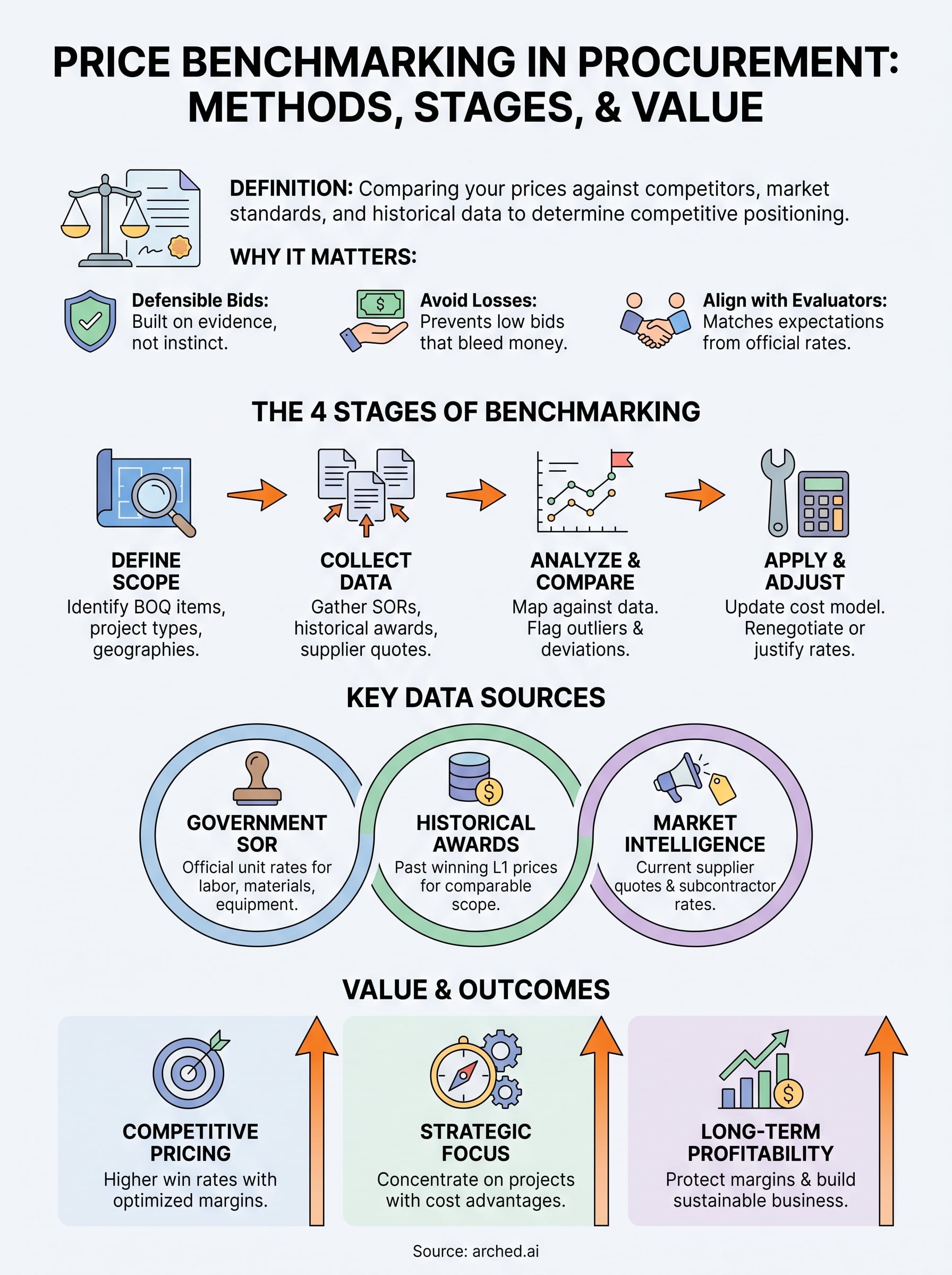
What is price benchmarking at its core is the structured process of comparing your rates against official schedules, historical award data, and live market prices before you commit to a bid. You need all three sources working together, not just one in isolation. SOR rates give you the evaluator's reference point, historical L1 data shows you where winning bids actually landed, and supplier quotes keep your input costs grounded in current reality.
Run benchmarking at the line-item level, not as a single aggregate comparison. Flag every rate that deviates from the benchmark corridor, address those outliers before your pricing review, and refresh your data at least quarterly so you're never working off stale figures.
Your pricing needs to be both competitive and defensible, and that only happens when it's built on evidence. If you want Arched to prepare the estimate and rate build-ups for your next bid, see how our estimating service works.
Have a package your team can’t get to? Send it to us. Our engineers check and sign off everything we deliver.