Prebid Meeting: Purpose, Process, Agenda, Minutes, Template
A prebid meeting can be the difference between submitting a sharp, compliant bid and wasting weeks chasing a contract you were never going to win. It's the one formal opportunity where procuring agencies and prospective bidders sit across the table, physically or virtually, to clarify scope, resolve ambiguities in tender documents, and raise concerns before the submission deadline locks everything in.
Yet many firms, especially in India's AEC sector, either skip these meetings or walk in unprepared. The result? Misread BOQ line items, overlooked eligibility criteria, and bids built on assumptions that fall apart during technical evaluation. For BD managers and bid teams juggling dozens of live tenders across portals like GeM, CPPP, and state e-procurement systems, knowing which prebid meetings to prioritize, and how to extract maximum value from them, is a real competitive edge.
At Arched, we prepare estimates and BOQs for infrastructure firms bidding on government tenders in India, but no estimate replaces the strategic clarity you gain from a well-prepared prebid meeting. This guide covers exactly what a prebid meeting is, why it matters, how to prepare for one, and includes ready-to-use templates for agendas and minutes so your team shows up with a plan, not just a printout.
What a prebid meeting is and who attends
A prebid meeting is a scheduled, formal gathering convened by the procuring authority after a tender is published but before bids are submitted. Its core purpose is to give prospective bidders a structured opportunity to ask questions about the tender document, the scope of work, the technical specifications, and the terms and conditions. The procuring authority records all questions raised and publishes official responses, typically in the form of a corrigendum or addendum, which then becomes part of the binding tender document.
The formal definition and legal basis
In India's public procurement framework, prebid meetings are not optional courtesy events. For contracts above certain thresholds, particularly those procured under GFR (General Financial Rules) 2017 or through Central Public Procurement Portal guidelines, holding a prebid meeting is a standard procedural step. The procuring entity sets a specific date and time in the NIT (Notice Inviting Tender), and all official communication from the meeting becomes legally binding on both parties once published as a formal amendment.
A corrigendum issued after a prebid meeting carries the same weight as the original tender document, so anything clarified or changed at the meeting directly reshapes the scope you are bidding against.
Failing to attend does not exempt you from the changes made. If the procuring authority revises qualification criteria or alters BOQ quantities based on questions raised during the meeting, your bid must reflect those updated terms regardless of whether your team was present.
Who sits in the room
The attendees at a typical prebid meeting fall into two distinct groups. On the procuring authority's side, you will find the tender-issuing officer, technical consultants or project managers, finance or legal representatives, and sometimes officials from the end-user department. On the bidder's side, attendance usually includes BD managers, estimation engineers, legal or contracts staff, and occasionally a senior partner or director for high-value contracts.
For large infrastructure tenders, such as highway packages or multi-city water supply projects, the bidder delegation often includes site engineers who have already visited the project location. Their on-ground observations make the prebid meeting far more productive because they can ask precise questions about ground conditions, access constraints, or discrepancies between the drawing set and actual site conditions.
| Attendee Side | Typical Representatives |
|---|---|
| Procuring Authority | Tender officer, technical consultant, legal or finance rep |
| Bidder | BD manager, estimation engineer, contracts lead, site engineer |
| Optional | End-user department head, external project management consultant |
Why prebid meetings matter in Indian tenders
Indian tender documents are notoriously dense. A standard NIT on CPPP or a state e-procurement portal can run to hundreds of pages, combining technical specifications, BOQ sheets, eligibility conditions, and contractual clauses drafted by multiple departments. Errors, contradictions, and ambiguities are common. The prebid meeting is the only formal channel that gives you a direct line to the procuring authority before you commit your resources to a bid.
The cost of misreading a tender
When your team spends two to three weeks preparing a bid based on an incorrect reading of the scope, the financial loss is real: estimator hours, legal review time, and management attention all go to waste. More damaging is the risk of technical disqualification because you misunderstood an eligibility criterion that could have been clarified in 60 seconds at a prebid meeting. In a sector where a single large infrastructure contract can represent months of revenue, that is a loss you cannot afford.
Missing or skipping a prebid meeting does not just cost you information. It costs you the ability to shape the final terms of the tender in your favor.
Why Indian procurement adds specific complexity
The procurement landscape in India spans multiple frameworks and portals simultaneously, from central government departments using CPPP and GeM to state PWD systems, IREPS for railways, and MSTC for specialized auctions. Each system has its own document standards, and the quality of tender drafting varies significantly across agencies. A municipal corporation NIT may contain gaps that a well-prepared bidder can flag and get corrected through a prebid query, directly improving bid conditions for everyone who attends.
Attending prebid meetings consistently also builds direct relationships with technical officers at procuring agencies, which improves your ability to interpret future tenders from the same authority far more accurately.
Prebid meeting process from notice to corrigendum
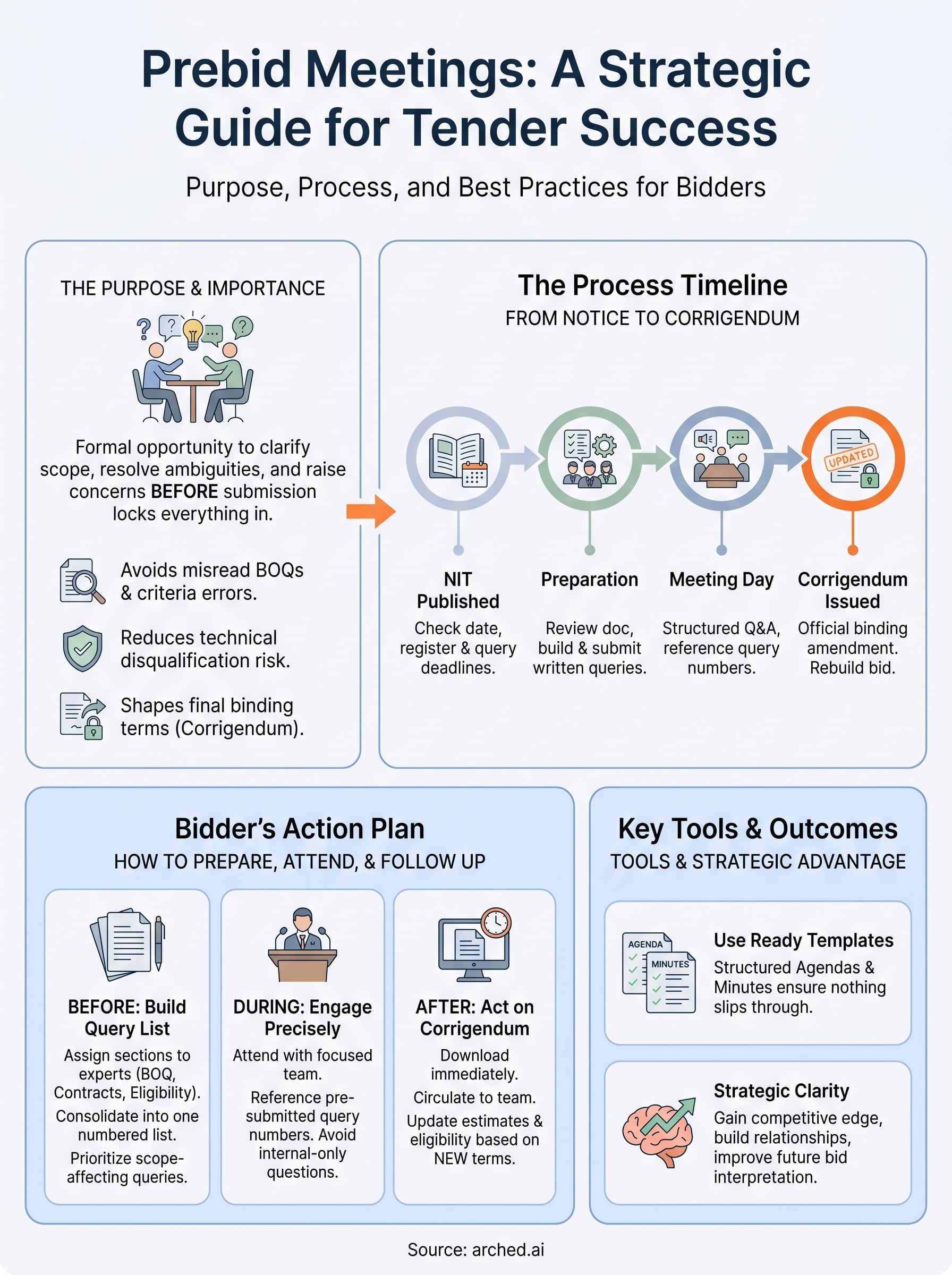
Every prebid meeting follows a fixed sequence, and missing any step can cost you both information and eligibility. Understanding each stage helps your team track the right deadlines and prepare targeted queries instead of scrambling at the last minute.
From NIT to the meeting day
When a procuring authority publishes a tender on portals like CPPP or a state e-procurement platform, the NIT includes a specific prebid meeting date, a venue or video link, and often a deadline by which prospective bidders must register or confirm attendance. Some agencies require a formal written request before they grant entry, so read the NIT carefully. Missing the registration window locks you out entirely.
Check these details in every NIT immediately:
- Prebid meeting date and time
- Attendance registration deadline
- Query submission deadline
- Portal where the corrigendum will appear
What happens during the meeting
The meeting runs as a structured question-and-answer session, not an open discussion. The tender-issuing officer chairs proceedings, and bidders raise queries in sequence. All questions and official responses are recorded in minutes published by the procuring agency afterward.
Most Indian agencies prefer written queries submitted before the meeting, which allows technical staff to prepare accurate, binding answers rather than giving vague verbal responses on the spot.
Submit your written queries before the prebid meeting deadline, not on the day itself, so the procuring authority has time to prepare detailed responses.
How the corrigendum finalizes terms
After the meeting, the authority reviews all queries and publishes a corrigendum or addendum on the original NIT portal. This document captures every clarification, BOQ revision, change to eligibility thresholds, and updated submission deadline.
From that point, the corrigendum forms part of the binding tender. Evaluators check your submission against the revised terms, not the original document, so align your bid accordingly before the final submission date.
How to prepare, attend, and follow up as a bidder
Getting value from a prebid meeting depends almost entirely on how much work your team does before stepping into the room. Firms that walk in without a prepared query list leave with the same gaps they arrived with, while competitors who studied the document in advance leave with clarifications that directly sharpen their bid pricing and eligibility positioning.
Before the meeting: build your query list
Start by assigning specific sections of the tender document to each team member based on their expertise. Your estimation engineer reviews BOQ quantities and unit rates, your contracts lead flags unusual penalty clauses or payment terms, and your BD manager checks eligibility thresholds against your firm's credentials. Running these reviews in parallel saves time and surfaces conflicts faster.
Compile every query into a single numbered document and submit it before the written query deadline, not the morning of the meeting.
Prioritize questions that affect eligibility, scope interpretation, or BOQ assumptions rather than minor formatting queries. These are the clarifications that change how you price the job.
During the meeting: engage precisely
Attend with a small, focused team and bring your pre-submitted query list with space to note the official response beside each item. When the chair opens the floor, reference your query by number so the record is clean and traceable. Avoid raising issues that your own internal review could answer, as this signals poor preparation to the procuring authority.
After the meeting: act on the corrigendum
Download the published corrigendum the moment it appears on the portal and circulate it immediately to everyone working on the bid. Rebuild any affected cost estimates, update your eligibility checklist against revised criteria, and note the new submission deadline if it changed. Your final submission must reflect the corrigendum terms in full, or evaluators will flag the discrepancy during technical scrutiny.
Agenda and minutes templates, plus sample questions
Having a ready-made structure saves your team time and ensures nothing important slips through during a prebid meeting. The templates below are designed for Indian infrastructure tenders, but the format works across most procurement categories.
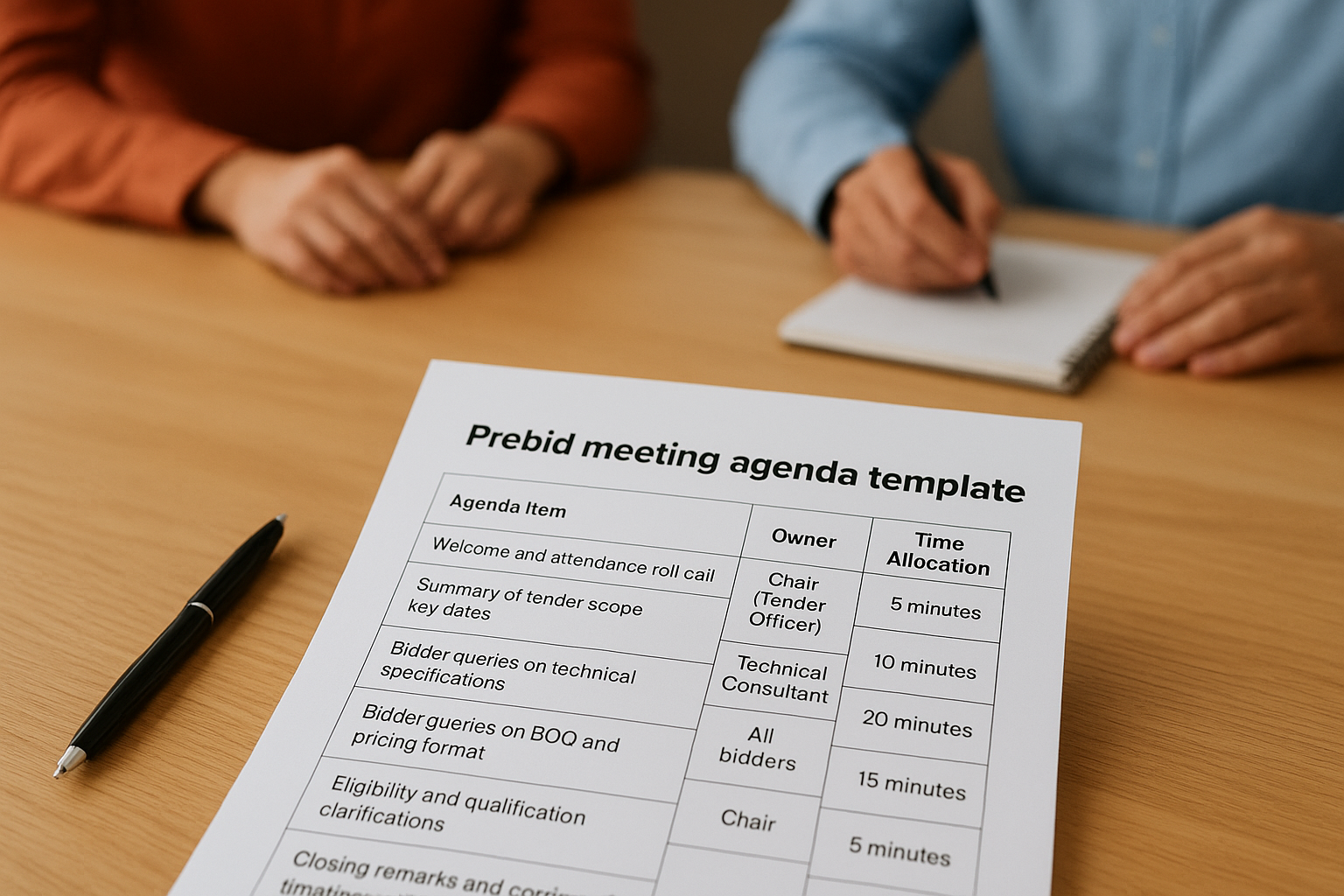
Prebid meeting agenda template
Use this structure when you are either hosting the meeting as a procuring authority or need to map your own preparation against the expected flow.
| Agenda Item | Owner | Time Allocation |
|---|---|---|
| Welcome and attendance roll call | Chair (Tender Officer) | 5 minutes |
| Summary of tender scope and key dates | Technical Consultant | 10 minutes |
| Bidder queries on technical specifications | All bidders | 20 minutes |
| Bidder queries on BOQ and pricing format | All bidders | 15 minutes |
| Eligibility and qualification clarifications | All bidders | 10 minutes |
| Closing remarks and corrigendum timeline | Chair | 5 minutes |
Circulate your written queries before the meeting opens so the chair can group similar questions and give more precise official responses.
Minutes structure
Your minutes document should record every query raised, the name of the firm that raised it, and the official response given by the procuring authority. A clean format makes it easier to cross-reference later when the corrigendum is published.
Capture these fields for each query: query number, section of tender it references, question text, and official response. If the authority defers an answer for the corrigendum, note that clearly as "response pending corrigendum."
Sample questions to raise
These questions cover the areas where ambiguities in Indian tender documents most frequently cause bid errors.
- What is the basis for BOQ quantities, and will revisions appear in the corrigendum?
- Does prior experience with a joint venture partner count toward individual eligibility thresholds?
- Are any sub-criteria within the technical qualification scored on a pass-fail basis?
- What format does the procuring authority accept for audited financial statements from foreign subsidiaries?
- Is the mobilization period counted from letter of award or from site handover?
What to do next
A prebid meeting gives you a direct window into the procuring authority's thinking before your bid is even priced. The firms that consistently win government contracts in India treat these meetings as a core part of their BD process, not an optional attendance item. Every query you raise, every corrigendum you track, and every follow-up action you complete builds a sharper, more accurate final submission.
The challenge for most BD teams is juggling several tenders at once while still finding time to prepare for each meeting properly. Clarifications raised at the prebid often change quantities and scope, and the estimate has to keep up. If you need that estimate prepared, Arched can do it: send us the project and we deliver a reviewed BOQ on your deadline.
Have a package your team can’t get to? Send it to us. Our engineers check and sign off everything we deliver.