Competitor Intelligence Framework: A Practical Step-By-Step
Build a competitor intelligence framework to analyze rival bidding patterns and win rates. Learn how to gain a strategic edge in Indian government tenders.
Every government tender your firm bids on has other companies eyeing the same contract. The difference between consistently winning and constantly losing often comes down to one thing: how well you understand who you're up against. A competitor intelligence framework gives you a structured way to gather, analyze, and act on information about rival bidders, so you stop guessing and start making decisions backed by evidence.
Most BD teams in Indian infrastructure and construction firms rely on gut feel or word-of-mouth to assess competition. Someone heard that a particular firm dominates road projects in Maharashtra. Someone else assumes a competitor won't bid below a certain margin. These assumptions are expensive when contract values run into hundreds of crores, and a single misread can mean months of wasted effort on a bid you were never going to win. The firms that pull ahead are the ones that replace assumptions with a repeatable system.
This is exactly why we built Arched. Our platform already tracks competitor activity across 500+ government portals, surfacing win rates, bidding patterns, and qualification gaps in real time. But technology works best when it sits inside a clear strategic process. This article walks you through a practical, step-by-step approach to building your own competitor intelligence framework, one that helps you identify which rivals matter, what they're doing, and where your openings are in India's public procurement market.
What a competitor intelligence framework is
A competitor intelligence framework is a structured, repeatable system for collecting, organizing, and acting on information about the firms you compete against in procurement markets. It is not a one-time report or a static spreadsheet someone updates before a large bid. It is an ongoing operational process that your team runs on a defined schedule, continuously feeding current data into decisions about which tenders to pursue, how to position your price, and where to close gaps in your firm's qualifications.
The three core layers
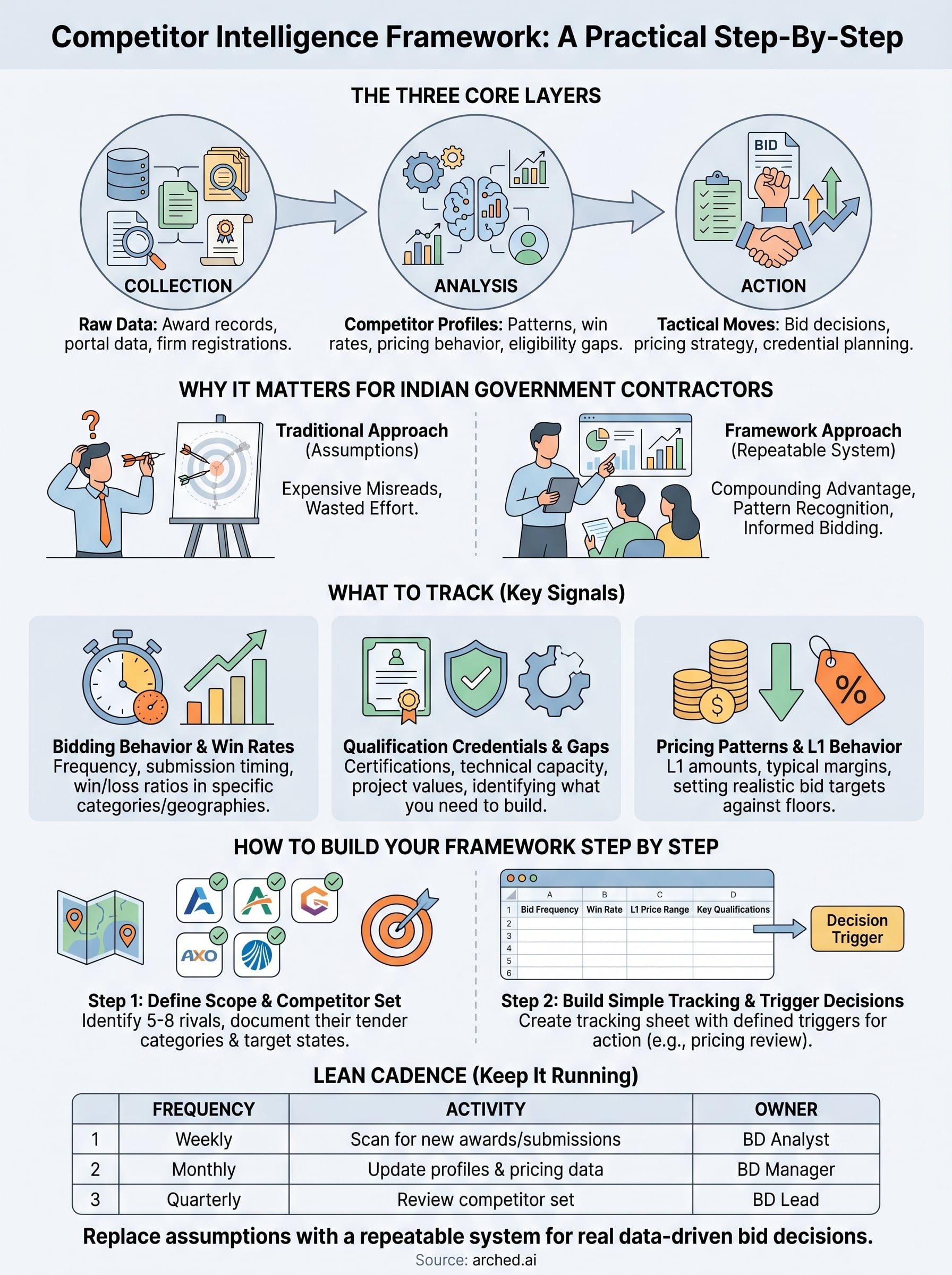
Every competitor intelligence framework is built on three layers: collection, analysis, and action. Collection pulls raw information from publicly available sources, including tender award records, e-procurement portal data, company registration filings, and published qualification documents. Analysis converts that raw data into useful conclusions, such as identifying which firms consistently win road contracts in a particular state or which competitors lack the certifications to qualify for large urban infrastructure work. Action is what separates a functioning framework from an expensive archive: the concrete decisions your BD team makes differently because of what the analysis surfaced.
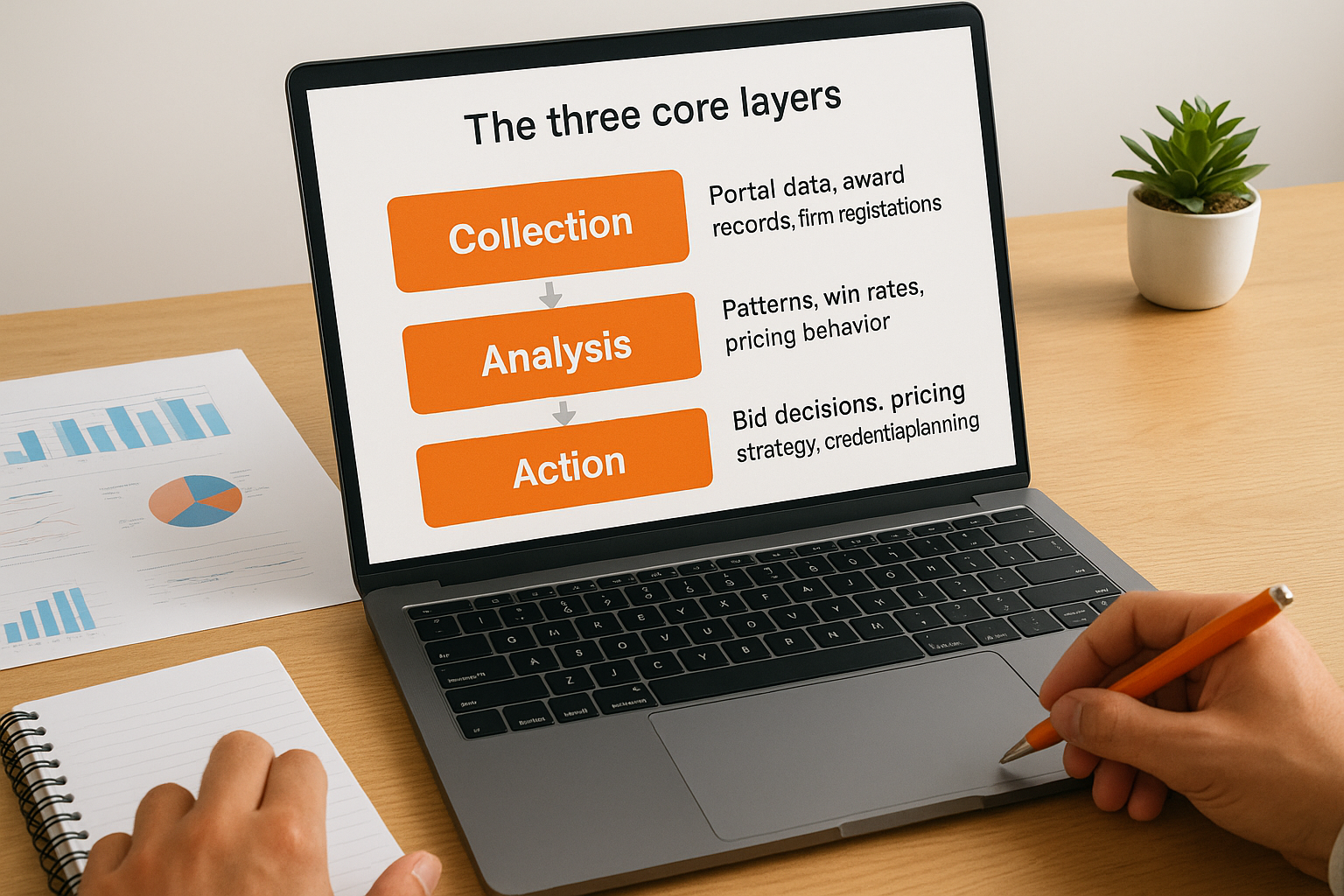
Here is how those three layers connect in practice:
| Layer | What it covers | Output |
|---|---|---|
| Collection | Portal data, award records, firm registrations | Raw data sets |
| Analysis | Patterns, win rates, pricing behavior | Competitor profiles |
| Action | Bid decisions, pricing strategy, credential planning | Tactical moves |
What it is not
Many BD teams confuse a competitor intelligence framework with basic monitoring. Monitoring means you track what competitors are doing. A framework means you track it, interpret it, and connect the findings to a specific decision your firm needs to make. Without the analysis and action layers, you accumulate a large volume of data and change nothing about how you bid. This distinction matters because time is the real cost for most BD teams, and a process that does not drive decisions wastes it.
A framework without an action layer is just a filing system. The value comes from the decisions you make differently because of it.
This approach also relies entirely on publicly available procurement data, including GeM award records, state e-procurement portals, and published company registrations. There is no requirement for confidential information. Your competitor intelligence framework should be narrow enough to stay manageable, which for most Indian infrastructure and construction firms means starting with five to ten key rivals in your target tender categories.
Why it matters for Indian government contractors
India's public procurement market generates thousands of new tender notices every week across national and state portals. For BD teams operating in roads, bridges, and urban infrastructure, the volume makes it nearly impossible to assess each opportunity properly without a structured process behind your decisions.
The stakes are higher in government contracts
Government contracts in India are publicly awarded, which means your competitors can see every tender you win or lose, just as you can see theirs. This transparency gives you access to the raw data you need to build a competitor intelligence framework, but your rivals are doing the same. Firms that analyze procurement data rigorously gain a compounding advantage because each cycle adds new information about pricing behavior and qualification patterns.
Three data points that matter most in Indian public procurement:
- Award records: who won, at what price, and in which category
- Qualification submissions: what credentials competitors used to clear eligibility
- Bid frequency: how often a rival targets the same geography or sector as your firm
The firms consistently winning high-value tenders in India are not always the largest; they bid strategically based on competitor data.
Pattern recognition gives you a real edge
Public procurement data is rich with repeatable signals once you know where to look. A competitor that consistently wins contracts in Rajasthan at margins well below your typical bid is telling you something specific about their cost structure or geographic focus. Recognizing these behavioral patterns before you commit resources lets your team prioritize tenders where you have a genuine advantage and skip the ones where a rival has a structural edge you cannot easily close.
Your BD team can also use this analysis to identify contract categories where competitors show weaknesses, whether in qualification credentials, pricing consistency, or geographic reach. That knowledge shapes which opportunities to pursue and which to skip before you invest weeks in a bid preparation process.
What to track in public procurement competitors
Knowing you need a competitor intelligence framework is one thing; knowing what to actually track is another. India's public procurement portals generate a large volume of data, and without a focused list of signals, your team will either track everything and act on nothing, or monitor the wrong things entirely. Start narrow and build from there, concentrating on data points that directly connect to your bidding decisions.
Bidding behavior and win rates
Your competitors' bid frequency and win rates in specific tender categories tell you far more than any market report. Pull award records from portals like GeM and CPPP to see which firms win repeatedly in your target sectors, whether roads, bridges, or irrigation projects. Patterns in their submission timing also matter: some firms consistently bid at the last day of a window, which may indicate capacity constraints or a reactive approach rather than a strategic one.
A firm winning the same category repeatedly in the same state is not lucky; they have built a deliberate qualification and pricing strategy worth studying.
Qualification credentials and eligibility gaps
Track the certifications, past project values, and technical capacity declarations competitors submit to clear eligibility criteria. This data appears directly in tender award notices and empanelment lists on state e-procurement portals. When a rival clears a high-value tender your firm cannot yet qualify for, their submitted credentials show you exactly what you need to build to compete in that category next cycle.
Pricing patterns and L1 behavior
Monitoring L1 (lowest bid) amounts across multiple award cycles reveals a competitor's typical margin behavior in different project types. Some firms consistently undercut in certain geographies to build a regional portfolio. Tracking this helps your BD team set realistic bid targets rather than pricing blind against an unknown floor.
How to build your framework step by step
Building a competitor intelligence framework does not require a large team or specialized software to get started. Begin with a clear scope and add one layer at a time so your BD team can maintain the process without it becoming a full-time job. The goal is a system that feeds real decisions, not one that generates reports nobody reads.
The firms that gain the most from competitor intelligence are the ones who build a small, disciplined process and run it consistently, not the ones who attempt the most sophisticated system on day one.
Step 1: Define your scope and competitor set
Your first task is to identify five to eight firms that regularly appear in the same tender categories and geographies you target. Pull their names directly from recent award records on GeM, CPPP, or the state portals most relevant to your sector. Resist the temptation to monitor every rival across your entire market; a narrow list produces richer, more usable profiles than a broad one with shallow data.
Once you have your list, document the specific tender categories and states each competitor targets most frequently. This gives you a clear map of where competitive pressure is heaviest and helps your team prioritize where to concentrate analysis effort first.
Step 2: Build your tracking structure and connect it to decisions
For each competitor, create a simple tracking sheet with consistent columns so every team member records information in the same format. A basic structure covers the data points that matter most:

| Column | What to record |
|---|---|
| Bid frequency | Submissions per quarter in your category |
| Win rate | Wins divided by total submissions |
| L1 price range | Lowest bid amounts by project type |
| Key qualifications | Credentials used to clear eligibility |
Define a decision trigger for each rival profile you maintain. A competitor consistently winning at margins well below your floor bid in a target state, for example, should automatically prompt a pricing review before your next submission in that geography.
How to keep it running with a lean cadence
A competitor intelligence framework only delivers value if your team actually runs it on a defined schedule. Most BD teams that build a framework and then abandon it do so not because the data is hard to find, but because they never assigned clear ownership or set fixed review dates. Solve the ownership problem first, and the cadence holds itself together.
A framework reviewed once a quarter beats a sophisticated dashboard that nobody checks.
Set a fixed review rhythm
Your process needs two distinct review cycles: a weekly scan for new award notices and bid submissions, and a monthly session to update competitor profiles and refresh L1 pricing data. Assign both to a named team member, not a shared group responsibility. Shared ownership in BD teams almost always collapses into no ownership in practice.
A simple cadence structure that works for most Indian infrastructure firms:
| Frequency | Activity | Owner |
|---|---|---|
| Weekly | Pull new award records from GeM and CPPP | BD analyst |
| Monthly | Update competitor profiles and pricing data | BD manager |
| Quarterly | Review competitor set, add or remove firms | BD lead |
Connect findings to your next bid cycle
Tracking competitor data produces no return unless it feeds directly into your bid decisions before submission. Add one step to your existing bid review process: before your team finalizes any submission, pull the relevant competitor profile and confirm that your pricing assumptions still hold against the most recent L1 data. This check takes under fifteen minutes and eliminates the most common and costly mistake, which is pricing a bid against figures that are two tender cycles out of date.
Keeping the process lean also means removing any data point your team never acts on. If a signal has not changed a single bid decision in three months, drop it from your tracking sheet and redirect that time toward information that does.
Simple next steps
You now have a complete picture of what a competitor intelligence framework looks like in practice, from defining your competitor set to running a lean review cadence that actually sticks. The core idea is simple: replace assumptions about rival bidders with a repeatable process that feeds real data into every bid decision your team makes.
Start with one action this week. Pull the last ten award records in your primary tender category from GeM or CPPP and identify the firms that appear most often. Build a basic tracking sheet with those five to eight names, record their win rates and recent L1 prices, and add a fifteen-minute competitor check to your next bid review. That single habit, repeated consistently, compounds into a measurable edge over the firms still operating on instinct.
If you want a faster path to this data, see how Arched tracks competitor activity across 500+ portals in real time.