What Is Vendor Empanelment? Process, Criteria, Documents
Learn what is vendor empanelment and how to join pre-vetted supplier pools. Discover the process, eligibility criteria, and documents needed to qualify.
TL;DR — Vendor empanelment is a pre-qualification step: a buyer vets firms once — on turnover, past work, certifications and legal standing — and admits the ones that clear the bar to an approved panel. Work is then awarded from that panel through direct orders, rate contracts, or limited-bid invitations that non-empanelled firms never see. It grants access, not award, and panels usually run for a fixed term.
If you've ever tried bidding on a government contract in India, you've probably hit a wall: "Only empaneled vendors may apply." So what is vendor empanelment, exactly, and why does it keep showing up as a gatekeeper to high-value projects?
Vendor empanelment is a pre-qualification process where a government body or large organization builds an approved list of suppliers who meet specific technical, financial, and legal criteria. Think of it as a screening round before the actual tender. Once you're on the panel, you gain access to contracts that non-empaneled firms simply cannot bid on, across sectors like roads, bridges, irrigation, and urban infrastructure.
For firms operating in India's AEC space, understanding empanelment isn't optional, it's a strategic necessity. At Arched, our platform parses tender documents across 500+ government portals and routinely flags empanelment requirements buried deep in eligibility clauses. We built this guide because we see, every day, how many firms miss opportunities not due to lack of capability, but because they didn't complete the right empanelment at the right time.
This article breaks down the full empanelment process, what it involves, what criteria organizations typically evaluate, and which documents you'll need to prepare.
Why vendor empanelment exists in procurement
Government agencies and large public sector bodies in India handle hundreds of procurement decisions every year. Running a full tender evaluation for every small or medium contract is costly, slow, and administratively exhausting. Vendor empanelment solves this by creating a pre-vetted pool of suppliers that organizations can draw from quickly, without restarting eligibility checks from scratch each time a contract comes up.
The problem with open procurement
Open tendering works well for large, complex projects where the stakes justify a lengthy evaluation process. But for routine contracts, such as maintenance work, consultancy retainers, or repeated supply orders, open tendering creates serious bottlenecks. Every new bid cycle means re-verifying the same documents, rechecking the same credentials, and re-evaluating the same firms, which consumes staff time on both sides of the transaction.
Organizations also waste resources processing bids from vendors who don't meet basic eligibility thresholds, including firms without the right certifications, turnover levels, or relevant experience. Empanelment shifts this verification work to the front end of the relationship. When a contract opens, the buying organization already knows who qualifies, and the process moves faster.
How empanelment reduces risk for buyers
At its core, what is vendor empanelment doing for the buying side? It builds a managed risk framework. When a government body empanels a vendor, it has already confirmed financial solvency, technical competence, and legal compliance. Contracts then go to firms with a documented track record, not to the lowest bidder who simply fills out a form correctly on the day.
Empanelment moves the risk-screening burden from the contract stage to the registration stage, giving buyers confidence that every vendor on their panel has already cleared a meaningful bar.
Public sector organizations in India, from CPWD to state PWDs and urban local bodies, use empanelment specifically to protect against contract defaults and quality failures. A firm on the panel has already put its credentials and financial history on record, which creates accountability before any work is awarded.
Why this matters for your firm
For vendors, the logic is straightforward. If you are not empaneled with the right organizations, you are invisible to those buyers regardless of how strong your portfolio is. Many contract opportunities never appear on public tender portals at all, because empaneled vendors receive direct work orders, rate contracts, or limited-bid invitations that bypass open competition entirely.
This is why strategic empanelment planning directly affects your revenue pipeline. Firms that treat empanelment as a one-time administrative task miss renewal windows, overlook new portals, and find themselves locked out of sectors where they have genuine capability. Firms that treat it as ongoing business development consistently access contract categories that their non-empaneled competitors simply cannot reach.
How the vendor empanelment process works
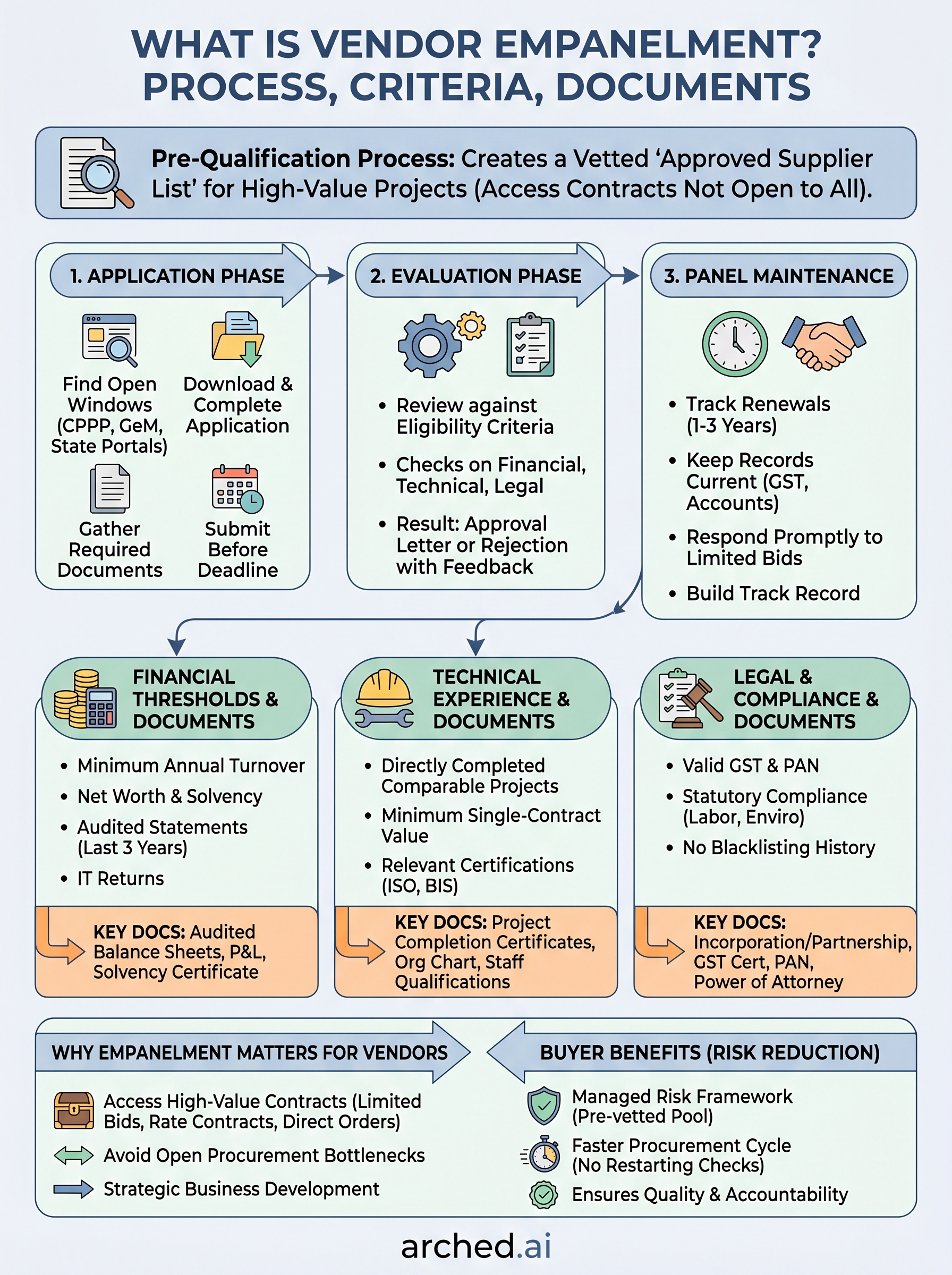
Understanding what is vendor empanelment means understanding how it unfolds in practice. The process runs in three broad phases: application, evaluation, and panel maintenance. While specific steps vary by organization and sector, the overall structure stays consistent across most government and public sector buyers in India.
Finding open empanelment windows
Most government bodies open empanelment applications at specific times, often at the start of a financial year or when an existing panel needs renewal. You'll find notices on the buyer's official website, on state e-procurement portals, or on central platforms like GeM and CPPP. Missing these windows means waiting for the next cycle, which can take six months to a full year.
Empanelment windows are not always advertised widely, so monitoring the right portals consistently is one of the most important habits a firm can build.
Common platforms to monitor include:
- Central Public Procurement Portal (CPPP)
- Government e-Marketplace (GeM)
- State-level e-procurement portals such as those run by state PWDs and urban local bodies
Submitting your application
Once you identify a relevant notice, you download the application form, gather the required documents, and submit the complete package by the stated deadline. Most applications ask for legal registration certificates, financial statements, and technical experience records. Some portals accept online submissions, but many state-level bodies still require physical dossiers with attested copies.
You need to read each empanelment notice carefully because submission requirements vary significantly between buyers. A format accepted by one department may not satisfy another, and incomplete submissions are rejected without further review.
Evaluation and panel approval
The buying organization reviews your submission against its published eligibility criteria. This stage can take anywhere from a few weeks to several months depending on application volume and internal processing capacity. Successful applicants receive a formal approval letter or registration number to use when responding to limited tenders or rate contract invitations from that organization.
Rejected applicants typically receive reasons for rejection and can reapply in the next empanelment cycle after addressing the specific gaps identified in the review.
Eligibility criteria buyers use to screen vendors
Knowing what is vendor empanelment also means knowing what buyers actually look for during the screening process. Each buying organization sets its own bar, but the core evaluation categories stay consistent across most government and public sector bodies in India. If your firm does not meet a specific threshold in any one of these areas, the application gets rejected outright, regardless of how strong your other credentials are.
Financial thresholds
Every empanelment notice specifies a minimum annual turnover requirement, and this figure usually ties directly to the contract values you would access once empaneled. A state PWD running road maintenance contracts at the crore level will set turnover thresholds accordingly. Beyond turnover, buyers also check net worth, solvency certificates, and profit-and-loss statements from the last three audited financial years.
If your financials show losses or irregular revenue, many buyers will flag your application before reaching any other criteria, so get your accounts in order before applying.
Some organizations also require a minimum working capital ratio or bank credit facility, to confirm you can execute contracts without financial disruption mid-project.
Technical experience requirements
Buyers verify that your firm has directly completed projects of comparable scope and value within a defined lookback period, typically five to ten years. They want project completion certificates, not just letters of intent or sub-contract work. Many empanelment panels in the AEC sector also require that qualifying projects meet a minimum single-contract value, meaning several small jobs do not substitute for one substantial one.
Relevant certifications such as ISO standards, BIS registrations, or sector-specific licenses can also become mandatory eligibility conditions depending on the buyer's category.
Legal and compliance checks
Buyers screen for active GST registration, PAN, and statutory compliance with labor and environmental regulations. Any pending litigation, blacklisting history, or debarment orders from other government bodies will disqualify your application immediately. Clean compliance records are a non-negotiable baseline across all empanelment categories.
Documents needed for vendor empanelment in India
The document package is where many applications fall apart. Understanding what is vendor empanelment means recognizing that the documents you submit are not a formality; they are the evidence that backs every eligibility claim your firm makes. Missing or incorrectly attested documents lead to outright rejection, even when your underlying credentials are strong enough to qualify.
Legal and registration documents
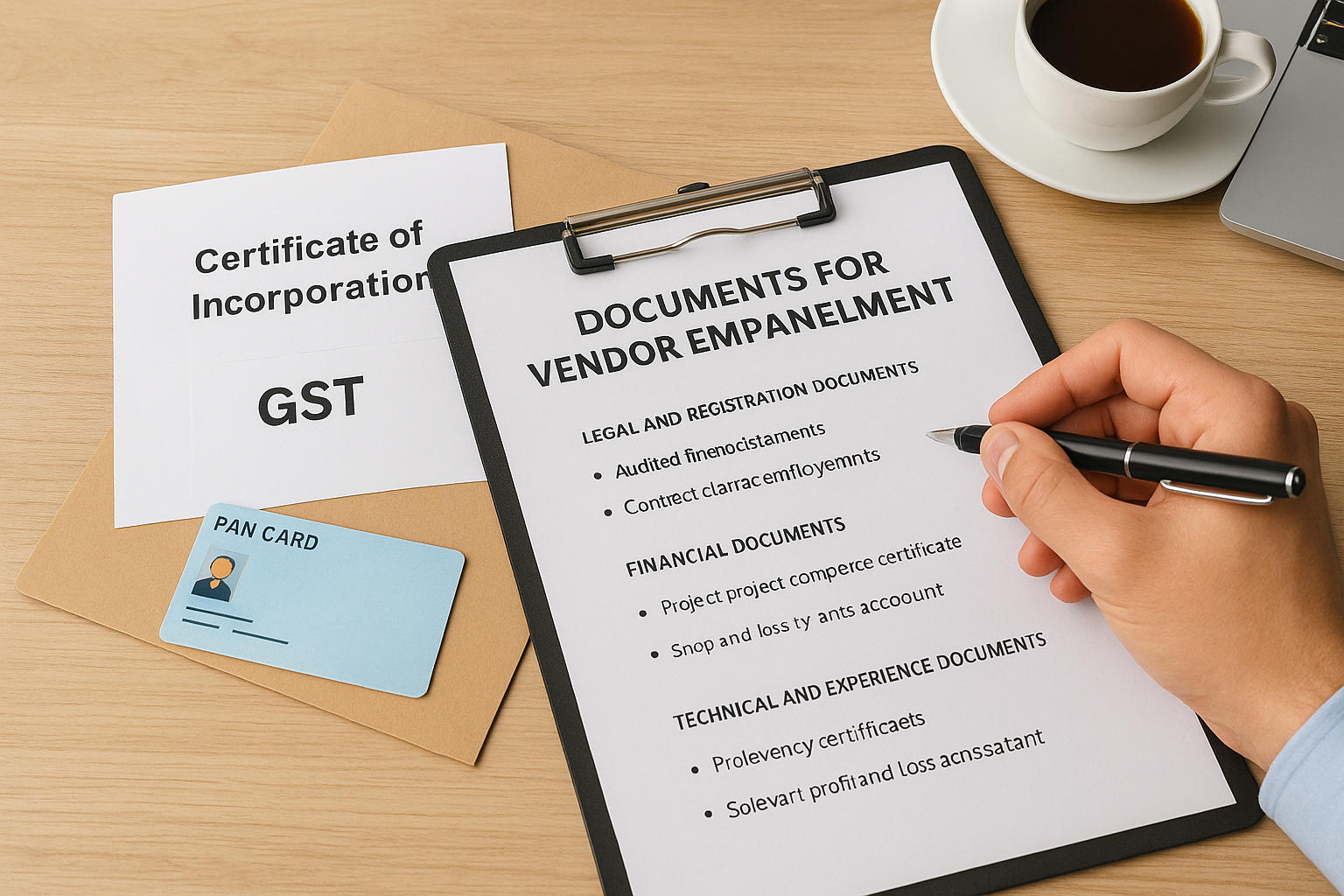
Every application starts with proof that your firm exists and operates legally. You need your Certificate of Incorporation or Partnership Deed along with a valid GST registration certificate and PAN card. Most buyers also require these documents:
- Memorandum and Articles of Association (for registered companies)
- Shop and Establishment Act registration or relevant trade license
- MSME or Udyam registration certificate, if applicable
- Power of attorney for the authorized signatory
Financial documents
This category typically receives the most scrutiny during evaluation. You need audited financial statements covering the last three financial years, including profit and loss accounts and balance sheets signed off by a registered chartered accountant. Solvency certificates from your bank and IT return acknowledgments for the corresponding years round out the financial package most buyers require.
Submitting unaudited accounts or informal financial summaries will get your application rejected at the first review stage, regardless of your actual turnover figures.
Technical and experience documents
Your technical documents prove you have done comparable work before. Prepare project completion certificates from previous clients that include contract value, scope description, and verifiable client contact details. Many buyers also ask for an organizational chart showing key technical staff alongside their qualification certificates, such as engineering degrees or relevant trade certifications.
Some organizations require ISO certificates or quality management registrations as part of the technical package. Check each empanelment notice individually because document requirements shift by sector and buying organization.
What to do after you get empanelled
Getting empanelled is the start of the work, not the end of it. Many firms treat panel approval as a finish line, then wonder why contracts don't follow. Understanding what is vendor empanelment means recognizing that the panel gets you in the room, but consistent engagement keeps you active in that room over time.
The firms that win the most work from empanelled panels treat their approval letter as a business development asset, not a filing cabinet item.
Track renewal dates and keep your records current
Every empanelment has a validity period, typically one to three years, after which you must reapply or renew. Missing a renewal deadline removes you from the active panel and can cost you months of contract access. Set internal reminders at least 90 days before expiry so you have time to update your financial statements, refresh your project completion certificates, and resolve any compliance gaps before resubmitting.
Your GST returns, audited accounts, and statutory filings must stay current throughout the empanelment period. Some buyers conduct mid-cycle compliance checks and de-list vendors who fall behind on their statutory obligations.
Respond to limited tender invitations promptly
Once empaneled, you will receive limited bid invitations or rate contract requests directly from the buying organization. These move quickly because the eligibility screening is already done. Delays in responding signal low interest and can affect how often that buyer includes your firm in future invitation lists, even if your empanelment remains technically active.
Keep your bid team informed of which panels you hold and build a response protocol so you can turn around competitive proposals within tight windows. Firms that respond consistently and professionally to limited invitations build a stronger track record with buyers, which directly influences how those buyers allocate sole-source work orders and urgent contracts within the panel.
Next steps
Now you know what is vendor empanelment, how the process works, what buyers evaluate, and which documents you need to prepare. The practical reality is that empanelment is not a passive process: you need to find the right panels, meet the eligibility bar, and then stay active on those panels once approved. Most firms lose ground not because they lack the credentials, but because they miss open application windows or renewal deadlines while monitoring dozens of portals manually.
Arched monitors over 500 government procurement portals across India, parses tender and empanelment documents automatically, and maps your firm's existing credentials against eligibility requirements so you know exactly where gaps exist before you apply. You get alerts when relevant empanelment windows open, and you get clear analysis of what each one requires. If you want to stop missing opportunities your firm already qualifies for, explore what Arched can do for your procurement strategy.