7 Team Collaboration Best Practices for Stronger Teams Today
Winning a government contract is never a solo effort. From the BD manager spotting the right tender to the bid team parsing qualification criteria and the consultant reviewing BOQ line items, every stage demands tight coordination across multiple people. When that coordination breaks down, missed deadlines, duplicated effort, a critical corrigendum nobody flagged, the cost isn't just wasted hours. It's a lost contract worth crores. That's exactly why team collaboration best practices matter so much in high-stakes environments like infrastructure contracting.
We've seen what happens when bid teams work in silos, checking portals independently, emailing PDFs back and forth, losing track of who reviewed what. Collaboration isn't a soft skill in government procurement; it's operational infrastructure.
But tools alone don't fix broken workflows. The practices your team adopts, how you share information, assign ownership, and make decisions together, determine whether you consistently submit competitive bids or constantly scramble at the last minute. This article breaks down seven proven collaboration practices that strengthen teams, reduce friction, and help everyone pull in the same direction. Whether you're a five-person consultancy or a large EPC firm with offices across states, these strategies will give you a concrete framework to work from.
1. Centralize bid collaboration in one place
Fragmented workflows are the single biggest collaboration killer in bid teams. When one person monitors GeM, another checks a state e-tender portal, and a third reviews shortlisted PDFs in a shared drive folder nobody updates consistently, critical information falls through the cracks. Centralizing your entire bid operation in one platform changes how your team works together at a fundamental level.

Why it matters
Every time a team member has to pull information from a separate system, send a follow-up email, or ask a colleague which version of a document is current, you lose time and introduce risk. Bid deadlines in Indian government procurement are strict and non-negotiable, so any coordination overhead directly threatens your submission quality. A single source of truth eliminates the back-and-forth and keeps everyone working from identical, up-to-date information.
When your team operates from one shared workspace, fewer decisions stall, fewer documents get missed, and fewer opportunities slip by unnoticed.
How to do it
Start by routing all tender discovery through one shared tracker that covers every portal you bid on, including GeM, CPPP, IREPS, MSTC, and state-level e-procurement systems. Assign each active opportunity a dedicated workspace where your BD manager, bid writer, and technical consultant all access the same tender documents, qualification flags, and BOQ extracts. Set up real-time alerts so the entire team gets notified of amendments or corrigendums the moment they appear, not hours later when someone manually checks a portal.
Examples in Indian government bidding
Consider a mid-size civil engineering firm bidding on road projects across Maharashtra and Rajasthan. Without centralization, each state portal requires a separate login and manual check, meaning your team likely misses corrigendums issued mid-cycle. With a shared tracker, the same firm receives a single alert covering both portals, and the tender documents are available to every team member without downloading separate PDFs or forwarding email attachments.
Metrics to track
Once you centralize, track these three numbers monthly to confirm the practice is working:
- Portal coverage rate: percentage of relevant portals actively monitored versus checked manually
- Alert-to-review time: how quickly a team member opens and acts on a new tender alert
- Document version disputes: number of times your team worked from outdated documents in a given bid cycle
2. Define roles and decision rights for every bid
When multiple people work on the same bid without clear ownership, tasks stall or get duplicated. Someone assumes the technical consultant reviewed the eligibility criteria. Someone else assumes the BD manager flagged the financial turnover requirement. Nobody did either. Defining roles and decision rights upfront is one of the most foundational team collaboration best practices you can implement before a single document gets drafted.
Why it matters
Bid work involves distinct functions: opportunity screening, document analysis, compliance checking, and final submission approval. When those functions lack named owners, accountability diffuses and deadlines slip. Every person on your team needs to know exactly what they own and what decisions they can make without escalating to someone else.
Unclear ownership is the most common reason a bid team misses a submission deadline despite having enough people to handle the work.
How to do it
Create a simple RACI matrix for each bid: Responsible, Accountable, Consulted, and Informed. Assign one person as the bid lead with authority to make final submission calls. Map out who reviews the BOQ, who confirms certifications, and who approves the final price before the document goes out. Review the matrix at kickoff and update it if the team composition changes mid-cycle.
Examples in Indian government bidding
On NHAI or PWD tenders, compliance documents and technical qualifications often originate from separate departments. Assigning one person to own the full compliance checklist prevents two departments from each assuming the other handled a key certificate.
Metrics to track
Track role assignment completion rate at bid kickoff and the number of tasks that changed hands mid-bid due to unclear ownership. Both numbers should trend toward zero.
3. Set clear communication norms for sync and async
Bid teams waste significant time in unnecessary meetings and lose critical context when conversations happen in scattered channels. Communication without structure creates confusion about where decisions live, who needs to respond by when, and what requires a real-time discussion versus a written update. Applying one of the most overlooked team collaboration best practices, defining exactly how and when your team communicates, removes that friction before it builds up.
Why it matters
Without shared norms, your team defaults to whatever feels comfortable, which usually means too many status calls and too many informal messages that leave no record. In procurement work, where decisions and document reviews have direct compliance consequences, undocumented communication is a liability.
A single unrecorded decision about a qualification document can cost your team the bid during final compliance review.
How to do it
Separate your communication into two categories. Use synchronous communication for time-sensitive decisions, bid strategy alignment, and final submission reviews. Reserve asynchronous channels for document comments, status updates, and non-urgent queries. Set a written rule: any decision that affects a bid document gets logged in your shared workspace, not buried in a chat thread.
Examples in Indian government bidding
On large CPWD or state irrigation tenders, pre-bid query deadlines are tight. Agreeing in advance that all pre-bid questions route through one designated person via async written review prevents duplicate submissions and conflicting queries.
Metrics to track
Track meeting count per bid cycle and the number of decisions that were made verbally but never documented. Both should decrease within two months of setting explicit norms.
4. Run tight kickoff and milestone reviews
Every bid your team works on benefits from two structured touchpoints: a kickoff meeting before work begins and milestone reviews at defined intervals. Without these, tasks drift, assumptions go unchallenged, and the submission date arrives before anyone has a complete picture of where the bid stands. Building structured reviews into your process is one of the most underused team collaboration best practices in government contracting firms.
Why it matters
A kickoff meeting aligns everyone on the scope, deadline, and known risks before a single document gets drafted. Milestone reviews catch problems early, when you can still fix them, rather than at the final submission stage when your options narrow significantly.
Catching a missing credential two weeks before submission is recoverable. Catching it two days before is not.
How to do it
Keep kickoffs under 30 minutes with a fixed agenda: tender overview, key qualification requirements, assigned roles, and deadline milestones. Schedule one mid-cycle review to check document progress, resolve blockers, and confirm compliance status. Document the outcomes of both meetings in your shared workspace so every team member can reference them.
Examples in Indian government bidding
On multi-crore NHAI or urban infrastructure tenders, pre-qualification requirements and BOQ complexity mean early alignment prevents costly rework. A kickoff that flags a missing ISO certification week one gives your team time to request it.
Metrics to track
Track kickoff completion rate across all active bids and the number of compliance issues first identified at milestone reviews versus the final submission check.
5. Standardize handoffs with checklists and templates
Every time work moves from one person to another on a bid, information gets lost unless you have a documented structure for the transfer. Standardizing handoffs with checklists and templates is one of the most practical team collaboration best practices you can implement right now, with no additional tools required.

Why it matters
Without a standard handoff format, the person receiving work has to chase the sender for context, missing deadlines or making incorrect assumptions about what's already been done. In government procurement, a single missed compliance document during handoff can invalidate an entire submission.
One overlooked certificate passed silently between reviewers costs more than the hours spent building a proper checklist ever will.
How to do it
Build a standard handoff checklist for each stage of your bid workflow: discovery, document analysis, compliance review, and final submission. Each checklist should confirm what was completed, what remains open, and any flags the next person must act on. Pair each checklist with a reusable template for common document types so no one starts from a blank page.
Examples in Indian government bidding
On CPWD or state PWD tenders, technical qualification documents and financial bid sections often move between different team members. A handoff checklist that confirms which certificates are attached and which BOQ items still need pricing prevents last-minute scrambles before the portal closes.
Metrics to track
Track handoff error rate per bid cycle and the number of tasks returned to the previous owner due to incomplete transfers. Both should drop within the first quarter.
6. Build psychological safety and rules for conflict
Strong team collaboration best practices don't just cover tools and processes. They also shape how your people treat each other when the pressure builds. Bid teams under deadline stress frequently avoid raising concerns or skip flagging a problem because they fear looking incompetent. That silence is expensive.
Why it matters
Psychological safety is the shared belief that you can raise a problem, challenge an assumption, or admit a mistake without being penalized. Without it, critical risks stay hidden until they surface at the worst possible moment, usually during final compliance review.
A team where everyone speaks up catches errors that a team of individual experts working in silence will always miss.
How to do it
Set an explicit norm at your next bid kickoff: concerns about document gaps, eligibility risks, or timeline slippage get raised immediately, not held until a formal review. Create a simple written protocol for disagreements. When two team members conflict over a technical interpretation, they each write their position briefly, then the bid lead decides. No shouting matches, no stewing in silence, and no majority-rules votes that override relevant expertise.
Examples in Indian government bidding
On complex NHAI tenders, eligibility criteria interpretations often split technical and BD team members. A written conflict protocol prevents that disagreement from stalling the submission while both sides wait for the other to back down.
Metrics to track
Track the number of risks flagged per bid cycle and how many were raised early versus discovered late. Rising early flags signal a healthier team culture.
7. Track a few collaboration metrics and improve monthly
Most bid teams skip measurement entirely, which means collaboration problems stay invisible until they show up as a lost contract or a missed deadline. Applying team collaboration best practices without tracking whether they're actually working leaves you guessing rather than improving systematically.
Why it matters
Metrics turn subjective impressions into concrete evidence. Without them, you can't tell whether your communication norms are reducing unnecessary meetings or whether your handoff checklists are genuinely cutting errors. Measurement creates accountability and gives your monthly review a factual foundation instead of a vague feeling that things are or aren't working.
How to do it
Pick three to five metrics you can realistically collect from your existing workflows without adding significant overhead. Review them once a month as a team, identify one specific behavior to improve, and set a target for the next cycle. Keep the review under 30 minutes so it becomes a sustainable habit rather than another meeting your team dreads.
Examples in Indian government bidding
On high-volume portals like GeM or state e-procurement systems, bid volume and submission success rates give your team an immediate read on whether your collaboration process is producing better outputs over time. Rising win rates paired with fewer last-minute document scrambles confirm your practices are taking hold.
Metrics to track
Focus on these four numbers each month:
- Bid-to-win ratio tracked month over month
- Average time from tender alert to submission decision
- Number of compliance errors caught post-submission
- Task completion rate before scheduled milestone reviews
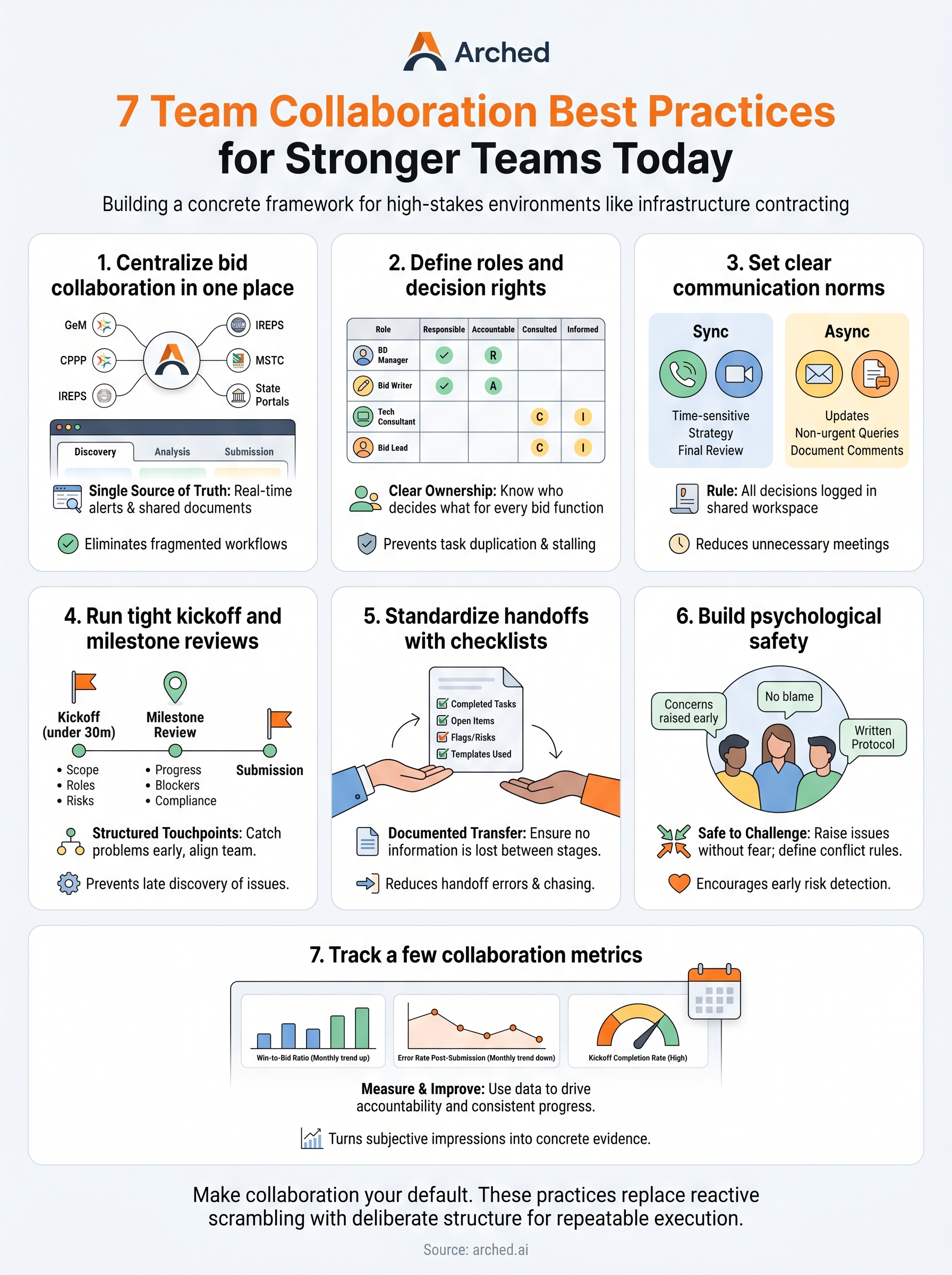
Make collaboration your default
The seven team collaboration best practices in this article share a common thread: they replace reactive scrambling with deliberate structure. Centralizing your bid operations, defining ownership, setting communication norms, running structured reviews, standardizing handoffs, building psychological safety, and measuring your progress monthly are not isolated fixes. They compound. Each practice reinforces the others, and together they shift your team from constant firefighting to consistent, repeatable execution on every bid you run.
Government procurement in India moves fast. Corrigendums drop without warning, eligibility requirements shift mid-cycle, and portal deadlines don't move for anyone. Your team needs a collaboration system that absorbs that pressure without breaking down. Start with one practice from this list, embed it firmly into your next bid cycle, confirm it's working against the metrics, and then layer in the next one. Small, consistent improvements add up to a measurably stronger team over a single quarter.
And when the bottleneck is pricing the bid, Arched can take the estimate off your team's plate: send us the project and we deliver a priced BOQ reviewed by an engineer.
Have a package your team can’t get to? Send it to us. Our engineers check and sign off everything we deliver.