Team Collaboration vs Teamwork: Key Differences, Examples
Most people use "teamwork" and "collaboration" as if they mean the same thing. They don't. The distinction between team collaboration vs teamwork shapes how projects get planned, how decisions get made, and ultimately, how effectively a group delivers results. Swap one for the other in the wrong situation, and you end up with confused roles, duplicated effort, or missed deadlines.
This matters especially in high-stakes environments like infrastructure contracting and public procurement. A bid team responding to a government tender, for instance, needs both: structured teamwork to hit submission deadlines and cross-functional collaboration to parse complex BOQs, eligibility criteria, and risk clauses buried in tender documents. We've seen firsthand how the right team structure can decide whether a firm submits a clean, competitive bid.
This article breaks down the real differences between teamwork and collaboration, walks through examples from professional and project-based settings, and gives you a practical framework for knowing when each approach fits. By the end, you'll have a clear picture of how to apply both concepts where they actually matter.
Teamwork and collaboration defined
When people discuss team collaboration vs teamwork, they typically treat both terms as synonyms for "people working together." That's imprecise enough to cause real problems. Each concept describes a distinct way of organizing group effort, and applying the wrong one to a project leads to wasted time, unclear accountability, and poor outcomes. Getting the definitions right is the starting point for everything else.
What teamwork means
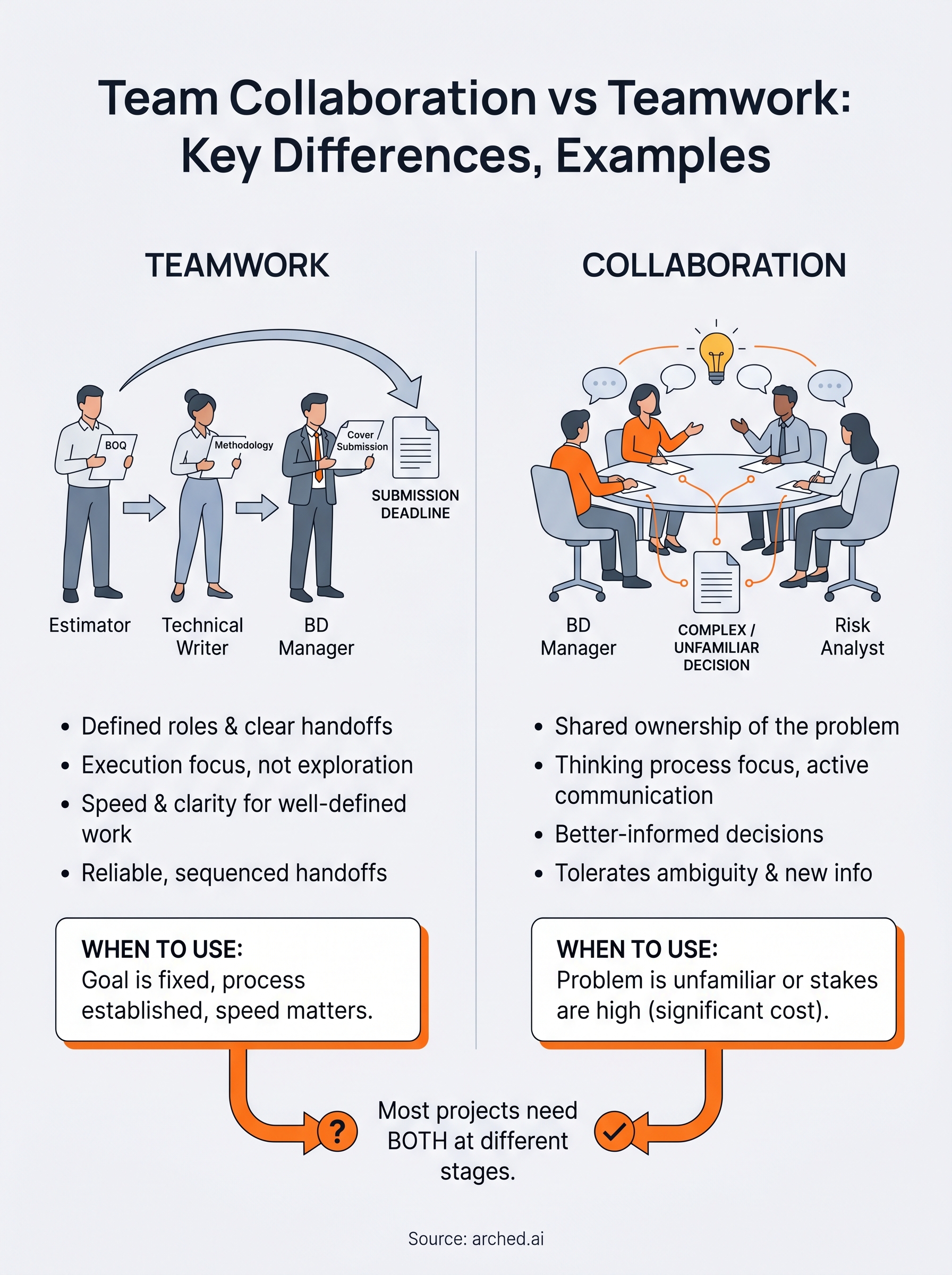
Teamwork is the coordinated effort of a group where each person holds a defined role and contributes a specific piece toward a shared, pre-set goal. The goal itself is fixed before the work begins. A structural engineering firm responding to a road tender illustrates this well: the estimator prices the BOQ, the technical writer drafts the methodology, and the BD manager prepares the cover submission. Each person executes their lane, and the bid comes together through reliable, sequenced handoffs.
In teamwork, you don't need members to deeply understand each other's work. You need them to complete their own part accurately and on schedule. This makes teamwork highly efficient for process-driven, time-bound tasks where the path to the outcome is already well understood. The emphasis is on execution, not exploration.
Teamwork succeeds when roles are clear and everyone trusts that the other parts of the process will hold.
What collaboration means
Collaboration is a different mode entirely. It involves multiple people contributing knowledge, judgment, and perspective to solve a problem that doesn't have a predetermined answer. The goal in a collaborative process often shifts as the group surfaces new information and challenges each other's assumptions.
Consider a firm evaluating whether to pursue a large irrigation contract for the first time. The BD manager, a senior engineer, a finance lead, and a risk analyst all bring different lenses to that decision. None of them holds the full picture individually. The final call - bid or pass, and on what terms - emerges from their combined input, not from any single person completing a task. That's collaboration: the output is shaped by the thinking process itself, not just the execution of predetermined steps.
Collaboration requires active communication and shared context. It also requires tolerance for ambiguity, because the right answer isn't visible at the start. This makes collaboration slower in the short term, but far better suited to complex, unfamiliar, or high-stakes decisions.
How they overlap and where they diverge
Both teamwork and collaboration require trust and communication between participants. In both cases, you're trying to produce something that individuals couldn't deliver working in isolation. That's where the overlap ends.
The real divergence comes down to structure and ownership. Teamwork runs on structure: assigned roles, fixed deliverables, and a clear division of labor. Collaboration runs on shared ownership of the problem itself. Role boundaries blur because the priority is producing the best possible answer, not completing a specific task.
A practical way to frame it: teamwork asks you to do your part well, while collaboration asks you to think alongside others until the group finds the right path. Most serious projects in infrastructure, procurement, and professional services require both, often at different stages of the same engagement.
Key differences that matter at work
Knowing the definitions helps, but the real value comes from understanding how these two modes behave differently once a project is underway. When you look at team collaboration vs teamwork side by side, three concrete differences stand out - and each one changes how you set up your team, assign responsibility, and measure success.
Structure and role clarity
Teamwork operates on fixed roles and clear handoffs. Each person owns a specific deliverable, and the group moves forward as those deliverables stack up in sequence. You know exactly who is responsible for what, which makes accountability straightforward and performance easy to measure. A tender submission team runs on this logic: the estimator prices the BOQ, the technical writer drafts the methodology, and no one waits around for a group vote.
Collaboration deliberately loosens role boundaries. The best insight in a collaborative session might come from the finance lead spotting a technical risk, or the engineer flagging a contractual clause that changes the budget picture entirely. Keeping people strictly inside their lanes shuts that kind of cross-functional thinking down before it starts.
The more defined the roles, the faster the execution - but the narrower the thinking.
Decision-making and ownership
In teamwork, decisions typically flow from a project lead or manager. The team leader sets the goal, assigns tasks, and resolves disputes. Individual contributors focus on their own outputs and trust the lead to steer the overall direction.
Collaboration distributes decision-making across the group. No single person holds authority over the final answer. That shared ownership produces better-informed outcomes when the problem is complex, but it also means the process takes longer and requires all participants to stay fully engaged throughout.
Speed and adaptability
Teamwork is faster for well-defined work. When the process is already mapped out, structured roles eliminate friction and reduce back-and-forth. A bid team working against a portal submission deadline cannot afford open-ended discussion; they need clean execution across every assigned task.
Collaboration, by contrast, handles ambiguity far better than teamwork does. When the problem is unclear or the cost of a wrong call is high, a collaborative process surfaces risks and blind spots that a task-focused team would miss entirely. You pay for that clarity with time, which is exactly why choosing between the two modes matters.
Benefits and trade-offs of each approach
Understanding team collaboration vs teamwork means going beyond definitions to look at what each approach actually delivers, and what it costs you. Every mode of working has real strengths, but also genuine limitations that show up clearly once a project is underway. Knowing both sides helps you make better decisions about how you structure your teams at each stage of a project.
What teamwork does well (and where it falls short)
Teamwork's biggest strength is speed and clarity. When roles are set and the goal is fixed, a team can execute at a pace that open-ended collaboration simply cannot match. Accountability is straightforward because each person owns a specific deliverable, which makes it easy to track progress and resolve blockers without pulling everyone into a meeting.
The trade-off is rigidity. Teamwork struggles when conditions change mid-project or when the problem turns out to be more complex than the initial plan assumed. Because members work within narrow lanes, cross-functional risks can go unspotted until they become expensive to fix. A team optimized for fast execution often lacks the structure to catch what it doesn't already know to look for.
Teamwork rewards precision and speed, but it requires you to have the right answer before the work begins.
What collaboration does well (and where it falls short)
Collaboration's core strength is quality of thinking. When you bring multiple disciplines into the same problem, blind spots shrink. A finance lead might catch a cash-flow risk in a tender clause that the technical team missed entirely. That kind of cross-functional insight routinely produces better-informed decisions on high-stakes, unfamiliar, or complex problems where a wrong call carries significant cost.
The trade-off is time and coordination overhead. Collaboration requires all participants to stay fully engaged, align on shared context, and tolerate ambiguity long enough to reach a sound conclusion together. That process is inherently slower than assigning tasks and executing against a deadline. In fast-moving procurement environments, where submission windows are tight and portals close without warning, a purely collaborative approach can leave you without a completed bid. The answer is usually knowing when each mode fits - which is exactly what the next section covers.
When to use teamwork vs collaboration
Choosing between team collaboration vs teamwork comes down to two questions: how well-defined is the goal, and how high is the cost of getting it wrong? Both questions have practical answers that point you toward the right mode before a project kicks off, not after it has already gone sideways.
Use teamwork when the path is clear
Teamwork fits best when the goal is fixed, the process is established, and speed matters. Tender submissions are the clearest example in the AEC space. The deadline is firm, the deliverables are known, and each team member needs to complete their section without waiting for group input to move forward. Adding open-ended discussion to that environment creates friction without adding value.
You should also default to teamwork for recurring tasks with measurable, predictable outputs: monthly reporting, standard document preparation, or portal monitoring across a set list of government procurement sites. When the process works and the variables are stable, structured roles and clean handoffs get you to the finish line faster than any amount of joint deliberation.
If you already know the answer and just need it executed reliably, teamwork is the right call.
Use collaboration when the problem is unfamiliar or the stakes are high
Collaboration earns its place when the problem carries real uncertainty or when a wrong decision is expensive to reverse. Deciding whether to pursue a new contract category, evaluating an unusual risk clause in a tender, or building a growth strategy into an unfamiliar vertical are not execution problems. They require diverse perspectives working through the ambiguity together before anyone can define what "done" even looks like.
High-stakes decisions in government contracting fit this profile exactly. A bid on a large infrastructure project in a category your firm has limited experience with deserves a collaborative review, not just a task assignment. Bringing your BD manager, senior engineer, and finance lead into the same room to stress-test the approach reduces the chance of a costly mistake at a stage where the time investment still pays off. Once the decision is locked and the approach is set, you shift back to teamwork to execute it cleanly.
Real examples and a simple decision guide
Theory only goes so far. Seeing team collaboration vs teamwork applied to real scenarios makes the right choice obvious much faster than any abstract definition. The examples below pull directly from contexts that AEC firms and government contractors encounter regularly, and the decision guide that follows gives you a fast, practical way to apply the same logic to your own projects.
What each approach looks like in practice
A road widening project bid is a textbook teamwork scenario. Your estimator prices the BOQ, your engineer drafts the technical methodology, and your bid coordinator compiles the submission package. Each person owns a fixed deliverable, and the whole effort moves on clean handoffs toward a locked portal deadline. No one needs to fully understand every other person's work; they need to complete their own section accurately and on time.
By contrast, a firm evaluating whether to pursue its first large bridge contract faces a genuine collaboration scenario. Your BD manager, finance lead, and senior structural engineer each hold a different piece of the risk picture. No single person can assess eligibility, cash flow exposure, and technical complexity alone. The firm reaches a sound decision only when all three perspectives surface and interact, and the final call emerges from the group's combined thinking, not from any one person completing an assigned task.
The right mode is not about preference; it is about matching your approach to the actual structure of the problem.
A simple decision guide
Use this table to make a fast call when you are setting up a new project or task:
| Situation | Right approach |
|---|---|
| Deadline is fixed and deliverables are known | Teamwork |
| Problem involves high uncertainty or unfamiliar territory | Collaboration |
| Multiple disciplines need to stress-test a decision | Collaboration |
| Execution follows an already-approved plan | Teamwork |
| A wrong call carries significant financial or legal cost | Collaboration |
| Speed and predictable output are the priority | Teamwork |
Run through these conditions before you assign work. Most projects shift between both modes at different stages - collaborative during strategy and evaluation, then structured teamwork through execution. Recognizing that shift and adjusting your team structure accordingly is what separates firms that bid smart from those that simply bid often.
Quick recap and next steps
The core distinction in team collaboration vs teamwork comes down to structure and intent. Teamwork gives you speed and accountability through fixed roles and clean handoffs, while collaboration gives you better decisions through shared thinking on complex or unfamiliar problems. Neither approach beats the other universally. The right call depends on whether your goal is already fully defined or still being worked out through collective input.
Most AEC firms and government contractors need both, often within the same engagement. Use collaboration to evaluate whether a tender is worth pursuing, assess unusual risk clauses, or plan entry into a new contract category. Switch to structured teamwork once the decision is made and the execution clock starts. And if pricing is where your bid team is stretched, Arched's estimating service can deliver an engineer-reviewed BOQ for your tender.
Have a package your team can’t get to? Send it to us. Our engineers check and sign off everything we deliver.