Construction Cash Flow Template: What It Is And How To Build One
Every contractor knows the feeling: the project is on schedule, the client is paying on time, and yet the bank balance keeps sliding into the red. That gap between billing and actual cash in hand sinks more construction firms than bad workmanship ever does. A construction cash flow template fixes this by giving you a structured way to project every rupee coming in and going out, week by week or month by month, across the life of a project.
If you searched for this template hoping to download something you can actually use, you are in the right place. This article breaks down exactly what belongs in a working cash flow sheet, from retention percentages and mobilization advances to labor payouts and material procurement schedules, and then walks you through building one from scratch in Excel.
We will also cover how tender-stage assumptions, like payment terms and milestone schedules buried inside BOQ documents, feed directly into your cash flow projections. Getting that data right early, before you even bid, is what separates firms that plan cash flow from firms that just react to it. Accurate forecasting starts long before mobilization, and this guide shows you where.
Why construction cash flow forecasting matters
Ask any bid manager how many projects they have watched turn profitable on paper while the company scrambled to make payroll, and you will get a knowing laugh. Cash flow forecasting exists because profit and cash are not the same thing, and construction is one of the few industries where that gap can swallow an otherwise healthy business whole. A project might show a 15% margin at completion, but if the cash to fund labor, materials, and subcontractors arrives months after you spend it, the margin means nothing when the bank account hits zero in month four.
The profit-cash flow disconnect
Construction accounting runs on accrual-based reporting, which recognizes revenue when milestones are certified, not when the client actually transfers funds. Government contracts make this worse because certification, verification, and payment release often happen in three separate stages, each with its own bureaucratic delay. A firm can be fully compliant with its contract terms and still run out of working capital simply because the timing between spend and receipt was never mapped out in advance.
A project can be profitable on paper and bankrupt in practice if nobody mapped the timing between spend and receipt.
Why construction bleeds cash faster than other industries
Most sectors collect payment close to the point of delivery. Construction does not work that way. You mobilize a site, buy cement and steel upfront, pay labor weekly, and then wait 30, 60, or sometimes 90 days for a running account bill to clear, all while a chunk of that bill sits locked in retention until final handover. Layer on mobilization advances that need to be repaid through deductions, and you get a payment structure that front-loads your costs and back-loads your income by design.
Here is what that mismatch typically looks like across a mid-sized road or irrigation project:
| Cash Flow Stage | Typical Timing | Impact on Working Capital |
|---|---|---|
| Mobilization advance received | Week 1-2 | Temporary relief, but recoverable |
| Material procurement outflow | Week 2-6 | Major cash drain begins |
| Labor and subcontractor payouts | Weekly | Continuous drain throughout project |
| First running account bill submitted | Month 2 | No cash impact yet |
| Bill certified and payment released | Month 3-4 | Partial relief, minus retention |
| Retention released | Post-defect liability period | Delayed by 6-12 months typically |
Without a forecast that lays this timeline out in advance, firms end up funding the gap with overdraft facilities or, worse, delaying payments to their own subcontractors, which damages relationships they will need on the next tender.
The cost of getting it wrong
Undercapitalized projects do not usually fail because the work was bad. They fail because someone assumed the money would show up when the schedule said it should. Working capital shortfalls force contractors into a familiar and expensive spiral: they borrow at high interest to cover payroll, delay their own vendor payments to preserve cash, and eventually slow down site progress because suppliers stop extending credit. That slowdown then triggers penalty clauses for missed milestones, which drains even more cash at the worst possible moment.
The firms that avoid this cycle are not the ones with the biggest balance sheets. They are the ones that built a cash flow template before mobilization and updated it every time a payment term, BOQ quantity, or schedule assumption changed. Forecasting does not eliminate the timing gap between spend and receipt, since that gap is structural to how government contracts work. What forecasting does is let you see the gap coming far enough in advance to arrange a credit line, negotiate better mobilization terms, or simply plan procurement around when the money actually lands rather than when the contract says it should.
How to build a construction cash flow template
Building a working cash flow sheet does not require expensive software. A well-structured Excel spreadsheet handles this job for most mid-sized contractors, as long as you set it up with the right logic from the start. The goal is a rolling model that updates every time a payment term, quantity, or schedule assumption changes, not a static document you build once and forget.
Set up your time-phased structure
Start with columns for weeks or months across the full project duration, and rows for every category of inflow and outflow. Weekly granularity works best for projects under six months, while monthly columns suit longer infrastructure jobs where labor and material costs shift less abruptly week to week.
- Header row: project timeline in weeks or months
- Row block 1: cash inflows (advances, RA bills, retention releases)
- Row block 2: cash outflows (labor, materials, subcontractors, overheads)
- Bottom row: net cash position, cumulative
Pull real numbers from the BOQ and contract
Your outflow figures should come directly from the Bill of Quantities, not rough estimates. Match each BOQ line item to the schedule it corresponds to, then spread the cost across the weeks or months when that work actually happens. Do the same for inflows using the payment terms buried in the tender document: advance percentages, RA bill frequency, retention percentage, and defect liability period length all belong in your assumptions tab before you touch the main sheet.
A cash flow template is only as accurate as the contract terms you feed into it.
Build the running balance formula
The row that actually tells you whether you are safe or exposed is the cumulative net position, calculated by carrying the prior period's balance forward and adding the current period's net inflow or outflow.
Net Cash This Period = Total Inflows - Total Outflows
Cumulative Balance = Previous Cumulative Balance + Net Cash This Period
Once this formula runs across every column, any month where the cumulative balance turns negative flags exactly when you will need a credit line or a renegotiated advance.
Where the manual approach breaks down
Manually extracting BOQ line items and payment clauses from a 200-page tender PDF takes hours, and firms often build templates on assumptions that turn out wrong once someone actually reads the fine print. Starting from a reviewed BOQ with checked quantities and payment terms gives your cash flow model numbers that are verified rather than guessed.
Key components every template should include
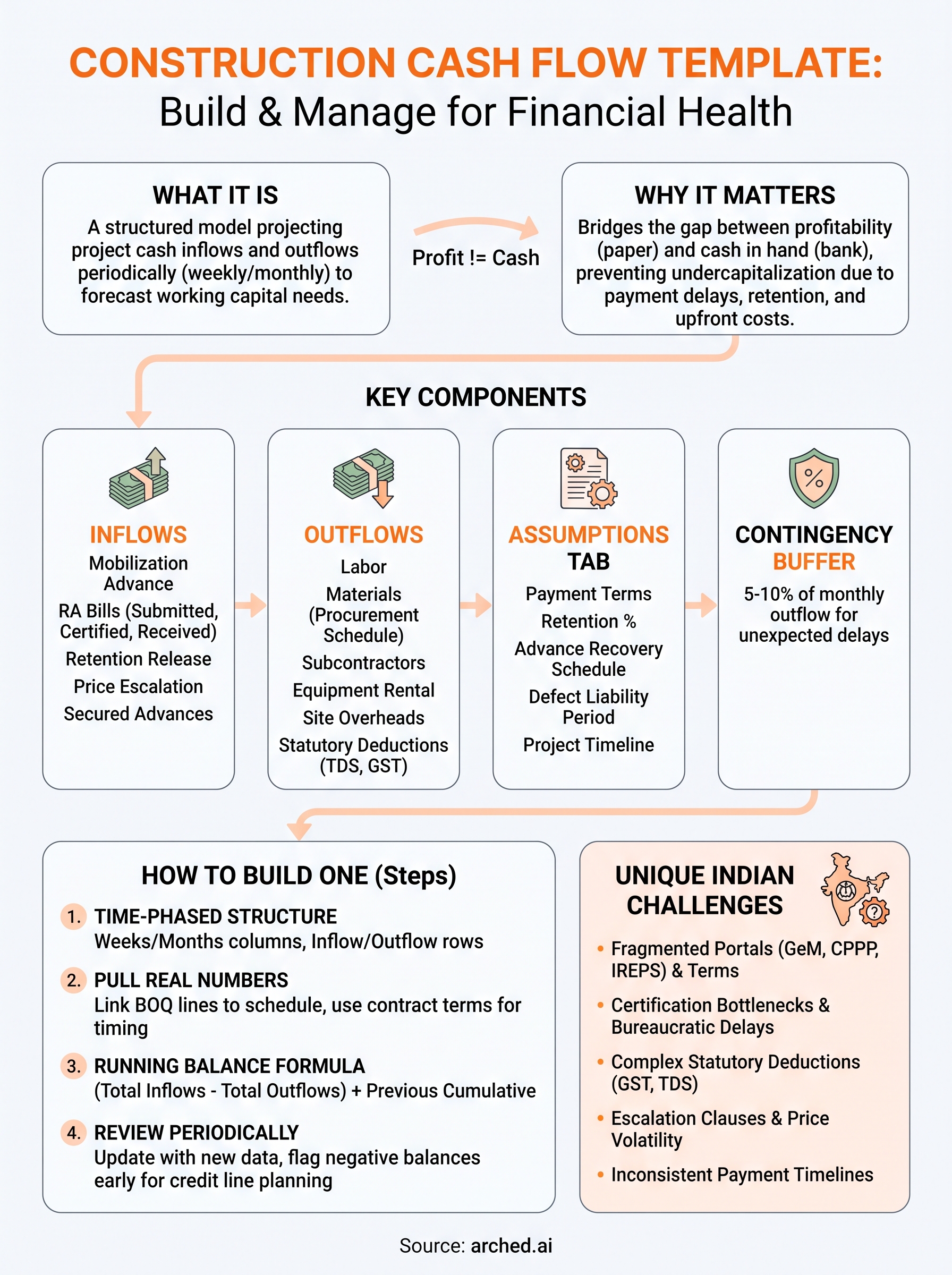
A construction cash flow template only earns its keep if it captures every line item that actually moves money, not just the obvious ones. Skip a component and the forecast looks tidy on screen while the real bank account tells a different story. Below are the pieces that belong in any template built for an Indian infrastructure or government contract, organized by what they do rather than where they sit on the sheet.
Inflow line items
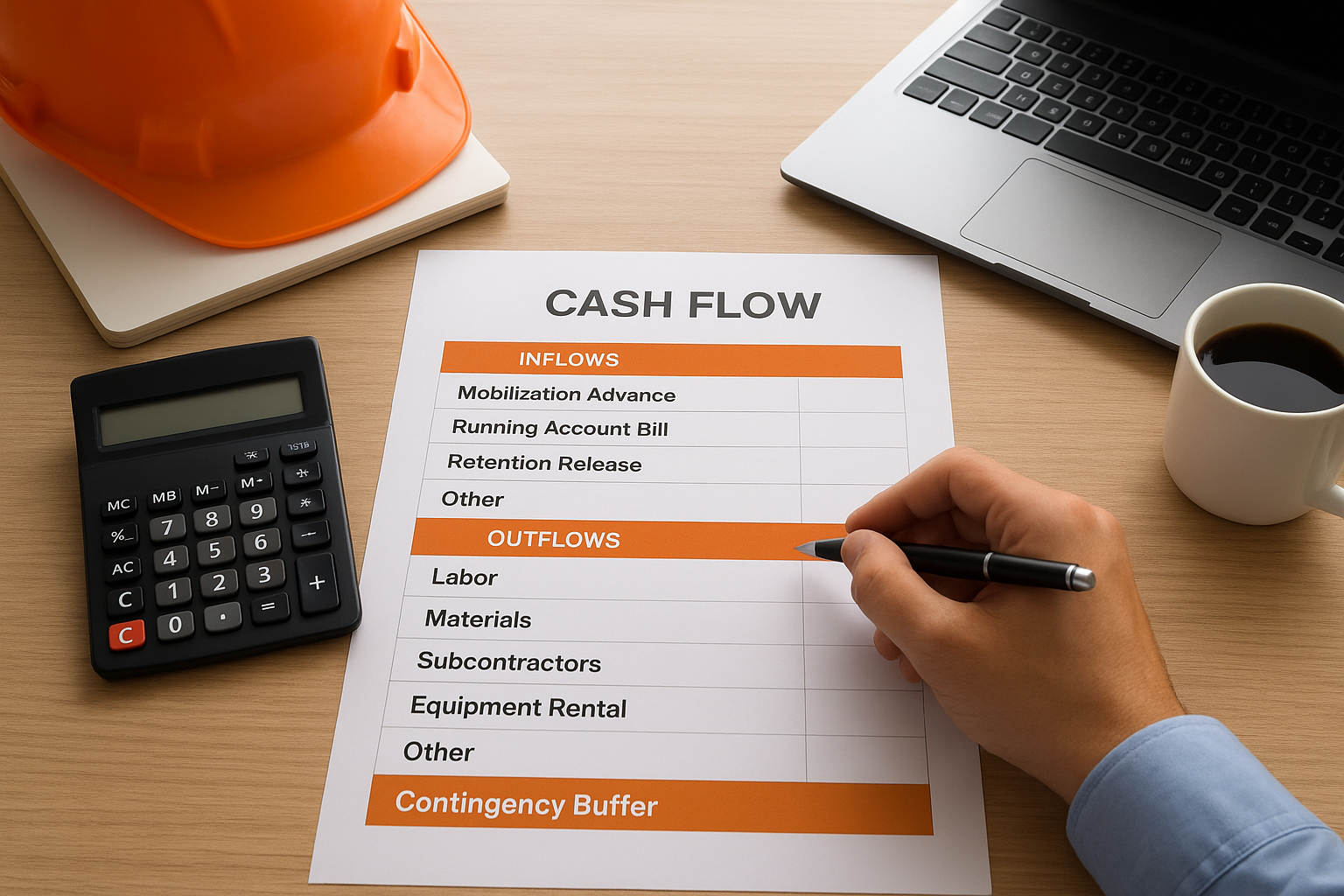
Every rupee coming into the project needs its own row, tagged to the payment clause that triggers it. This includes the mobilization advance, each running account bill, retention releases, price escalation claims where applicable, and any secured advance against materials stored on site. Government contracts often stagger these across multiple approval stages, so your template should separate "bill submitted" from "bill certified" from "payment received," since treating them as one event hides weeks of delay that will hit your working capital.
Outflow line items
On the outflow side, break costs into labor, materials, subcontractor payments, equipment rental, site overheads, and statutory deductions like TDS and GST liabilities. Materials deserve their own sub-schedule because bulk purchases of cement, steel, or bitumen often need to be paid before the corresponding work gets billed, which is exactly the kind of timing gap that catches contractors off guard.
The buffer and assumptions layer
Every template needs an assumptions tab that documents the payment terms, retention percentage, advance recovery schedule, and defect liability period pulled from the contract. This tab is what makes the model auditable and easy to update when terms change mid-project.
A template without a documented assumptions tab is just a guess dressed up as a forecast.
Alongside assumptions, build in a contingency buffer, typically 5 to 10% of monthly outflow, to absorb payment delays that run longer than the contract specifies, which happens routinely on government work.
| Component Category | Examples | Why It Matters |
|---|---|---|
| Inflows | Advances, RA bills, retention release | Drives when cash actually lands |
| Outflows | Labor, materials, subcontractors, statutory dues | Drives when cash actually leaves |
| Assumptions tab | Payment terms, retention %, DLP length | Keeps the model tied to contract reality |
| Contingency buffer | 5-10% of monthly outflow | Absorbs delays beyond contract terms |
Together, these four layers turn a generic spreadsheet into a working forecast rather than a document you fill in once and never revisit.
A sample cash flow calculation walkthrough
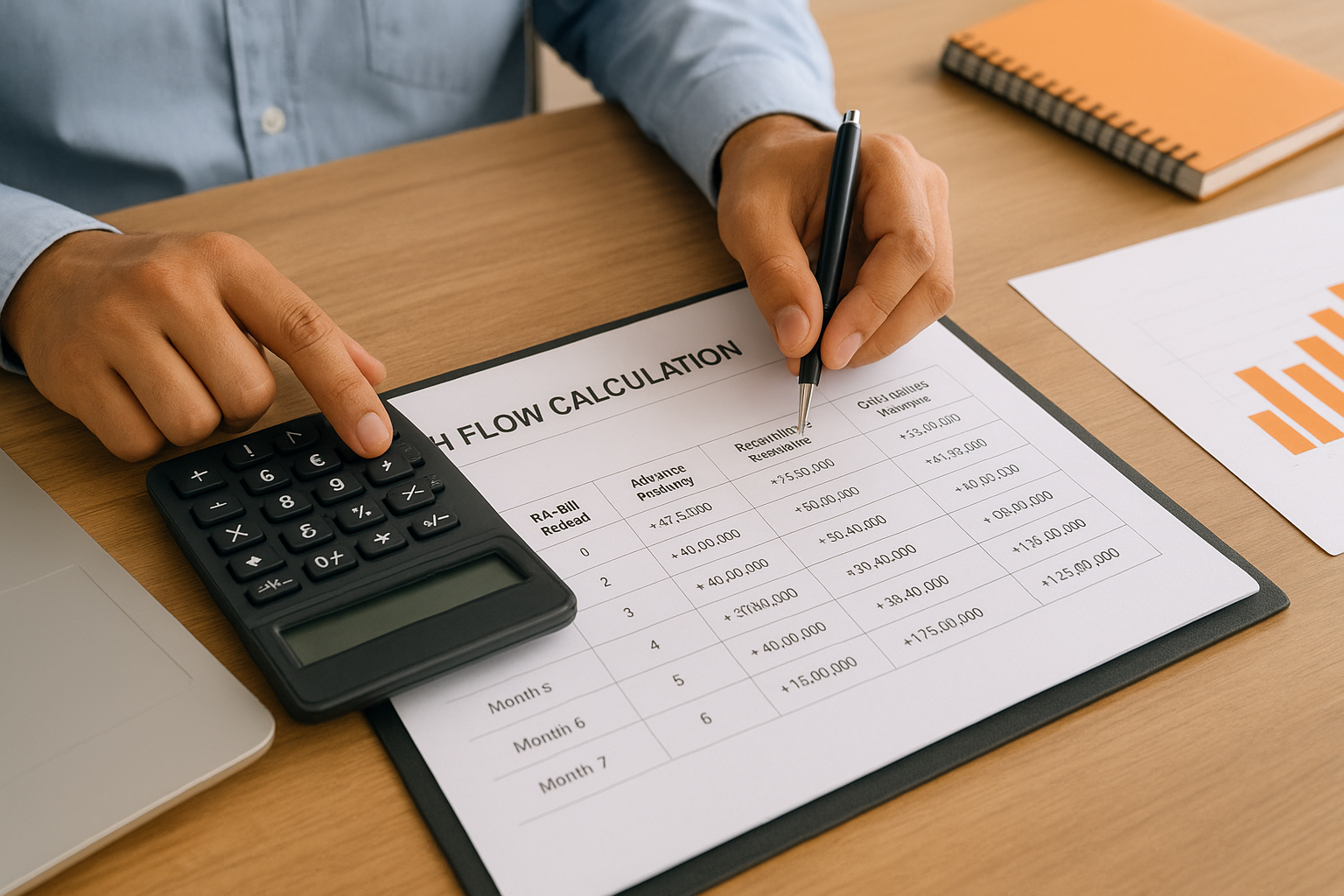
Numbers make this concept click faster than theory ever will, so let's run a small road project through the template. Assume a ₹5 crore contract, a 10% mobilization advance, monthly RA bills, 5% retention, and a 90-day certification-to-payment cycle typical of state PWD contracts.
Setting up the assumptions
Before touching the main sheet, the assumptions tab needs these figures locked in:
- Contract value: ₹5,00,00,000
- Mobilization advance: 10%, recovered in equal installments over the first six RA bills
- Retention: 5% held on every certified bill, released after the defect liability period
- Monthly work progress: roughly ₹40 lakh in months 1 through 6, ramping to ₹60 lakh in months 7 through 10
- Payment lag: bill certified in month X, cash received in month X+3
Running the numbers month by month
With those assumptions feeding the formulas from the earlier section, the first six months look like this:
| Month | RA Bill Raised | Advance Recovery | Net Received (after retention) | Cumulative Outflow | Cumulative Balance |
|---|---|---|---|---|---|
| 1 | 0 | Advance ₹50,00,000 in | 0 | ₹35,00,000 | +₹15,00,000 |
| 2 | ₹40,00,000 | -₹8,33,333 | 0 (bill in process) | ₹75,00,000 | -₹23,33,333 |
| 3 | ₹40,00,000 | -₹8,33,333 | 0 | ₹1,15,00,000 | -₹63,33,333 |
| 4 | ₹40,00,000 | -₹8,33,333 | ₹30,40,000 (month 1 bill) | ₹1,55,00,000 | -₹1,01,26,667 |
| 5 | ₹40,00,000 | -₹8,33,333 | ₹30,40,000 | ₹1,95,00,000 | -₹1,38,53,333 |
| 6 | ₹40,00,000 | -₹8,33,333 | ₹30,40,000 | ₹2,35,00,000 | -₹1,75,80,000 |
Reading the result correctly
Notice how the cumulative balance turns sharply negative around month 3, even though every bill gets certified on schedule. That gap is not a sign of a failing project. It is the normal lag between spend and receipt showing up on paper months before it would show up in a bank statement if nobody had modeled it.
The template's job isn't to make the negative number disappear, it's to show you exactly which month you'll need a credit line before that month arrives.
Contractors who run this exercise before mobilization typically arrange an overdraft facility or negotiate a larger mobilization advance during contract negotiation, rather than scrambling for funds once the site is already underway and subcontractors are asking for payment.
Cash flow challenges unique to Indian government contracts
A generic cash flow template built for private construction work misses several traps that only show up on Indian government contracts. Public procurement runs through hundreds of portals, each with its own payment cycle, escalation clause format, and approval hierarchy, and a template that ignores this ends up wrong from month one.
Fragmented portals and inconsistent payment terms
GeM, CPPP, IREPS, and state-level e-procurement systems each structure advances, RA bill frequency, and retention differently, so a template calibrated on one department's terms often fails on the next tender from a different state PWD or irrigation board. Bid teams juggling multiple live contracts across portals end up maintaining separate assumption sets for each one, which multiplies the manual work of pulling BOQ data and payment clauses out of every fresh tender document.
Certification bottlenecks and bureaucratic delay
Government contracts route every bill through measurement, technical certification, and financial sanction before release, and each stage sits with a different officer who may be on leave, awaiting a transfer order, or simply backlogged. This is why the 90-day payment lag used in the earlier walkthrough is treated as an optimistic case on many state contracts rather than a worst case.
On government work, the contract's stated payment timeline and the actual payment timeline are rarely the same number.
GST, TDS, and statutory deduction complexity
Every RA bill on a government contract gets hit with TDS deductions under the Income Tax Act and GST-related withholding before the net amount reaches your account, and these deduction rates vary depending on whether the client is a central ministry, a state department, or a public sector undertaking. According to the Central Public Procurement Portal, departments are required to follow standardized bidding formats, but statutory deduction handling still differs enough across agencies that a template built for one client often needs adjustment for the next.
Escalation clauses and material price volatility
Long-duration infrastructure contracts usually carry a price escalation clause tied to indices for cement, steel, or bitumen, and claiming that escalation requires separate documentation and a separate approval cycle from the main RA bill. Firms that forget to model escalation inflows as a distinct line item, arriving months after the underlying work, routinely underestimate how long their cash position stays negative even when the underlying contract terms look generous on paper.
Staying ahead of your project's cash position
A construction cash flow template only works if you build it before mobilization and update it every time a payment term or BOQ quantity shifts. The math in this guide, the assumptions tab, the running balance formula, the contingency buffer, all of it exists to show you the negative month before it arrives, not after your subcontractors start asking questions. Indian government contracts add real friction on top of that baseline, since certification delays, statutory deductions, and escalation clauses rarely match what the tender document promises.
The firms that stay solvent through this are the ones treating cash flow as a living forecast rather than a spreadsheet they filled in once. If you would rather start your forecast from a reviewed BOQ than assemble one by hand, see how Arched's estimating service works: send us the tender and we deliver a priced BOQ, reviewed by an engineer.
Have a package your team can’t get to? Send it to us. Our engineers check and sign off everything we deliver.