Bilateral Tenders: Definition, Eligibility, And Bid Process
When two governments sign a development cooperation agreement, say, India and Japan collaborating on a metro rail corridor, the funded projects that follow are procured through bilateral tenders. These tenders come with their own eligibility rules, funding conditions, and procurement guidelines that differ significantly from standard domestic government contracts.
For infrastructure firms and consultancies bidding on public projects in India, bilateral tenders represent some of the highest-value opportunities available. Contracts funded by agencies like JICA, KfW, ADB (under bilateral windows), or USAID often run into hundreds of crores and carry structured payment mechanisms backed by international agreements. But they also come with layered compliance requirements, nationality restrictions, and documentation standards that catch unprepared bidders off guard.
The challenge isn't just finding these opportunities, it's understanding which ones you actually qualify for. Bilateral tenders are scattered across multiple portals and agency websites, and the eligibility criteria buried inside their procurement notices can take hours to parse manually.
This article breaks down what bilateral tenders are, who can bid on them, how the procurement process works, and what your firm needs to prepare a competitive submission. Whether you're targeting your first bilaterally funded project or looking to move into larger contract tiers, this guide covers the essentials.
What bilateral tenders are and how they work
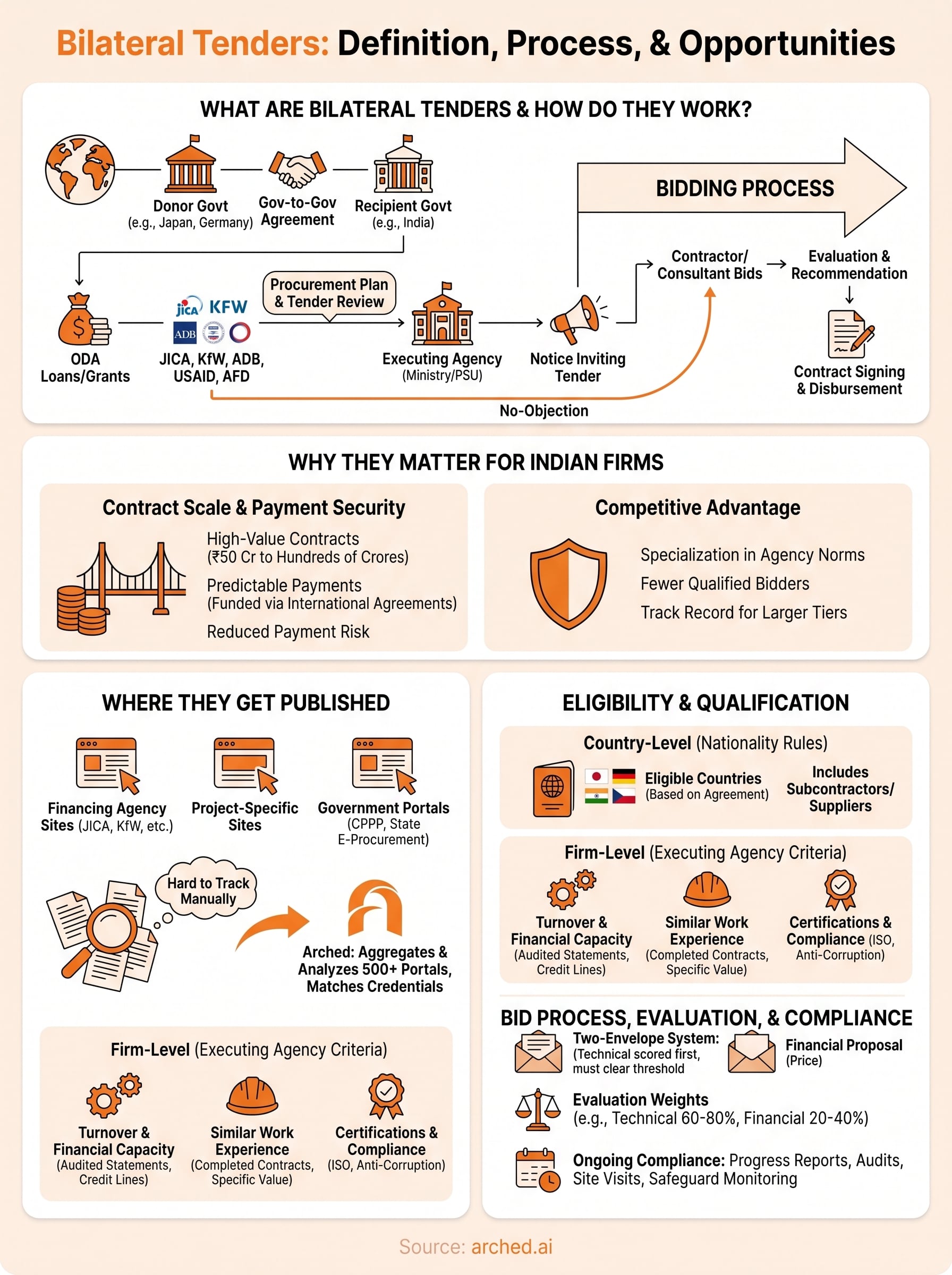
A bilateral tender is a procurement notice issued for a project funded under a government-to-government cooperation agreement. When two countries formalize a development partnership, one government (the donor or financing country) extends credit, grants, or technical assistance to the other (the recipient country) for specific infrastructure or social development projects. The recipient government then procures contractors, consultants, or suppliers through a structured bidding process that follows the financing agency's procurement rules, not just domestic regulations. That distinction shapes everything from how you search for opportunities to how you submit your bid.
The funding structure behind bilateral agreements
Most bilateral tenders in India are tied to Official Development Assistance (ODA) loans or grants from foreign governments and their development finance institutions. Japan's JICA, Germany's KfW, France's AFD, South Korea's EDCF, and similar agencies regularly finance infrastructure projects across sectors like urban transit, water supply, highway development, and power transmission. Each of these agencies maintains its own procurement guidelines and standard bidding documents that the executing ministry or department must follow when issuing tenders.

When a bilateral funding agency finances a project, it retains the right to review and approve major procurement decisions, which adds a layer of oversight that goes well beyond standard domestic government processes.
The financing structure typically works like this: the donor agency disburses funds to the recipient government's executing agency, which could be a central ministry, a state government body, or a public sector undertaking. That executing agency handles the day-to-day procurement operations, including issuing the Notice Inviting Tender, evaluating bids, and recommending contract awards. But before any major decision moves forward, the financing agency must issue a formal "no objection" or concurrence. This two-level approval structure is one of the defining features that separates bilateral procurement from routine government contracting.
How procurement works under bilateral frameworks
Bilateral tenders follow a defined sequence that mirrors standard public procurement but inserts compliance checkpoints tied to the financing agency's rules. The process typically moves through these stages:
- Procurement plan approval: The executing agency submits a procurement plan to the financing agency at the start of the project cycle, setting out timelines, contract packages, and bidding methods.
- Tender document review: Before publishing the Notice Inviting Tender, the financing agency reviews draft bidding documents for compliance with its own norms.
- Competitive bidding category: Depending on contract value and funding conditions, the tender may be open to international firms, restricted to firms from eligible countries, or limited to domestic bidders under national competitive bidding rules.
- Bid evaluation and no-objection: The executing agency evaluates submissions and sends its recommendation to the financing agency for approval before issuing a Letter of Award.
- Contract signing and disbursement: Only after the financing agency issues its no-objection certificate does the contract get signed and disbursement begin.
Your firm's position within bilateral tenders depends on where a specific contract sits in this structure. Contracts above a set threshold, which varies by agency and project agreement, go through full international competitive bidding with strict documentation standards. Contracts below that threshold may use simplified national procedures, but they still require compliance with the agency's eligibility criteria, anti-corruption provisions, and audit requirements.
Why bilateral tenders matter for Indian contractors
For Indian contractors and consultancies, bilateral tenders open access to a category of contracts that domestic procurement rarely matches in scale or payment reliability. Projects funded under government-to-government agreements tend to carry larger contract values, more predictable disbursement timelines, and stronger dispute resolution frameworks than standard CPWD or state PWD contracts. That combination makes them genuinely attractive to firms that have the credentials to qualify and the capacity to meet international compliance standards.
Contract scale and payment security
Bilaterally funded projects in India frequently run from ₹50 crore to several hundred crores per package, particularly in sectors like urban metro systems, water treatment infrastructure, and national highway development. The payment security matters just as much as the size. Because funds are disbursed through the financing agency, the risk of delayed payments that plagues many domestic government contracts drops significantly. Executing agencies draw from pre-committed credit lines rather than competing for annual budget allocations, which means your invoices move through a more structured and predictable approval chain.
For firms that have struggled with payment delays on domestic contracts, bilaterally funded projects represent a structurally different cash flow environment backed by international agreements.
Competitive advantage through specialization
Most Indian contractors focus entirely on domestic procurement, which means the pool of firms actively tracking and bidding on bilaterally funded work stays relatively small. If your firm builds competency in understanding JICA procurement norms, KfW environmental standards, or AFD bidding procedures, you operate in a noticeably less crowded field. Your win rate on these contracts improves simply because fewer qualified firms submit technically compliant bids.
Specialization compounds over time as well. Each completed bilaterally funded project strengthens your credentials and makes it easier to qualify for the next tier of contracts. Executing agencies and financing institutions consistently favor firms with demonstrated experience in international procurement environments, and that preference shows up directly in technical evaluation scoring. Building this track record early positions your firm to access the highest-value contract packages in future project cycles, while most of your competitors are still working through domestic channels.
Where bilateral tenders get published
Finding bilateral tenders requires checking sources that most domestic procurement teams never monitor. Unlike standard government contracts that appear on GeM or CPPP, bilaterally funded opportunities are distributed across financing agency websites, executing ministry portals, and project-specific notice boards, often without cross-referencing between them. Knowing which sources to check, and how often, determines whether your firm catches an opportunity before the pre-bid deadline or misses it entirely.
Financing agency portals and project websites
Each bilateral financing agency maintains a public procurement section on its website where it lists active and upcoming tenders tied to its funded projects. JICA publishes procurement notices under its India operations page, while KfW lists its tenders through the executing agency and references them in project disclosures. AFD and EDCF operate similarly. These portals are the most reliable source for internationally competitive packages because the financing agencies are required to ensure broad visibility as part of their own transparency obligations.
Your firm should subscribe to email notifications on each financing agency's website and check project-specific notice boards regularly, as update frequencies vary and notices can close within weeks of being published.
Beyond the agency-level portals, individual project implementation units often maintain dedicated project websites where they publish corrigenda, addenda, and pre-qualification notices separately from the main agency portal. These project sites are easy to overlook if you only monitor the top-level agency page.
Government procurement portals in India
Many bilaterally funded contracts below the international competitive bidding threshold get published on domestic government portals rather than financing agency websites. Central Public Procurement Portal (CPPP) and state-level e-procurement systems carry a significant number of these notices, particularly for civil works packages procured under national competitive bidding rules. Executing agencies at the ministry or department level, such as NHAI, JNURM successor bodies, or state irrigation departments, publish notices through their own e-tender portals as well.
The practical challenge is that no single portal aggregates all bilateral tender notices across agencies, funding sources, and executing departments. Monitoring CPPP, individual state portals, ministry websites, and financing agency pages simultaneously demands either a large research team or a platform built specifically to track procurement across all these sources at once.
Eligibility and qualification requirements
Bilateral tenders impose two distinct layers of eligibility that you need to satisfy before your bid goes anywhere: country-level eligibility set by the financing agency and firm-level qualification criteria set by the executing agency. Both layers operate simultaneously, and failing either one disqualifies your submission regardless of how competitive your price or technical proposal is.
Nationality and country eligibility rules
The financing agency determines which nationalities can participate based on the terms of the bilateral agreement. JICA-funded projects typically restrict participation to firms from Japan and India, while KfW and AFD projects often follow their own positive lists of eligible member countries. Under national competitive bidding rules, participation may be limited to Indian firms only, even if the project itself is bilaterally funded. You need to read the eligibility section of each tender notice carefully because these restrictions apply not only to the lead firm but also to key subcontractors and equipment suppliers named in your bid.

A single ineligible subcontractor listed in your submission can trigger a full disqualification, even if your lead firm meets every other requirement.
Technical and financial qualification criteria
Executing agencies set firm-specific qualification thresholds that typically cover three areas: annual turnover, similar work experience, and available bid capacity. Turnover requirements are usually expressed as a multiple of the estimated contract value over the past three to five financial years. Similar work experience requires you to show completed contracts of a specified minimum value within a defined time window, often the last seven to ten years, in the same category of infrastructure work.
Financial qualification goes beyond turnover. Most bilaterally funded procurement requires you to demonstrate liquid assets or available credit lines sufficient to cover the estimated cash flow for the contract's first few months. You will typically need audited financial statements for the past three years and a letter of credit or bank solvency statement from your financial institution.
Qualification documentation for bilateral tenders also frequently includes requirements that domestic contracts skip entirely, such as ISO certifications, environmental management system accreditations, or proof of compliance with the financing agency's anti-corruption and integrity policies. Build a document checklist specific to each financing agency's standard bidding documents so nothing slips through during submission preparation.
Bid process, evaluation, and compliance
When you submit a bid for a bilaterally funded contract, you're responding to a structured process that the financing agency and the executing agency jointly control. The sequence is stricter than domestic procurement, and deviations in your submission format or documentation trigger outright rejection before evaluators even review your technical proposal.
Preparing and submitting your bid
Your bid package for bilateral tenders typically splits into two sealed envelopes: a technical proposal and a financial proposal. The technical envelope covers your firm's qualification documents, your project methodology, your staffing plan, and your proposed implementation schedule. Evaluators score the technical envelope first, and only bids that clear a minimum technical threshold proceed to financial evaluation.
Missing a single mandatory document, such as an audited balance sheet or a signed integrity declaration, disqualifies your entire submission regardless of how competitive your pricing is.
How evaluation criteria work
Financing agencies define the evaluation methodology in the bidding documents, and each criterion carries a fixed weight that evaluators cannot adjust. Technical criteria typically account for 60 to 80 percent of the total score, covering areas like similar project experience and key personnel qualifications, alongside your firm's proposed approach. The financial proposal contributes the remaining weight, and the lowest-priced technically compliant bid wins in most civil works contracts.
Consulting contracts often follow a different path. Under Quality and Cost-Based Selection (QCBS), your technical score directly influences how much leverage your final price carries, which means a stronger technical proposal reduces the price pressure on your firm more than trimming your fee proposal would.
Compliance obligations during contract execution
Signing the contract does not end your compliance responsibilities. Financing agencies require periodic progress reports, audit-ready financial records, and environmental or social safeguard documentation throughout the contract period. JICA and KfW contracts include specific provisions for field-level compliance monitoring, where agency representatives conduct site visits and review documentation against agreed milestones.
Your firm needs to assign a dedicated compliance point of contact who tracks reporting deadlines and maintains the documentation trail the financing agency expects. Missing a reporting obligation or failing an environmental audit mid-contract can trigger payment suspension, so treat compliance as an operational function rather than a paperwork exercise.
Next steps
Bilateral tenders offer some of the most reliable, high-value contracting opportunities available in India's public procurement landscape, but only if your firm can find the right ones in time and confirm you actually qualify before investing weeks in bid preparation. The firms that win these contracts consistently are the ones that track opportunities systematically, understand financing agency requirements, and submit technically compliant bids without gaps in their documentation.
If you are bidding on bilaterally funded work and want a reviewed estimate and BOQ behind your price, Arched can prepare it for you. See how our estimating service works.
Have a package your team can’t get to? Send it to us. Our engineers check and sign off everything we deliver.