Bid Security Declaration Meaning: Purpose In Tenders, Form
Understand the bid security declaration meaning and how it replaces EMD. Learn the correct format, eligibility for MSMEs, and how to avoid debarment risks.
If you've submitted tenders on GeM, CPPP, or any state e-procurement portal, you've likely come across the term bid security declaration meaning a signed commitment in lieu of a monetary deposit. It replaced the traditional Earnest Money Deposit (EMD) requirement for many government tenders after a 2020 policy push to reduce financial barriers for bidders, especially MSMEs.
But what exactly does it commit you to? And what happens if you violate it? These are the questions most bidders skip over, until they're penalized. A bid security declaration carries real consequences, including debarment from future tenders, yet its format and implications are often misunderstood or treated as a formality.
This article breaks down what a bid security declaration is, why it exists, what a standard format looks like, and where bidders commonly trip up. At Arched, we parse thousands of tender documents across 500+ government portals to flag exactly these kinds of requirements, so our users never submit a bid with a missing or non-compliant declaration.
What a bid security declaration means
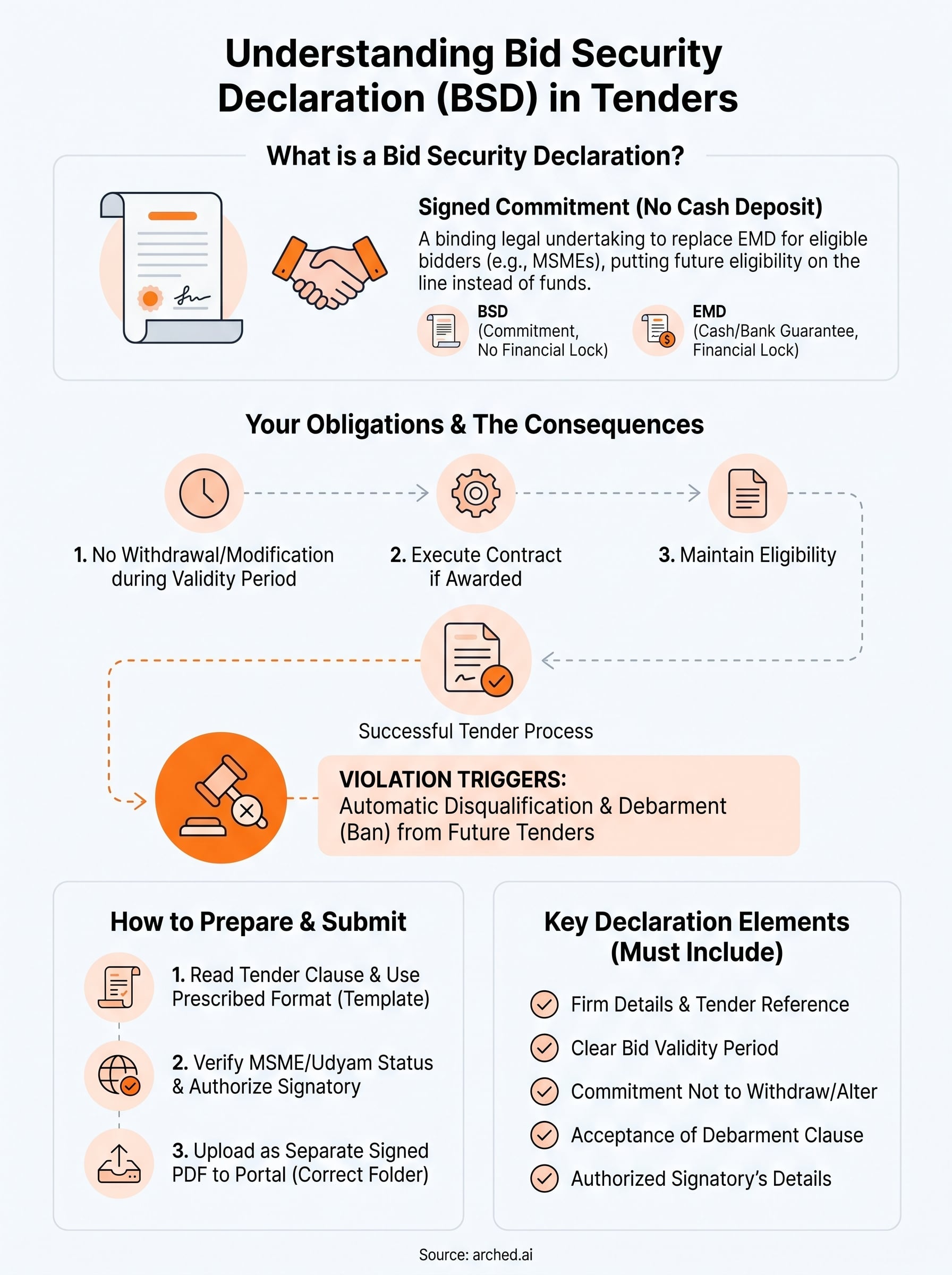
A bid security declaration is a written legal undertaking you submit with your bid, promising that you will not withdraw, modify, or back out of your offer during the validity period. Instead of depositing cash or a bank guarantee as collateral, you sign a declaration accepting that violating its terms triggers automatic disqualification and a ban from participating in that government body's tenders for a defined period. The bid security declaration meaning is straightforward: you put your eligibility on the line rather than your money.
A bid security declaration is not a formality. It is a binding commitment with consequences equal to forfeiting a cash deposit.
The legal commitment it creates
When you sign a bid security declaration, you accept three specific obligations: you will not withdraw the bid before the deadline, you will not alter its terms after submission, and you will execute the contract if awarded. These obligations are active for the entire bid validity period, which typically runs 90 to 180 days depending on the tender. The declaration is governed by the procurement rules issued by the Ministry of Finance and reinforced by GFR 2017, so the enforceability is backed by central government regulation.
Who qualifies to submit one instead of EMD
Not every bidder can substitute a declaration for a monetary deposit. The Government of India's 2020 circular extended this option primarily to MSMEs registered on the Udyam portal, startups recognized by DPIIT, and Central Public Sector Enterprises. If your firm falls outside these categories, the specific tender document governs whether a declaration is accepted, and you need to check the eligibility conditions in the tender notice before assuming you can skip the EMD. Some state governments have adopted similar provisions, but the coverage is not uniform across all portals, so reading the document carefully remains essential for every submission.
Why buyers ask for it
Government procurement authorities use bid security in any form to protect public resources. When a winning bidder backs out, the tendering department loses time, restarts the process, and often faces delays in project execution. A bid security declaration gives buyers the same protection they get from a cash deposit, without requiring bidders to tie up working capital for months at a stretch.
It filters out non-serious bidders
Procurement agencies deal with hundreds of bids per tender, and a significant portion historically came from firms with no intention of executing the contract. By requiring a signed declaration, the buyer creates a legal accountability layer. Submitting a declaration commits your firm's future participation rights in that department's tenders, which is a strong enough deterrent to discourage speculative bidding from parties who are not genuinely prepared to deliver.
The declaration shifts the cost of non-performance from a cash penalty to an eligibility penalty, which is often more consequential for active government contractors.
It supports the policy goal of easier MSME participation
The second reason buyers accept declarations is policy-driven. Requiring large cash deposits or bank guarantees locked out smaller firms from bidding on meaningful contracts. By accepting a declaration instead, procuring authorities expand their bidder pool while maintaining enforceable consequences for withdrawal or non-performance. This makes the competition more open without making it less serious, which serves the public interest that government procurement is designed to protect.
Bid security declaration vs EMD and bid security
The three terms often appear in the same tender document, but they refer to different instruments with different obligations. Understanding the bid security declaration meaning in context helps you choose the right compliance approach and avoid submitting the wrong document for your category of firm.

How EMD and bid security differ from a declaration
An Earnest Money Deposit (EMD) is a cash amount, demand draft, or bank guarantee you deposit upfront with the tendering authority before the bid opens. A bid security is the broader category that covers both EMD and formal bank guarantees issued by scheduled banks. Both instruments require you to commit real financial assets. If you withdraw your bid or fail to perform after being awarded, the authority encashes or forfeits that deposit directly, resulting in an immediate financial loss.
A declaration replaces the financial deposit entirely, substituting your firm's future bidding eligibility for cash as the at-risk asset.
When each instrument applies
Your choice of instrument depends on the tender's eligibility conditions and your firm's registration status. If you qualify under the MSME Udyam registration or the DPIIT startup recognition, you submit a declaration and retain your working capital. If the tender explicitly mandates a bank guarantee or EMD regardless of MSME status, you must comply with that specific requirement. Some tenders list both options in the bid security clause and allow either form. Always read that clause first before preparing your financial compliance documents.
How to prepare and submit a bid security declaration
Understanding bid security declaration meaning in practice starts with reading the tender document's bid security clause carefully. That clause tells you whether a declaration is accepted, the exact format required, and who needs to sign it. Many portals like GeM and CPPP provide a pre-filled template you download, complete, and upload as part of your bid package, so check the portal's document section before drafting one from scratch.

Steps to complete and submit it correctly
Your declaration must be signed by an authorized signatory of your firm, typically the person named in your board resolution or authorization letter. Before signing, confirm that your Udyam registration or DPIIT certificate is current and valid for the tender's submission date, because an expired certificate invalidates your eligibility to substitute the declaration for an EMD.
Submit your declaration as a separate signed PDF, not embedded inside another document, unless the portal's upload instructions specify otherwise.
Once signed, upload the declaration through the portal's bid security section, not the technical or financial bid folder. Misplacing the document in the wrong folder is one of the most common reasons bids get rejected at the preliminary scrutiny stage. After submission, save a timestamped confirmation receipt from the portal so you have proof of compliant submission if the authority raises a query later.
Format and key clauses to include
A standard bid security declaration follows a fixed structure regardless of the portal you're submitting to. Most procurement authorities, including those on CPPP and GeM, publish a prescribed format within the tender document itself. If the tender doesn't include one, you can model your declaration on the format issued by the Ministry of Finance's 2020 circular, which sets the baseline template for central government procurement.
Core elements every declaration must contain
Your declaration needs to cover five essential elements to be compliant. Omitting any of them makes the declaration deficient, and the evaluation committee can reject your bid at the preliminary scrutiny stage without reviewing your technical submission.
- Your firm's name, address, and registration number
- The tender reference number and issuing authority
- The bid validity period as stated in the tender
- A clear statement that you will not withdraw, alter, or back out of the bid
- Acceptance of debarment if you violate any of these commitments
A declaration that omits the debarment clause or the bid validity period is incomplete and can be grounds for outright rejection.
Matching the format to the tender's terms
Understanding bid security declaration meaning in context means confirming that your declaration's language mirrors the specific bid validity period stated in that tender, not a generic one. Your authorized signatory's designation must match the authorization letter included in your bid package, and your Udyam or DPIIT registration number must appear exactly as it does on your certificate.
Final takeaways
Understanding bid security declaration meaning in full detail protects your firm from avoidable rejections and debarment risks. A declaration is not a formality you fill in quickly and forget. It is a binding legal commitment that puts your future bidding eligibility on the line, and it only substitutes for an EMD if your firm qualifies under Udyam registration or DPIIT recognition.
Before every submission, confirm that your declaration includes all five required elements, matches the exact bid validity period in the tender, and is signed by an authorized signatory whose designation aligns with your authorization letter. Upload it to the correct portal folder, and keep your timestamped receipt.
If you want to stop tracking these requirements manually across hundreds of portals, Arched parses tender documents automatically and flags compliance requirements before your deadline. Check the Arched platform to see how it handles bid security and document analysis for your firm.