What Is Prestressed Concrete? Definition, Types, And Uses
What Is Prestressed Concrete? Definition, Types, And Uses
Prestressed concrete carries roughly 70% of the world's highway bridges, and for good reason. If you're asking what is prestressed concrete, you're looking at a construction method that fundamentally changed how engineers design structures that span long distances and bear heavy loads. By introducing compressive stress into concrete before it takes on service loads, this technique overcomes concrete's natural weakness in tension, allowing for longer spans, thinner sections, and reduced material use.
For bridge engineers and contractors, understanding prestressed concrete isn't optional, it's foundational. Every bid, every value-engineering decision, and every optimization run depends on knowing how prestressing affects cost, constructability, and performance. This article breaks down the mechanics, compares pre-tensioning versus post-tensioning methods, and covers the practical applications where prestressed concrete delivers the most value.
Why prestressing exists
Concrete performs exceptionally well under compression but fails at roughly one-tenth that strength when placed in tension. When you load a beam, the bottom face stretches and the top face compresses. Without reinforcement, concrete cracks almost immediately on the tension side, losing most of its structural capacity. Traditional reinforced concrete addresses this by embedding steel bars in the tension zone, but the concrete itself still cracks under load.
These cracks create problems you can't ignore. Water and chlorides penetrate through cracks, corroding the steel reinforcement and reducing service life. More importantly, cracked concrete contributes nothing to structural stiffness, forcing you to use deeper sections and more material to meet deflection limits. For bridges spanning more than 40 feet, the extra dead weight from conventional reinforced sections becomes a compounding problem.
Concrete's tension problem
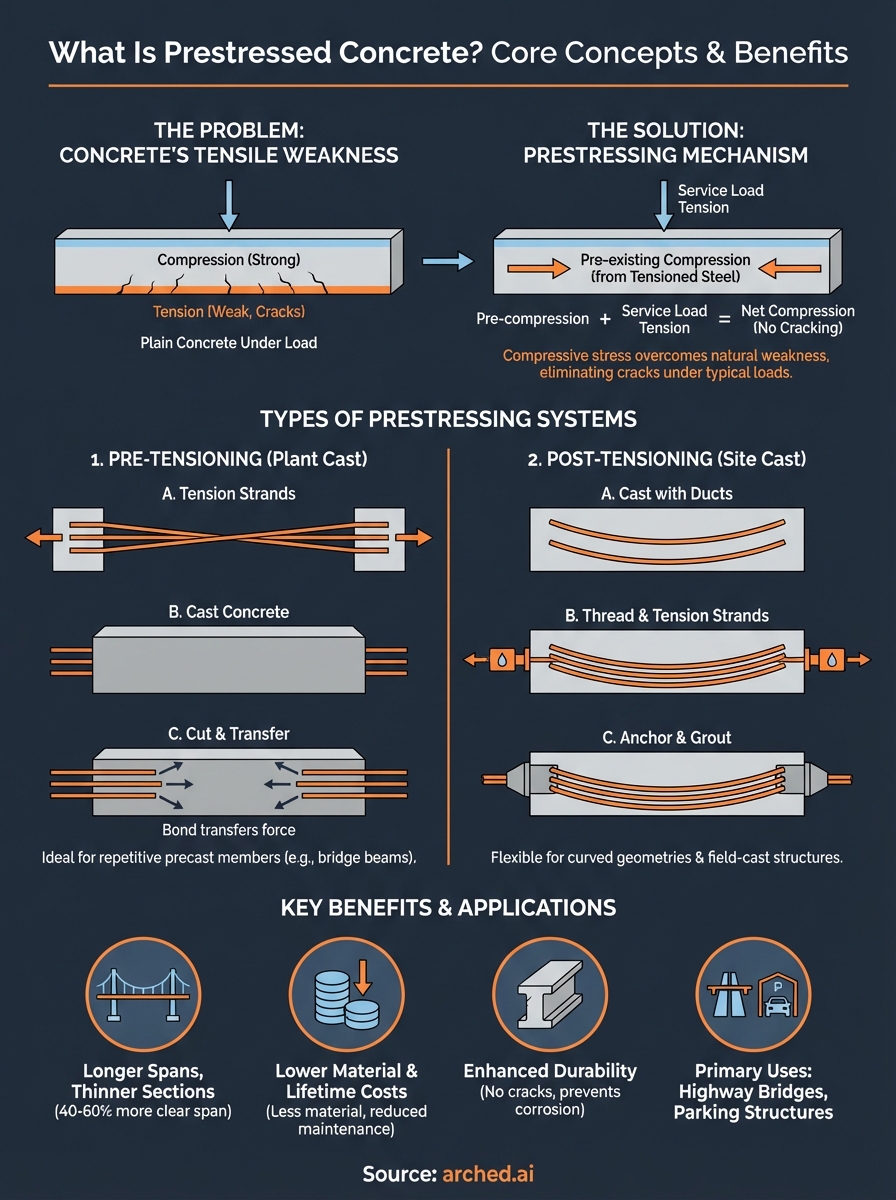
Prestressing solves this by placing the entire concrete section into compression before any service loads arrive. You introduce compressive stress through high-strength steel strands tensioned to 70% of their ultimate capacity. When external loads try to create tension in the bottom fiber, they first have to overcome the pre-existing compression before the concrete experiences any net tensile stress.
Prestressing transforms concrete from a material that tolerates tension into one that eliminates it entirely under typical service conditions.
The economic case for prestressing
Contractors choose prestressed concrete because it delivers longer spans with less material and lower lifetime costs. A prestressed beam at 54 inches deep can replace a reinforced beam at 72 inches for the same span, cutting dead load by 25% or more. Reduced section depth means lower substructure costs, smaller bearing pads, and faster erection cycles that directly impact your bid competitiveness on bridge projects.
How prestressed concrete works
Understanding what is prestressed concrete starts with the mechanics of introducing stress before service loads arrive. You achieve this by tensioning high-strength steel strands to 70-80% of their ultimate capacity and then transferring that force into the concrete. The steel wants to contract back to its original length, but the bond between steel and concrete prevents this shortening, creating a permanent compressive force throughout the member.
The transfer mechanism
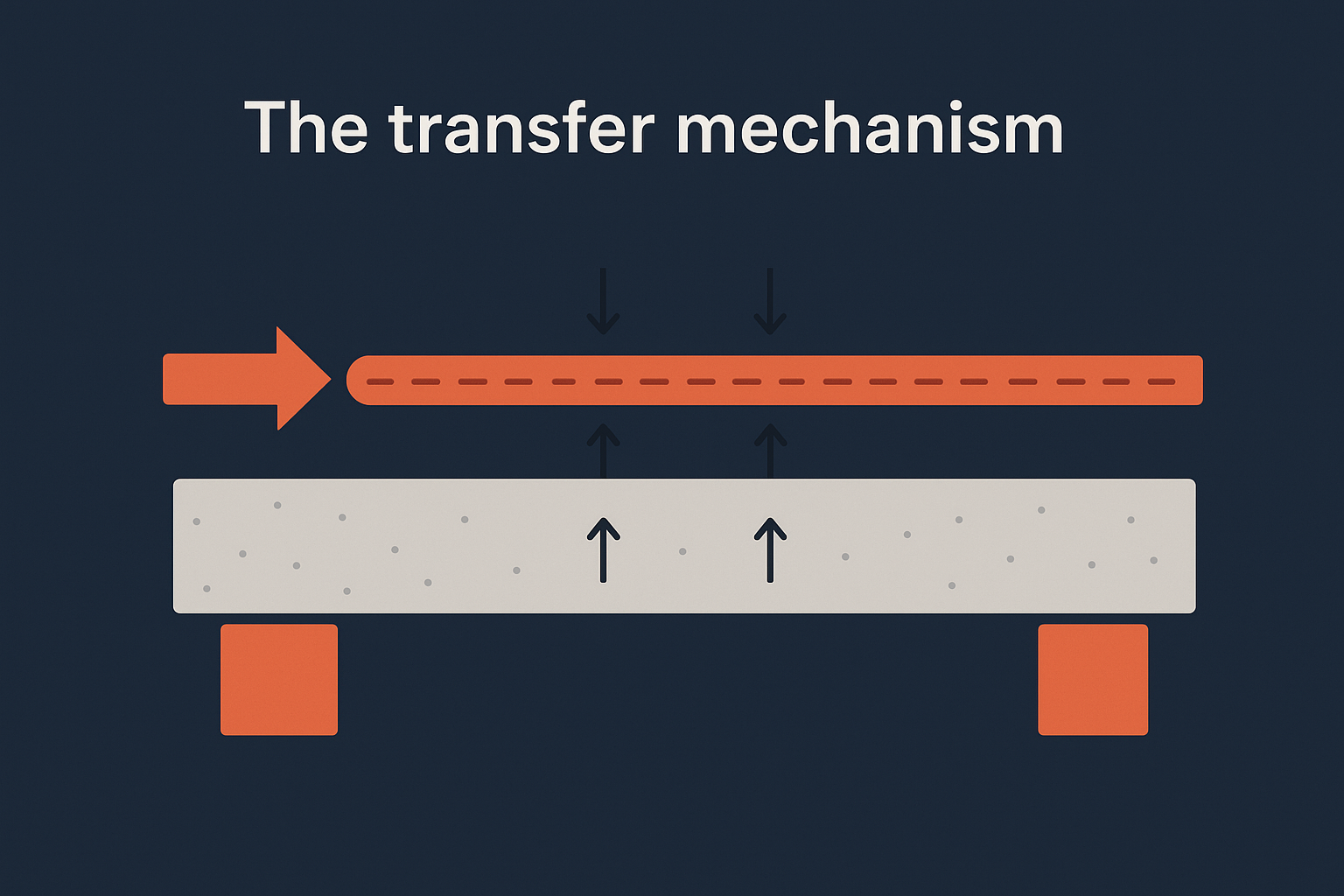
When you tension the strands, they elongate by several inches depending on member length. Once the concrete reaches sufficient strength (typically 4,000 to 5,000 psi), you release or cut the strands. The steel tries to return to its unstressed length, but the concrete restrains this movement through bond stress, compressing the concrete along the entire length of the member. This compression remains locked in place for the life of the structure.
Service load response
Under actual bridge loads, the bottom fiber of a prestressed beam experiences compression from prestressing plus tension from applied loads. Your design succeeds when the net stress remains in compression or stays below the concrete's allowable tensile strength. This approach eliminates cracking under normal service conditions and allows you to use shallower sections with higher strength-to-weight ratios than reinforced concrete alternatives.
The key advantage is that prestressing forces and service load stresses work in opposite directions, canceling each other out in the tension zone.
Types of prestressed concrete systems
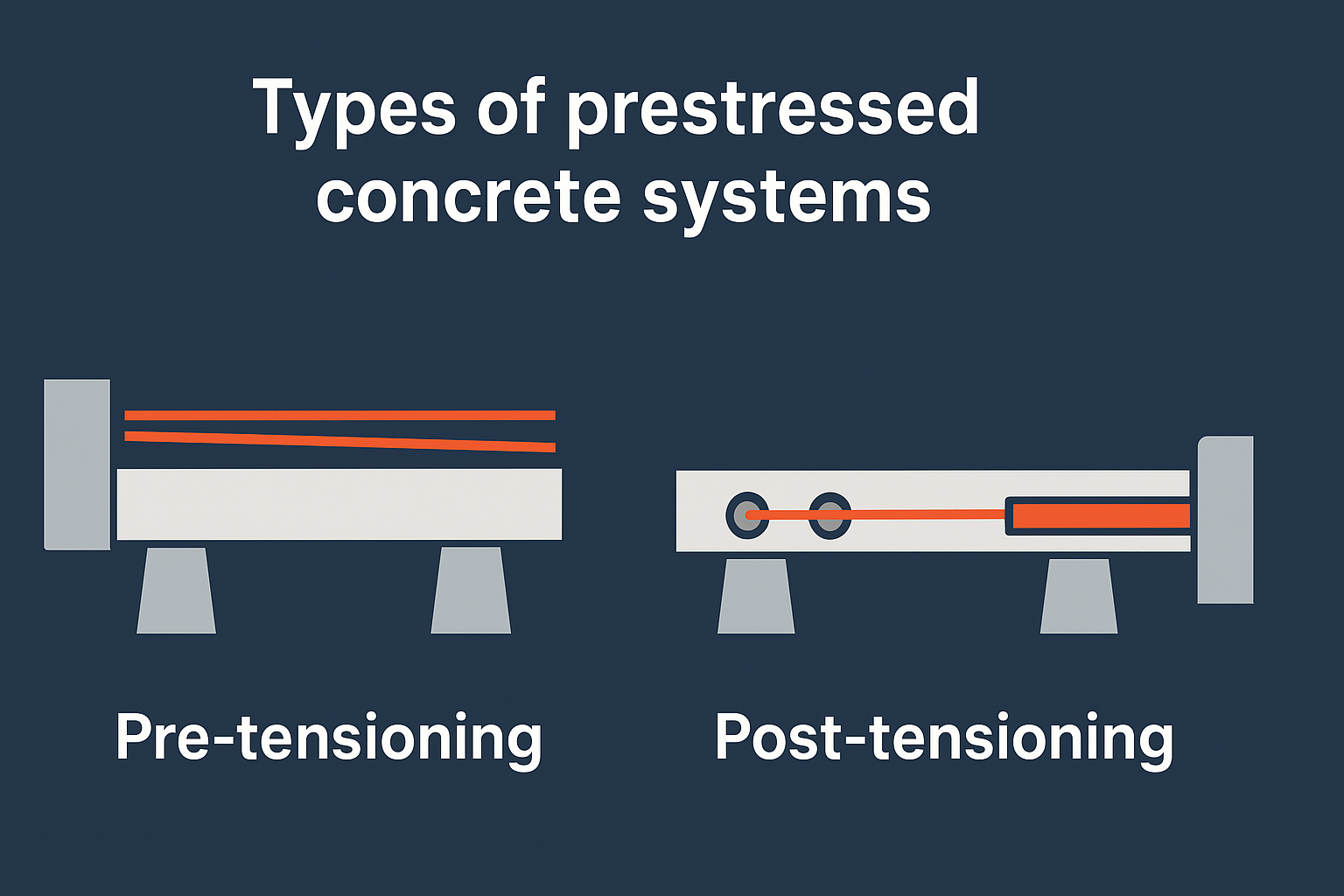
When contractors ask what is prestressed concrete, the answer splits into two distinct construction methods: pre-tensioning and post-tensioning. Both systems achieve the same goal of introducing compressive stress into concrete, but they differ fundamentally in when and how you tension the strands. Your choice between these methods depends on whether you fabricate members in a controlled plant environment or cast them on site.
Pre-tensioning
Pre-tensioning works by stressing strands before you pour the concrete. You anchor high-strength steel strands to abutments at the ends of a casting bed, tension them to design force, and then cast concrete around the stressed steel. After the concrete cures to minimum release strength, you cut the strands and transfer the prestress force through bond. This method dominates precast beam production because it allows you to cast multiple identical members in a single operation, reducing labor costs per piece.
Post-tensioning
Post-tensioning reverses the sequence by casting concrete first with ducts or voids for strands. Once the concrete reaches design strength, you thread strands through the ducts, tension them against the hardened concrete using hydraulic jacks, and anchor them at the member ends. This approach gives you flexibility for curved geometries and field-cast structures like cast-in-place bridge decks where pre-tensioning isn't practical.
Prestressed vs reinforced concrete
The difference between prestressed and reinforced concrete comes down to how each system handles tension stresses. Reinforced concrete accepts cracking as inevitable and uses steel bars to carry tensile forces across those cracks. Prestressed concrete eliminates cracking entirely under service loads by keeping the entire section in compression. This fundamental distinction changes everything from span capabilities to long-term durability.
Material efficiency comparison
Reinforced concrete requires 30-40% more material to achieve the same span and load capacity as prestressed concrete. You need deeper sections because cracked concrete contributes nothing to stiffness, forcing you to compensate with additional depth and weight. Prestressed members leverage the full concrete section by preventing cracks, allowing you to reduce beam depth by 20-30% while maintaining structural performance. This translates directly to lower material costs and reduced dead load on foundations.
When comparing what is prestressed concrete to traditional reinforcement, prestressing delivers 40-60% longer clear spans with identical section depths.
Structural performance differences
Deflection control separates these systems more than strength. Reinforced beams crack under service loads and deflect more than twice as much as comparable prestressed sections. Prestressed concrete maintains zero or minimal cracking, keeping deflections within L/800 limits that reinforced concrete cannot achieve without excessive depth. Your maintenance costs drop because no cracks exist to admit chlorides and moisture that corrode steel reinforcement.
Where prestressed concrete gets used
When contractors evaluate what is prestressed concrete for specific projects, they find it dominating applications where span-to-depth ratios and dead load reduction create measurable cost advantages. You see prestressed systems most frequently in structures that require repetitive identical members, long clear spans, or aggressive construction schedules. The economics work best when you can amortize precasting setup costs across multiple units or when post-tensioning eliminates mid-span supports that would otherwise require expensive falsework.
Highway bridge girders
Bridge superstructures consume more prestressed concrete than any other application. You specify AASHTO standard shapes like Types II through VI for spans from 40 to 120 feet, with deeper bulb-tee sections handling longer crossings. Prestressed girders reduce pier costs by spanning further between supports and cut erection time to days instead of weeks compared to cast-in-place alternatives.
State DOTs standardize prestressed shapes specifically because precasting plants can produce them efficiently at scale while maintaining consistent quality control.
Parking structures and building floors
Multi-level parking demands flat plate or double-tee systems that span 55 to 60 feet between column lines. Post-tensioned slabs give you the flexibility to adjust column placement during design while maintaining economical thickness. You avoid beam-and-girder framing entirely, reducing floor-to-floor height and maximizing usable parking levels within municipal height restrictions.
Where to go from here
Understanding what is prestressed concrete gives you the foundation to make informed decisions on bridge projects, but applying that knowledge to competitive bids requires analyzing thousands of design variables simultaneously. Manual optimization leaves money on the table because you physically cannot evaluate enough alternatives to find the true optimum between material cost, carbon impact, and constructability constraints.
Prestressing also drives cost: strand, anchorages, stressing and grouting all need to be priced. If you are bidding a prestressed bridge package, Arched can prepare the estimate and BOQ from your drawings, reviewed by an engineer. See how our estimating service works.
Have a package your team can’t get to? Send it to us. Our engineers check and sign off everything we deliver.