Defect Liability Period Meaning: Duration, Clause, Process
Learn the defect liability period meaning, typical clause durations, and how to manage the repair process to release performance security in Indian contracts.
Defect Liability Period Meaning: Duration, Clause, Process
Every government construction contract in India comes with a built-in accountability window after the project is handed over. This window is what the contract calls the defect liability period meaning, in simple terms, a fixed duration during which the contractor is legally obligated to repair any defects that surface in the completed work, at their own cost. Whether you're bidding on a highway project through GeM or a bridge tender on a state e-procurement portal, this clause directly affects your financial exposure and post-completion responsibilities.
For contractors and BD teams, misunderstanding this period, or missing it buried in a 200-page tender document, can turn a profitable project into a liability. The duration varies, the obligations differ across agencies, and the consequences of non-compliance can include encashment of your performance security. That's exactly why platforms like Arched exist: to parse tender documents automatically, flag critical clauses like defect liability terms, and surface the risks before you commit to a bid.
This article breaks down what the defect liability period actually is, how long it typically lasts across different Indian government contracts, what your obligations look like during this phase, and the exact process that kicks in when a defect is reported. Whether you're a seasoned contractor or evaluating your first public works tender, this guide covers the clause end to end, so you can bid with full clarity on what happens after the work is done.
What the defect liability period means
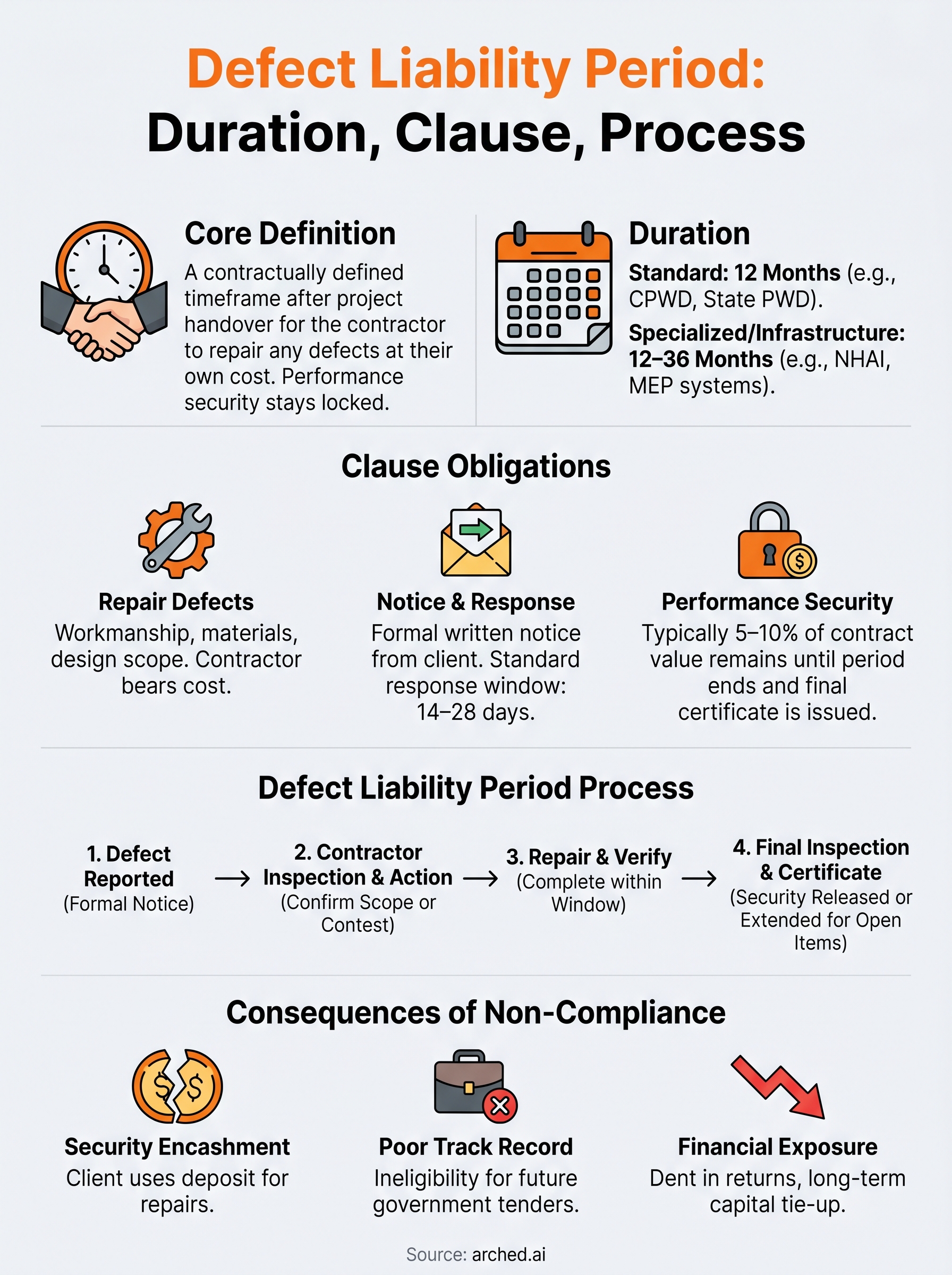
The defect liability period meaning in a construction contract is straightforward: it is a contractually defined timeframe that begins after the project is handed over to the client, during which the contractor remains responsible for identifying and fixing any defects in the completed work. Under Indian government contracts, this period is enforceable, and your performance security typically stays in place until it ends. If defects appear and you refuse to fix them, the client has the right to get the repairs done by another party and recover the cost from your security deposit.
The defect liability period is not a goodwill gesture from the contractor; it is a legal obligation written into the contract, backed by financial security.
What counts as a defect
Not every complaint from a client qualifies as a defect under the contract. A defect in the contractual sense refers to work that fails to meet the specifications, drawings, or standards stated in the original contract documents. This includes structural cracks in a concrete element, waterproofing failures in a roof slab, subsidence in a road surface, or faulty electrical installations in a government building. The defect must be traceable to your workmanship, materials, or design where you held that responsibility.
What does not qualify is damage caused by the client's own misuse, modifications made after handover by a third party, or natural disasters outside the contract's scope. Your obligation is limited to defects that originate from your original scope of work, and a well-drafted contract will define this boundary precisely. Many disputes during this period come from ambiguity on exactly this point, so reading the defect clause in full before you bid is critical.
How it fits into the contract lifecycle
The defect liability period sits at the final stage of a contract lifecycle, between practical completion and the release of the final retention or performance security. Before this period starts, the project goes through a completion inspection, often called a taking-over inspection, where the client and contractor jointly record the condition of the work. Any issues noted at that point are typically added to a snagging list, and you receive a set number of days to resolve them.

Once those items are cleared and the client issues a taking-over certificate, the defect liability period officially begins. During this window, you must remain responsive to defect notices, attend the site when required, and carry out repairs within the timelines the contract specifies. At the end of the period, a final inspection takes place, and if no outstanding defects remain, the client releases the performance security and issues a defects liability certificate, formally closing out your post-completion obligations.
Why the defect liability period matters
Understanding the defect liability period meaning goes well beyond reading a single clause in the contract. It has direct consequences for your cash flow, firm reputation, and eligibility for future government tenders. Most contractors concentrate on winning the bid and completing the work on time, but the post-completion phase carries real financial risk that can erase the margin you built during construction. Treating this period as an afterthought is one of the most costly mistakes in government contracting.
Financial exposure during the period
During the defect liability period, your performance security remains locked with the client. In most Indian government contracts, this deposit sits between 5% and 10% of the contract value. Until the client issues the defects liability certificate at the end of the period, you cannot recover that amount. If defects arise and you fail to fix them within the stipulated timeframe, the client can engage another contractor to carry out the repairs and deduct that cost directly from your security. On a large infrastructure project worth several crores, even a partial encashment creates a serious dent in your returns.
Your capital stays tied up long after the project is physically complete, which means your working capital position depends on how cleanly you manage this period.
Impact on your track record
Your conduct during the defect liability period feeds directly into your past performance record, which government agencies reference when evaluating future bids. Agencies under frameworks like CPWD, NHAI, and state PWDs track contractor compliance systematically. If your firm receives repeated defect notices and fails to respond within the required window, that history surfaces during pre-qualification for higher-value tenders. Agencies can also issue poor performance certificates, a formal record that directly limits your ability to qualify for projects above certain financial thresholds. Handling defect notices professionally and on time protects both your immediate security deposit and the eligibility credentials you need for your next big contract.
How long the defect liability period lasts
The duration of the defect liability period is not standard across all contracts. It depends on the type of project, the contracting agency, and sometimes the overall contract value. Knowing the typical range before you bid helps you plan your post-completion resource commitments accurately rather than treating this phase as an afterthought.
Standard durations in Indian government contracts
Most Indian government contracts set the defect liability period at 12 months from the date of taking over the completed work. CPWD contracts commonly use this one-year window, as do most state PWD and municipal contracts. NHAI projects for highway works often run to 12 to 24 months, particularly where the scope includes complex structural components like bridges or elevated road corridors.

For infrastructure-heavy contracts, always check whether the duration is measured from sectional completion of each phase or from the overall project handover date, as this distinction can significantly shift your obligations on multi-phase projects.
Contracts involving specialized systems, such as MEP installations or water treatment plants, may carry defect liability periods of up to 36 months, reflecting the longer window needed to assess performance under real operating conditions.
What affects the length
Several factors push the defect liability period beyond the default 12-month window. The complexity of the work is the primary driver: agencies set longer periods for projects where defects may take time to surface, such as embankment settlements or membrane waterproofing layers exposed to seasonal cycles. The nature of the end-user environment also plays a role, since facilities with heavy continuous use, like railway stations or public utilities, often attract extended periods.
Understanding the full defect liability period meaning in your specific contract requires you to check both the general conditions of contract and any special conditions that override the defaults. A document parsing tool that automatically flags these duration clauses saves your team hours of cross-referencing before you commit to a bid.
What a defect liability period clause includes
The defect liability period clause in a government construction contract is rarely a single sentence. It typically spans multiple sub-clauses across the general conditions of contract and the special conditions, and each part carries specific obligations. Understanding the full defect liability period meaning requires you to read these sub-clauses together, since they define your scope of responsibility, your response obligations, and the consequences of non-performance in concrete terms.
Core obligations the clause sets out
The clause starts by defining what constitutes a defect under that specific contract. This definition usually references the original drawings, specifications, and material standards. Beyond that, it outlines who bears the cost of repair, which in most cases is the contractor for any defect traceable to your materials or workmanship. The clause also specifies whether your obligation covers inspection access, meaning you may be required to attend the site within a set number of days after a defect notice is issued, regardless of whether you dispute the defect's origin.
If the clause is silent on who bears inspection costs, raise this during pre-bid queries, since site visits on a remote infrastructure project add up quickly.
Most clauses also carry a provision allowing the client to instruct you to uncover and test any part of the work, even where no visible defect exists, if they have reasonable grounds for concern. If the test reveals no defect, the client typically covers the cost. If it does, you do.
Notice and response timelines
Your response window after receiving a defect notice is one of the most operationally important elements of the clause. Standard CPWD and PWD contracts usually set a 14 to 28 day window for you to complete repairs, with shorter windows for defects that affect safety or continuous service. Missing this window gives the client the right to arrange repairs independently and recover the cost from your performance security. Always note these timelines in your project handover plan before the defect liability period begins.
How the defect liability period process works
The defect liability period meaning comes to life in a sequence of specific steps that both the client and contractor must follow once a defect surfaces. The process is procedural and time-bound, which means missing a single step, whether that is acknowledging a notice or completing a repair within the stipulated window, can escalate into a financial dispute quickly. Knowing each stage before the period begins puts you in a much stronger position.
How a defect gets reported
When the client identifies a defect, they issue a written defect notice to the contractor. This notice typically describes the location of the defect, its nature, and the date by which repair must begin or be completed. Most contracts require the notice to be delivered through a formally acknowledged channel, such as registered post or the project's document management system. Verbal reports carry no contractual weight, so train your site team to redirect any verbal complaints into the formal notice process immediately.
Always keep a timestamped record of every defect notice you receive, since the repair window starts from the date on the notice, not the date you read it.
What you do after receiving a notice
Once you receive the notice, your first step is to inspect the reported defect and confirm whether it falls within your contractual scope. If it does, you mobilize your team to carry out the repair within the response window the contract defines. If you believe the defect originates from client-side misuse or a cause outside your scope, you must formally contest the notice in writing within the same response window. Silence is treated as acceptance.
How the period closes out
At the end of the defect liability period, the client conducts a final joint inspection to confirm no outstanding defects remain. If the site is clear, they issue the defects liability certificate, which triggers the release of your performance security. If defects remain open, the client can extend the period for those specific items until repairs are confirmed complete.
Key takeaways
The defect liability period meaning is clear once you break it down: it is a legally binding window after project handover during which you carry full responsibility for repairing defects in your completed work. Your performance security stays locked with the client throughout this period, which means your post-completion conduct directly affects your cash flow, track record, and eligibility for future high-value government tenders.
Duration typically runs 12 to 24 months depending on the project type and contracting agency, with specialized contracts extending to 36 months. The clause defines what counts as a defect, your response timelines, and the consequences of missing repair windows. Following the formal notice process precisely protects you from costly disputes.
If you want to stop missing critical post-completion clauses buried in lengthy tender documents, explore how Arched parses tender documents automatically and flags your exact obligations before you commit to a bid.